

By Curious Femme | 21 November 2026
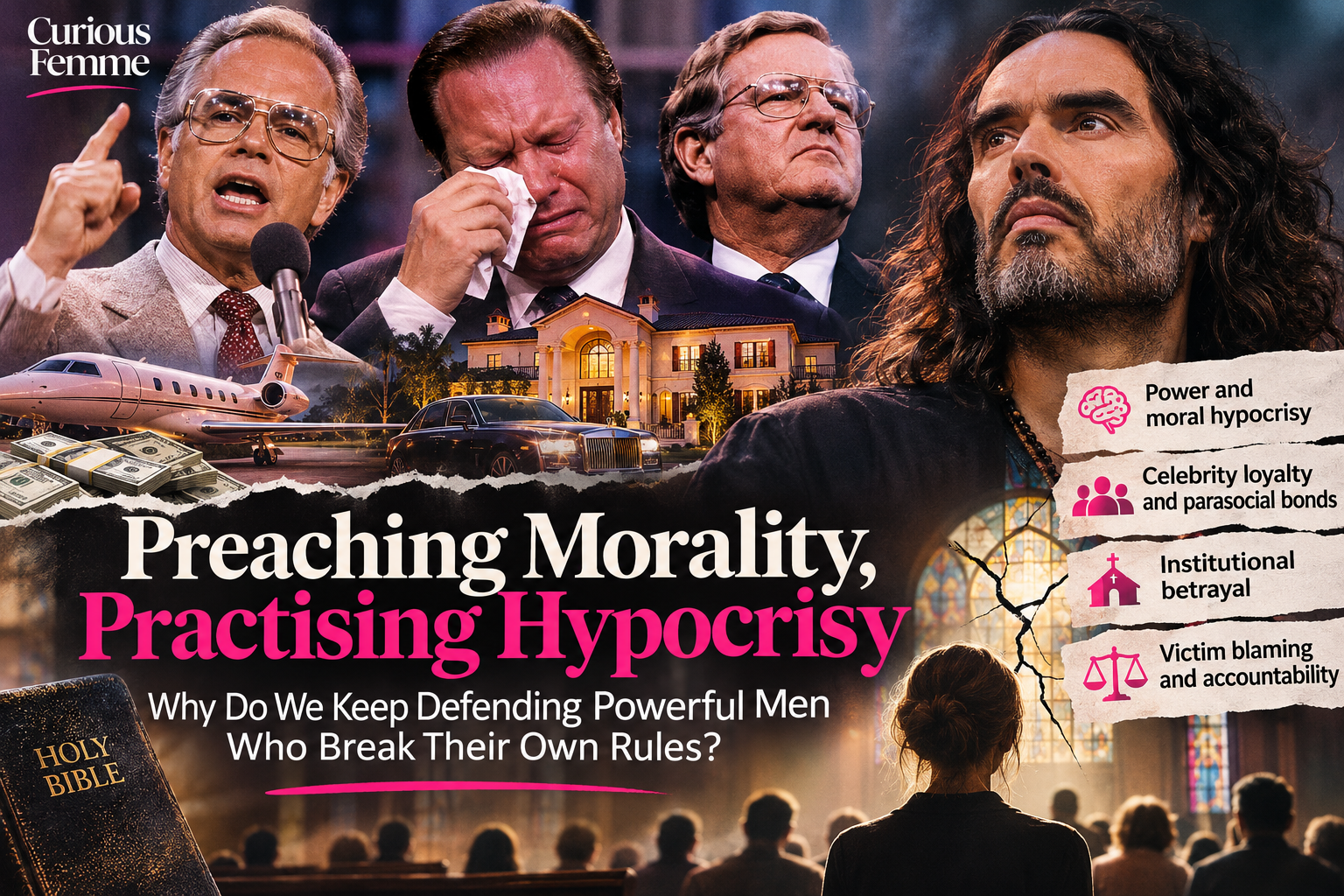
From the televangelist scandals of the 1980s to the modern celebrity culture surrounding Russell Brand, psychology offers important insights into moral hypocrisy, religious authority and the extraordinary loyalty powerful public figures can inspire.
Holier Than Thou, Until the Scandal Breaks
Imagine telling millions of people how they should live their lives. You preach honesty, faithfulness, sexual morality and personal responsibility.
Your followers trust you. They donate money. They regard you as a moral authority.
Meanwhile, you enjoy an extravagant lifestyle funded by the institution you lead. And, in some cases, behind the carefully cultivated public image, there is financial dishonesty, sexual misconduct or abuse of power.
When the truth emerges, something extraordinary sometimes happens.
Rather than withdrawing their support, followers defend the very individual who has violated the values they were taught to uphold.
Watching Netflix’s new documentary, Primetime Preacher$, released on 20 November 2026, raises a question that extends well beyond religion.
Why do we demand moral perfection from ordinary people while extending extraordinary forgiveness to powerful individuals who violate the standards they preach?
And why, when sexual abuse is involved, do complainants so often find themselves facing public hostility while the accused, or even convicted, figure continues to receive sympathy and support?
These questions are not simply about religion. They concern power, psychology, identity and accountability.
The Televangelists Who Built Empires in God’s Name
During the 1980s, American televangelists Jim Bakker, Jimmy Swaggart and Jerry Falwell became enormously influential public figures.
Through television broadcasts, religious ministries and fundraising appeals, they reached millions of followers.
Their popularity demonstrated the commercial potential of combining religion with entertainment.
Yet behind these increasingly powerful ministries lay scandals, rivalries and striking contradictions.
Jim Bakker: Faith, Money and Fraud
Jim Bakker and his wife, Tammy Faye, built the PTL television ministry into an extraordinary religious broadcasting and fundraising operation.
The ministry promoted spiritual salvation while soliciting substantial financial contributions from supporters.
In 1987, Bakker resigned following revelations involving former church secretary Jessica Hahn.
Hahn alleged that Bakker and fellow evangelist John Wesley Fletcher had sexually assaulted her in 1980. Bakker disputed that account, and those allegations did not result in his conviction for sexual assault.
His subsequent criminal prosecution concerned financial wrongdoing.
In October 1989, Bakker was convicted of 24 federal offences involving fraud and conspiracy connected to his ministry’s fundraising operations. He received a prison sentence.
The contradiction was profound.
A religious leader who encouraged followers to place their trust in his moral authority had been convicted of defrauding people who supported his ministry.
Jimmy Swaggart: Public Morality and Private Conduct
Jimmy Swaggart built another enormously successful television ministry.
He was known for his passionate preaching and uncompromising moral messages.
But in 1988, Swaggart became embroiled in a scandal after being photographed with a sex worker.
He delivered an emotional televised confession and subsequently left the Assemblies of God denomination following disciplinary proceedings.
A further scandal involving a sex worker emerged in 1991.
Swaggart continued preaching for decades, despite the damage to his public reputation.
Unlike Bakker, he was not imprisoned for fraud or sexual offences arising from those scandals.
The distinction matters because moral hypocrisy, religious disciplinary action and criminal conviction are not interchangeable.
Jerry Falwell, meanwhile, became involved in the struggle for control of Bakker’s ministry following the scandal. His role demonstrates how competition, institutional authority and personal ambition became intertwined within televangelism.
These were different individuals with different histories. However, together they illustrate how religious leadership, financial influence and personal celebrity can coexist with serious failures of accountability.
What Psychology Tells Us About Moral Hypocrisy
Moral hypocrisy occurs when individuals publicly endorse standards that their own behaviour contradicts.
Psychologists have investigated why people may condemn wrongdoing in others while behaving inconsistently themselves.
Research by Lammers, Stapel and Galinsky (2010) examined the relationship between power and moral hypocrisy. Their experimental findings suggested that power could increase the tendency to judge others strictly while applying more permissive standards to oneself.
Their findings should not be interpreted as proof that powerful people inevitably behave hypocritically. Nevertheless, the study identifies a psychological process worth examining when considering influential leaders.
More recent research has explored how perceptions of hypocrisy are shaped by group membership and social identity. Robertson, Akles and Van Bavel (2024) found mixed results when attempting to replicate earlier findings about moral double standards, demonstrating the importance of not treating a psychological explanation as a universal rule.
But another mechanism may help explain why supporters continue defending leaders whose conduct contradicts their public teachings.
That mechanism is motivated reasoning.
Why Followers Defend the People Who Betray Their Trust
Ziva Kunda’s influential review, The Case for Motivated Reasoning (1990), explains how people’s desires and motivations can influence the way they evaluate information.
Human beings do not always process evidence impartially.
When information threatens an important belief, identity or emotional attachment, people may scrutinise that information differently from evidence that supports what they already believe.
Consider someone who has followed a religious leader for twenty years.
They may have donated thousands of pounds, attended services, purchased books and defended that individual against criticism.
Accepting that the leader has committed serious wrongdoing may require them to reconsider years of trust and emotional investment.
That can be psychologically uncomfortable.
Instead, some followers may seek explanations that allow them to preserve their existing beliefs.
The allegations must be fabricated. The media must be corrupt. The person reporting abuse must be motivated by money. The prosecution must be politically motivated.
These explanations can protect an individual’s existing worldview.
Of course, people are entitled to question accusations, evaluate evidence and scrutinise criminal proceedings. The problem arises when evidence is rejected because accepting it would threaten a cherished belief.
Celebrity Worship and Parasocial Relationships
Another relevant concept is the parasocial relationship.
This describes a largely one-sided emotional relationship in which an audience member develops feelings of familiarity or attachment towards a public figure.
Researchers Jones, Cronin and Piacentini (2022) investigated what happens when fans experience a breakdown in their relationship with a celebrity following allegations of wrongdoing.
Their study, published in the Journal of Business Research, identified the emotional difficulties that can accompany such experiences.
The researchers described a process called para-loveshock, in which the loss of an admired celebrity relationship can feel personally distressing.
This helps explain why public scandals may generate responses that appear disproportionate to outsiders.
For some followers, the celebrity represents more than entertainment.
They may symbolise hope, belonging, political identity, spiritual meaning or personal transformation.
Criticism of that individual can therefore feel like criticism of the follower’s identity.
It is important, however, not to assume that all dedicated fans react this way. Many reassess their loyalties when presented with credible evidence.
When Religion Becomes a Defence Against Accountability
Religious conversion, repentance and forgiveness are important concepts within Christianity.
People can genuinely change their beliefs and behaviour. Faith can provide meaning, support recovery and encourage moral reflection.
However, spiritual forgiveness and legal accountability serve different purposes.
A person may sincerely repent while remaining responsible for offences they committed.
Religious conversion does not overturn a criminal conviction.
Nor does claiming divine forgiveness eliminate another person’s right to justice.
The danger arises when religious language is used to pressure people into abandoning legitimate complaints or to portray accountability as persecution.
This is not merely a theoretical concern.
The UK’s Independent Inquiry into Child Sexual Abuse documented how religious authority, deference towards leaders, shame and pressure to forgive could obstruct disclosures of abuse.
Some survivors described being encouraged to forgive perpetrators rather than receiving meaningful protection and support.
The Inquiry also identified situations in which protecting an institution’s reputation took priority over the welfare of those harmed.
Forgiveness must never become an obligation imposed upon the person who has been abused.
And repentance should never become a substitute for accountability.
Russell Brand: A Contemporary Comparison
Russell Brand publicly embraced Christianity in 2024, following the emergence of allegations concerning his earlier conduct.
In November 2026, he was convicted of rape and three sexual assaults against four women, offences committed between 2004 and 2009.
On 9 November, he was sentenced to ten years and six months in prison.
His conviction was for sexual offences, not for his religious beliefs or political opinions.
There is an important distinction between Brand and the televangelists discussed in the Netflix documentary.
Brand’s criminal case did not concern financial fraud within a religious ministry. There is also no evidential basis for concluding that his religious conversion was insincere merely because he was subsequently convicted.
The relevant comparison concerns the relationship between celebrity identity, religion and public accountability.
Some of Brand’s supporters have portrayed his prosecution as political persecution. Others have questioned the complainants’ credibility, dismissed witness testimony or suggested that his religious transformation should influence how his conduct is judged.
Such reactions raise a difficult question.
At what point does defending someone’s right to a fair trial become refusing to accept the outcome of that trial?
An individual is entitled to challenge a conviction through legitimate legal procedures. Public discussion of the evidence and judicial process is also legitimate.
However, asserting that a conviction was politically motivated requires evidence.
A person’s popularity, religious identity or political opinions do not invalidate a jury’s verdict.
Why Do Complainants Become the Target?
One of the most disturbing features of celebrity sexual abuse controversies is the hostility sometimes directed towards those who report abuse.
The language is familiar.
Why did they wait so long?
Why did they associate with him?
Why did they accept money?
Why did they not physically resist?
Why should we believe them rather than someone famous?
These questions can reflect established misconceptions about sexual violence.
Albert Bandura’s work on moral disengagement (1999) provides a useful framework for examining how people justify harmful conduct or shift responsibility away from those responsible.
Victim blaming can involve minimising wrongdoing, questioning the injured person’s character or portraying the perpetrator as the person who has been unfairly treated.
The Independent Inquiry into Child Sexual Abuse found that institutional loyalty and victim blaming could obstruct justice and compound the harm experienced by survivors.
This raises an uncomfortable contradiction.
A powerful public figure may receive sympathy, forgiveness and support, while the person reporting harm faces humiliation, suspicion and hostility.
That is not a demonstration of moral integrity.
It is a failure to apply consistent standards.
Institutional Betrayal: When Organisations Protect Their Reputation
Psychologists Carly Parnitzke Smith and Jennifer Freyd (2014) examined the concept of institutional betrayal.
Their research describes how institutions may cause additional harm when they fail to respond appropriately to abuse or mistreatment experienced by people who depend upon them.
This is particularly relevant to religious organisations.
A church, school, university or other trusted institution may play a central role in someone’s identity and social relationships.
If that institution responds to abuse by protecting an influential individual, discrediting the person who complained or discouraging external reporting, the betrayal may compound the original harm.
The problem is not faith itself.
It is the misuse of institutional authority.
Religious organisations can also be important sources of safeguarding, compassion, community support and justice. Many religious leaders have challenged abuse and worked to improve accountability.
The distinction is between institutions that protect people and institutions that protect reputations at people’s expense.
The Difference Between Forgiveness and Excusing Harm
Forgiveness is a personal decision.
Accountability is a social and legal responsibility.
These concepts should not be confused.
Someone can be forgiven by their family, their congregation or their God without being exempted from criminal punishment.
Equally, a survivor can choose not to forgive and still be entitled to dignity, protection and justice.
The responsibility for repairing harm belongs primarily to the individual responsible for causing it, not to the person who suffered it.
For religious communities, this means that safeguarding procedures, independent scrutiny and accountability must take precedence over loyalty to charismatic leaders.
For celebrity audiences, it means distinguishing admiration from evidence.
And for wider society, it means rejecting the idea that power, popularity or public declarations of morality make someone less accountable than anyone else.
Conclusion: The Question We Should Be Asking
The history of televangelism reveals how powerful personalities can build extraordinary followings through messages of faith, morality and personal transformation.
The scandals surrounding some of those figures also demonstrate how personal conduct can contradict public teachings.
But the more important question is not simply why powerful people sometimes behave hypocritically.
It is why institutions and followers sometimes continue protecting them after serious wrongdoing has been exposed.
Psychology suggests several possible explanations, including motivated reasoning, emotional investment, parasocial attachment and moral disengagement.
Research into institutional betrayal demonstrates how the failure to challenge powerful individuals can cause further harm.
Ultimately, religious faith should not be confused with moral immunity.
Celebrity should not be confused with credibility.
And forgiveness should never be confused with the absence of accountability.
Perhaps the real test of someone’s moral principles is not how loudly they condemn wrongdoing in others, but whether they are prepared to apply those same principles to the people they admire.
—
References
Bandura, A. (1999) ‘Moral disengagement in the perpetration of inhumanities’, Personality and Social Psychology Review, 3(3), pp. 193–209. Available at: https://doi.org/10.1207/s15327957pspr0303_3.
Crown Prosecution Service (2026) CPS statement following the sentencing of Russell Brand. 9 November. Available at: https://www.cps.gov.uk/national-news-london-south/news/statement-following-sentencing-russell-brand.
Independent Inquiry into Child Sexual Abuse (2021) Child protection in religious organisations and settings. London: IICSA. Available at: https://www.iicsa.org.uk/reports-recommendations/publications/investigation/cp-religious-organisations-settings.html.
Jones, S., Cronin, J. and Piacentini, M.G. (2022) ‘Celebrity brand break-up: Fan experiences of para-loveshock’, Journal of Business Research, 145, pp. 720–731. Available at: https://doi.org/10.1016/j.jbusres.2022.03.039.
Kunda, Z. (1990) ‘The case for motivated reasoning’, Psychological Bulletin, 108(3), pp. 480–498. Available at: https://doi.org/10.1037/0033-2909.108.3.480.
Lammers, J., Stapel, D.A. and Galinsky, A.D. (2010) ‘Power increases hypocrisy: Moralizing in reasoning, immorality in behavior’, Psychological Science, 21(5), pp. 737–744. Available at: https://doi.org/10.1177/0956797610368810.
Netflix (2026) Primetime Preacher$. Directed by Joe Berlinger. Available at: https://www.netflix.com/gb/title/81774139.
Robertson, C.E., Akles, M. and Van Bavel, J.J. (2024) ‘Preregistered replication and extension of “Moral hypocrisy: Social groups and the flexibility of virtue”’, Psychological Science, 35(7). Available at: https://doi.org/10.1177/09567976241246552.
Smith, C.P. and Freyd, J.J. (2014) ‘Institutional betrayal’, American Psychologist, 69(6), pp. 575–587. Available at: https://doi.org/10.1037/a0037564.
Additional historical sources: Contemporary reporting by United Press International (1989) on Jim Bakker’s fraud conviction, Associated Press (2025) on Jimmy Swaggart, and ABC News on the PTL scandal and Jessica Hahn’s allegations.
Leave a Reply