
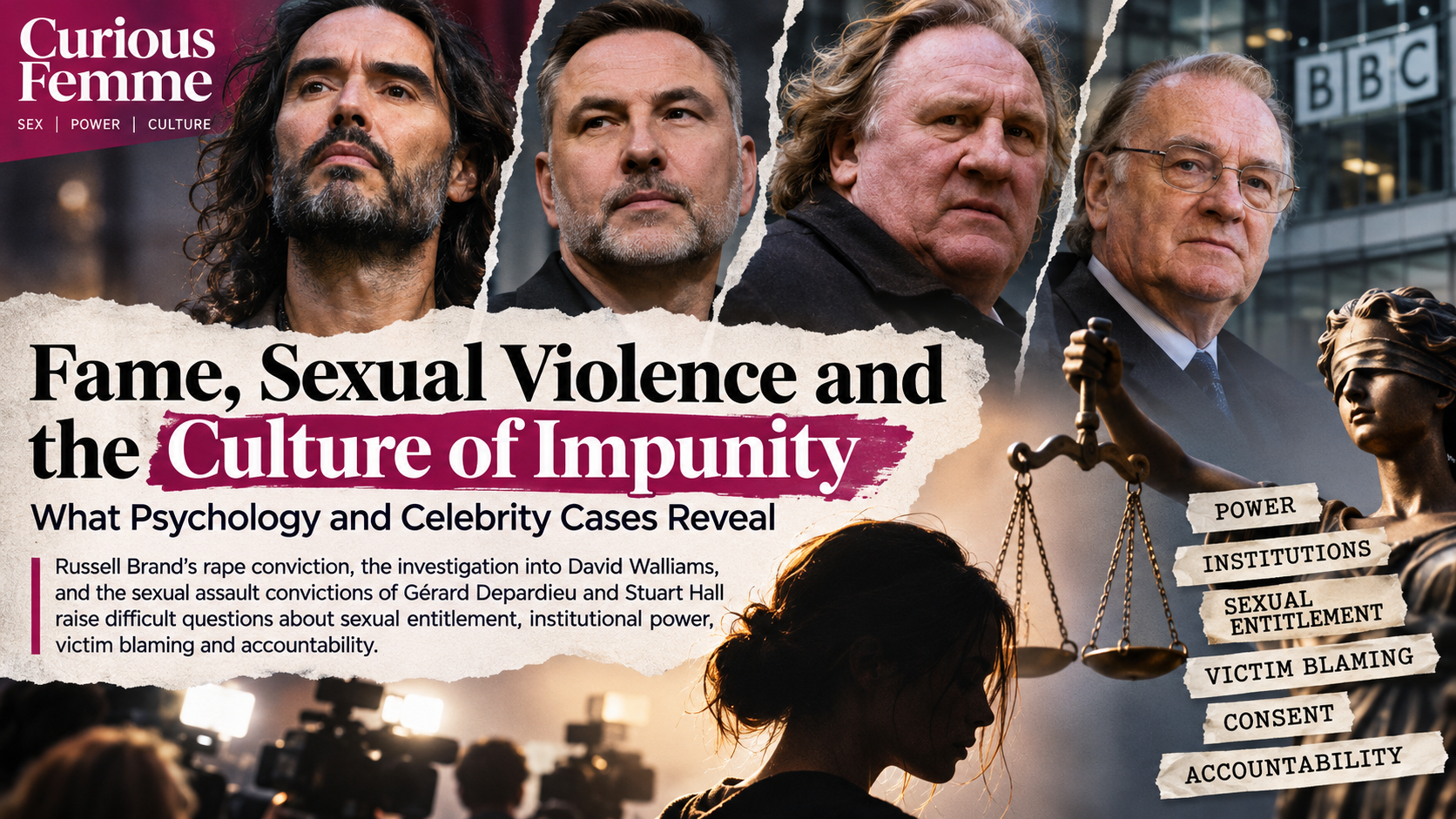

Russell Brand’s rape conviction, the investigation into David Walliams, and the sexual assault convictions of Gérard Depardieu and Stuart Hall raise difficult questions about sexual entitlement, institutioal power, victim blaming and accountability.
By Curious Femme | 21 November 2026
Content advisory: This article discusses sexual violence, coercion, trauma and allegations involving young people.
For decades, celebrity culture has encouraged audiences to admire people they have never met.
We know their voices, recognise their faces, watch their performances and sometimes feel that we understand who they are.
But familiarity is not evidence of character.
And fame is not evidence of innocence.
The conviction of Russell Brand in November 2026 has brought these distinctions into sharp focus. The separate police investigation into allegations concerning David Walliams has raised further questions about celebrity influence, access to young fans and the responsibilities of organisations that work with powerful public figures.
Meanwhile, in France, actor Gérard Depardieu has accepted a conviction for sexually assaulting two women working on a film set.
These cases have different legal statuses and must not be treated as interchangeable.
Nevertheless, they provide a timely reason to examine decades of psychological research into sexual aggression, perpetrator rationalisation, sexual entitlement and the beliefs that can influence how society responds to sexual violence.
The central question is not whether fame causes sexual offending. There is no evidence establishing that. It is whether celebrity status can create circumstances in which harmful behaviour becomes easier to excuse, overlook or challenge only after significant damage has been done.
1. Russell Brand: when the courts confront celebrity power
On 5 November 2026, Russell Brand was convicted at Southwark Crown Court of one count of rape and three counts of sexual assault against four women.
Four days later, Mr Justice Bennathan sentenced him to ten years and six months in prison.
The offences took place between 2004 and 2009, during Brand’s growing prominence in British broadcasting and entertainment.
The jury also acquitted him of three other charges. Those acquittals must be respected, and allegations not proved should not be presented as established crimes.
The sentencing remarks provide an unusually direct judicial examination of the relationship between celebrity status and sexual offending.
Addressing Brand, Mr Justice Bennathan stated:
«”Your status protected you until 2023″»
He was referring to the period before investigative reporting brought allegations into the public domain.
The judge described how Brand’s conduct was facilitated by his growing fame and by people around him who failed to challenge his behaviour.
In one incident, the court heard that Brand sexually assaulted a woman working at a radio station in the presence of members of his entourage.
The judge described the behaviour of those companions and their failure to intervene.
Another offence involved a woman who agreed to one form of sexual activity but did not consent to a different act. Brand was convicted of raping her.
This is an important legal distinction.
Consent to one sexual act does not constitute consent to another.
A further offence involved a woman working on a television production who felt compelled to comply with a demand made through Brand’s associates.
The sentencing remarks make the role of the surrounding social environment particularly relevant.
These were not simply encounters between an offender and individuals isolated from all social context.
They also involved workplaces, colleagues, professional hierarchies and the status attached to celebrity.
The court’s findings do not prove that every person surrounding Brand knew he was committing sexual offences.
Indeed, the judge expressly distinguished what he could establish from what he could not.
But the findings raise a wider question about professional environments that tolerate behaviour because the person responsible is commercially valuable, influential or famous.
(R v Russell Brand, sentencing remarks, 9 November 2026)
2. What the BBC investigation revealed
The questions surrounding Brand’s professional environment did not begin with his conviction.
In January 2025, the BBC published the findings of an internal review into complaints about his conduct during his employment between 2006 and 2008.
The review examined eight complaints, two of which had been raised during Brand’s time at the BBC.
It found that some staff had felt unable or unwilling to raise concerns because they believed their complaints would not be taken seriously.
The BBC subsequently apologised to those affected.
This evidence is important because it concerns institutional culture rather than a psychological diagnosis of an individual.
An organisation may have procedures for reporting inappropriate conduct, yet those procedures may be ineffective when employees believe that a powerful person is untouchable.
A junior employee may fear professional consequences.
A colleague may dismiss inappropriate behaviour as part of a celebrity’s public persona.
Managers may hesitate to challenge someone associated with audience figures, advertising revenue or the organisation’s reputation.
These are possible mechanisms of institutional failure. Their presence in any particular workplace must be established through evidence.
The BBC review identified problems with the handling and escalation of concerns, although not every allegation examined by the review was substantiated.
The distinction matters.
Nevertheless, its findings provide a documented example of how professional power can affect whether people feel able to speak.
An effective safeguarding culture is not measured only by whether complaints procedures exist. It is measured by whether people can use those procedures safely and whether concerns are properly investigated.
(BBC review reported by Sky News, 2025)
3. David Walliams: an investigation, not a conviction
On 10 November 2026, ITV News and The Guardian published findings from a joint investigation into allegations about comedian, television personality and author David Walliams.
The investigation included accounts from women who alleged inappropriate sexual conduct and abuse of celebrity influence.
Some alleged that their contact with Walliams began when they were teenagers.
The news organisations reported having spoken to more than 30 sources with first-hand accounts.
Walliams denies wrongdoing.
On 13 November, the Metropolitan Police confirmed that it had received separate allegations of non-recent serious sexual offences and had launched an investigation.
Police also said they were reviewing the media reporting to determine whether it contained evidence of offences.
As of 21 November 2026, Walliams has not been convicted of these alleged offences, and the allegations must not be presented as established facts.
It would therefore be inappropriate to describe him as a perpetrator, diagnose his motivations or claim that perpetrator research explains his conduct.
What can legitimately be investigated is the wider issue raised by the reporting.
How does celebrity status affect the relationship between a famous adult and a young fan?
What responsibilities do broadcasters, publishers, agents and other organisations have when concerns are raised?
And how can investigators distinguish between allegations, corroborating evidence, disputed accounts and behaviour that may or may not constitute an offence?
These questions do not require a presumption of guilt.
They require scrutiny of power, professional responsibility and the evidence available.
The High Court ruling and freedom of reporting
Before publication, Walliams sought an injunction intended to prevent the allegations being reported.
On 3 November 2026, Mr Justice Nicklin dismissed the application.
The proceedings involved competing legal considerations, including the claimant’s right to life, private and family life, and the media’s freedom of expression.
The court accepted that publication presented serious risks to Walliams’ mental health and safety.
Those risks were not dismissed as fabricated or insignificant.
However, the judge concluded that the legal arguments advanced did not justify imposing the requested restriction on publication.
Critically, the High Court did not determine whether the underlying sexual misconduct allegations were true.
That point is fundamental.
A court allowing journalism to be published is not the same as a criminal court finding that an individual committed an offence.
The ruling is nevertheless significant for discussions about public interest journalism, the protection of vulnerable individuals and the legal conditions under which serious allegations can be reported.
(PPT v Independent Television News Ltd and Guardian News & Media Ltd [2026] EWHC 2818 (KB); The Guardian, 2026)
4. Gérard Depardieu: a conviction and the language of minimisation
The recent French proceedings involving Gérard Depardieu provide a different perspective because they include an established criminal conviction.
In May 2025, a Paris court convicted Depardieu of sexually assaulting two women working on the film Les Volets Verts.
He received an 18-month suspended prison sentence.
On 16 November 2026, Depardieu withdrew his appeal, allowing the conviction and sentence to stand.
In a statement, he acknowledged his conviction and apologised for past behaviour, referring to the consequences of his conduct and the power associated with his position.
However, his statement did not amount to a detailed admission of the sexual assaults, which he had denied during the original trial.
The distinction between acknowledging a conviction, apologising for behaviour and accepting responsibility for specific criminal acts is analytically important.
Depardieu has also faced separate allegations of rape that remain the subject of legal proceedings or investigation. These are not established by his conviction for sexual assault.
His case provides a useful example of a convicted celebrity reflecting publicly on behaviour and influence.
But it would be speculative to conclude that his comments demonstrate a particular psychological defence mechanism.
The appropriate question is whether his account resembles patterns documented in research, while recognising that similarity does not establish motivation.
(Associated Press, 2026; AFP, 2026)
5. Stuart Hall: celebrity trust and crimes against children
Another important British comparison is former television presenter Stuart Hall.
In 2013, Hall pleaded guilty to 14 counts of indecent assault involving 13 victims.
The victims were aged between nine and 17 at the time of the offences.
His sentencing remarks documented offending across almost two decades.
The court considered circumstances in which Hall’s position as a television personality contributed to the trust placed in him by children and their families.
This historical case demonstrates a distinct but important concern.
Fame may make an individual appear familiar, trustworthy or authoritative to people who do not know them personally.
For young people, perceived familiarity can be particularly influential when combined with adult authority or access to professional settings.
However, these observations must not be confused with evidence that celebrity status necessarily produces predatory behaviour.
Hall’s criminal responsibility was established through his guilty pleas and the evidence before the court.
His case illustrates why safeguarding standards must apply consistently regardless of a person’s reputation.
(R v Stuart Hall, sentencing remarks, 17 June 2013)
6. Why some perpetrators minimise their actions
These cases become more meaningful when considered alongside research into how perpetrators describe their conduct.
Scully and Marolla (1984) interviewed 114 convicted rapists and examined the explanations they gave for their offending.
Some denied that their behaviour constituted rape.
Others acknowledged its wrongfulness but sought to excuse their actions through references to intoxication, emotional circumstances or loss of control.
A later review by Forrest and Tarzia (2024) synthesised qualitative studies of male perpetrators and identified recurring themes involving sexual entitlement, objectification, victim blaming and interpretations of masculinity.
These accounts provide insight into how perpetrators understand or portray their behaviour.
However, interviews after offending cannot establish with certainty what individuals believed at the time.
Their accounts may reflect retrospective justification, genuine but distorted beliefs, or attempts to manage how others perceive them.
The distinction between these possibilities matters.
It is particularly important when discussing high-profile defendants.
We should not infer that Brand, Depardieu or anyone else has a particular psychological mechanism simply because some of their publicly reported statements resemble themes identified in the literature.
Psychological research supplies analytical frameworks, not retrospective diagnoses.
(Scully and Marolla, 1984; Forrest and Tarzia, 2024)
7. Recognising coercion without recognising rape
Research into perpetration acknowledgment has identified another disturbing issue.
Edwards, Bradshaw and Hinsz (2014) found that some male university participants endorsed hypothetical forced sexual intercourse while rejecting the rape label.
The study was small and later received a correction concerning the reuse of data, so its findings require cautious interpretation.
More recent research by Anderson, Doctor and Piggott (2023) found that changing the label from rape to sexual assault increased acknowledgment among participants.
Malvini and colleagues (2026) further examined acknowledgment among people reporting behaviour classified as sexual perpetration by the researchers’ measures.
Their findings suggested that acknowledgment exists on a continuum rather than in a simple binary of admission and denial.
These studies demonstrate that people may describe, classify or interpret sexually aggressive conduct differently depending on the language used.
They do not prove that any specific defendant secretly recognises guilt or that disagreement about a criminal allegation is itself evidence of perpetration.
The implications for education are substantial.
A discussion of consent that relies entirely on whether participants recognise the word rape may fail to explore the behaviours and assumptions that require attention.
Prevention must address what agreement, freedom, capacity, coercion and reasonable belief actually mean.
(Edwards, Bradshaw and Hinsz, 2014; Anderson, Doctor and Piggott, 2023; Malvini et al., 2026)
8. Why celebrity status can redirect sympathy
Philosopher Kate Manne introduced the concept of himpathy to describe a disproportionate allocation of sympathy towards powerful men accused of, or responsible for, misogynistic wrongdoing.
It is a philosophical and social concept, not a clinical diagnosis.
Its relevance lies in the way public attention can shift.
When a famous person is accused or convicted, public debate may become dominated by concerns about the damage to their career, reputation, family relationships or public identity.
Those concerns may be legitimate in their own right, particularly before guilt is established.
But they should not make the experiences and rights of complainants disappear.
The contrast is especially important after conviction.
At that point, arguments that simply refuse to recognise established verdicts are different from legitimate questions about legal procedure, sentencing or appeals.
The presumption of innocence remains fundamental before conviction.
An individual also retains the right to challenge a conviction through lawful appeal procedures.
Nevertheless, evidence about victims should not automatically receive less attention because the person convicted is famous, charismatic or influential.
(Manne, 2017)
9. The evidence on victim blaming
A 2025 meta-analysis by Trottier and colleagues examined 40 studies involving 12,283 participants across 10 countries.
It found a significant association between rape myth acceptance, sexism and gender role expectations, and perceptions of sexual violence.
Greater endorsement of these attitudes was associated with increased victim blaming and reduced attribution of responsibility to perpetrators.
An updated 2026 meta-analysis by Bouillaut and colleagues examined 20 mock-juror studies involving 7,682 participants.
It identified a substantial association between rape myth acceptance and victim blaming, alongside a smaller association with judgements about guilt.
These findings do not prove that any individual juror relied on stereotypes.
Nor do they demonstrate that people defending a particular celebrity necessarily endorse rape myths.
But they provide evidence that beliefs about sexual violence can influence how allegations are interpreted.
The recurring narratives are familiar.
Why did the complainant agree to meet the person?
Why did they drink alcohol?
Why did they not physically resist?
Why did they wait to report?
Why did they remain in contact afterwards?
These may sometimes be legitimate evidential questions requiring context.
They become problematic when they are used to imply that all genuine victims must behave in one particular way.
There is no single universal behavioural response to sexual violence.
(Trottier et al., 2025; Bouillaut et al., 2026)
10. Trauma, silence and the absence of physical resistance
A particularly important study by Möller, Söndergaard and Helström (2017) examined tonic immobility among women attending a specialist sexual assault clinic.
Seventy per cent of the 298 participants reported significant tonic immobility during their assault.
Tonic immobility is an involuntary defensive response that can involve an inability or marked difficulty moving.
The sample was drawn from a particular clinical population, so these figures cannot be generalised to all sexual assault survivors.
Not every survivor freezes.
Some resist, some flee, some comply because of fear, and others attempt to minimise the immediate danger.
These responses do not provide a simple test for establishing whether an offence occurred.
The legal significance is that consent cannot be inferred automatically from silence, stillness or lack of injury.
Under the Sexual Offences Act 2003, consent requires agreement by choice, with the freedom and capacity to make that choice.
The prosecution must also establish the relevant absence of reasonable belief in consent.
In the Brand sentencing remarks, the judge explicitly addressed the fact that women retain their rights regardless of where they go, what they wear or whether they consume alcohol.
That judicial observation aligns with the basic legal principle that agreeing to one activity does not provide unrestricted consent to further sexual activity.
(Möller, Söndergaard and Helström, 2017; Sexual Offences Act 2003; R v Russell Brand, 2026)
11. What repeated celebrity scandals reveal about institutions
It is tempting to treat each celebrity case as an isolated scandal.
However, the documented failures and concerns surrounding some high-profile offenders raise wider organisational questions.
Who is responsible for receiving complaints?
Are individuals encouraged to challenge conduct that would be unacceptable from someone with less influence?
Do employers distinguish between a commercially valuable personality and behaviour that may place colleagues or members of the public at risk?
Do safeguarding policies apply to visiting performers, presenters, agents, executives and celebrities as consistently as they apply to junior staff?
And when allegations emerge, is the institutional priority establishing what happened or protecting reputational interests?
These questions can be examined without presuming that all organisations have deliberately concealed crimes.
The evidence must determine whether failures occurred, who knew what, and whether appropriate action was taken.
The BBC’s review of its handling of complaints about Brand provides a documented example of institutional weaknesses.
The broader lesson is that safeguarding and accountability cannot depend on whether someone is regarded as talented, profitable or popular.
12. Can the justice system respond more effectively?
Operation Soteria was introduced in England and Wales to improve the investigation and prosecution of rape and serious sexual offences.
Its principles emphasise victim-centred, suspect-focused and context-led investigations.
Rather than disproportionately concentrating on whether complainants behave according to stereotypical expectations, investigators are encouraged to examine the conduct of suspects, relevant communications, patterns of behaviour and the wider circumstances.
This does not mean abandoning the investigation of evidence that might support a defendant’s account.
The duty to pursue reasonable lines of enquiry remains.
In the Brand case, the CPS stated that prosecutors used a suspect-focused approach, drawing together evidence from complainants and other witnesses.
However, a successful prosecution does not establish that every part of Operation Soteria has been implemented effectively nationwide.
Continuing evaluation remains necessary.
The objective should be to improve the quality of evidence, the treatment of complainants and the fairness of investigations.
(Crown Prosecution Service, 2023; 2026)
13. What psychology can and cannot tell us about celebrity offenders
The research provides credible explanations for several broader patterns.
Sexual entitlement can influence how people interpret the boundaries of consent.
Moral disengagement may allow individuals to minimise harmful conduct.
Rape myths can influence how observers assign blame.
Power imbalances can affect whether people feel able to challenge inappropriate behaviour.
Celebrity status may create access, influence and professional deference.
But none of these findings proves that a particular person has committed an alleged offence.
A psychological theory cannot replace witness testimony, forensic evidence, contemporaneous records, judicial findings or other relevant evidence.
Nor should the concept of a celebrity perpetrator become a reason to assume that everyone accused in the entertainment industry is guilty.
The strongest approach is to apply research carefully, distinguish evidence from interpretation and acknowledge uncertainty.
For Brand and Hall, the relevant criminal conduct has been legally established.
For Depardieu, the sexual assault conviction stands, while separate allegations remain subject to legal processes.
For Walliams, the allegations remain under investigation.
These differences must shape how each case is reported.
Conclusion: fame must never become a substitute for accountability
The most revealing feature of these cases is not simply that some famous people have committed sexual offences.
It is the relationship between personal conduct and the environments in which powerful individuals operate.
The Brand sentencing remarks describe an offender whose fame helped facilitate his crimes and whose behaviour was, on occasions, tolerated by people around him.
The BBC review documents the reluctance of some staff to raise concerns.
Hall’s offending demonstrates the vulnerability of children when an adult’s public reputation becomes a source of misplaced trust.
Depardieu’s conviction highlights the importance of accountability within professional environments where an individual’s influence may be considerable.
The allegations concerning Walliams require investigation, not premature conclusions.
Psychological research helps explain why sexual coercion can be minimised, why entitlement can become normalised and why society sometimes directs greater sympathy towards powerful individuals than towards those reporting harm.
But research must never be stretched beyond what it establishes.
Celebrity should not determine whose account deserves investigation, whose rights are protected or whose behaviour is subjected to scrutiny.
Neither admiration nor public hostility can replace evidence.
The purpose of accountability is not to punish someone for being famous.
It is to ensure that fame does not insulate anyone from the standards of conduct and justice that apply to everyone else.
And for survivors, accountability begins with something equally important.
Their experiences must be taken seriously, their dignity protected, and their accounts assessed fairly, without stereotypes determining the outcome.
—
References
Anderson, R.E., Doctor, H.N. and Piggott, D.M. (2023) ‘Measuring sexual violence perpetration acknowledgment: Testing the effects of label and response format’, Aggressive Behavior, 49(5), pp. 499–508. Available at: https://doi.org/10.1002/ab.22086
Bandura, A. (1999) ‘Moral disengagement in the perpetration of inhumanities’, Personality and Social Psychology Review, 3(3), pp. 193–209. Available at: https://doi.org/10.1207/s15327957pspr0303_3
Bouillaut, K., Hinton, W., Fitton, L. and Beazley, P. (2026) ‘Rape myths and juror decision-making in sexual assault cases: An updated systematic review and meta-analysis’, International Journal of Law, Crime and Justice, 86, 100887. Available at: https://doi.org/10.1016/j.ijlcj.2026.100887
Crown Prosecution Service (2023) The National Operating Model for Adult Rape Prosecution. Available at: https://www.cps.gov.uk/publication/national-operating-model-adult-rape-prosecution
Crown Prosecution Service (2026) Russell Brand convicted of non-recent sexual offences against four women. 5 November. Available at: https://www.cps.gov.uk/national-news-london-south/news/russell-brand-convicted-non-recent-sexual-offences-against-four
Edwards, S.R., Bradshaw, K.A. and Hinsz, V.B. (2014) ‘Denying rape but endorsing forceful intercourse: Exploring differences among responders’, Violence and Gender, 1(4), pp. 188–193. Available at: https://doi.org/10.1089/vio.2014.0022
Forrest, J. and Tarzia, L. (2024) ‘Understanding the perspectives and experiences of male perpetrators of sexual violence against women: A scoping review and thematic synthesis’, Trauma, Violence, & Abuse. Available at: https://doi.org/10.1177/15248380241241014
Judiciary of England and Wales (2013) R v Stuart Hall: Sentencing remarks. 17 June. Available at: https://www.judiciary.uk/wp-content/uploads/JCO/Documents/Judgments/stuart-hall-sentencing-remarks-17062013.pdf
Judiciary of England and Wales (2026a) R v Russell Brand: Sentencing remarks. Mr Justice Bennathan, 9 November. Available at: https://www.judiciary.uk/wp-content/uploads/2026/11/R-v-Russell-Brand-Sentencing-Remarks-9.11.26.pdf
Judiciary of England and Wales (2026b) PPT v Independent Television News Ltd and Guardian News & Media Ltd [2026] EWHC 2818 (KB). 3 November. Available at: https://www.judiciary.uk/wp-content/uploads/2026/11/PPT-v-ITN-Guardian-2026-EWHC-2818-KB-FINAL-for-hand-down-1.pdf
Malvini, W. et al. (2026) ‘Turning the lens on sexual perpetration: Predictors of acknowledging sexual perpetration’, The Journal of Sex Research. Available at: https://doi.org/10.1080/00224499.2026.2747629
Manne, K. (2017) Down Girl: The Logic of Misogyny. New York: Oxford University Press.
Möller, A., Söndergaard, H.P. and Helström, L. (2017) ‘Tonic immobility during sexual assault: A common reaction predicting post-traumatic stress disorder and severe depression’, Acta Obstetricia et Gynecologica Scandinavica. Available at: https://doi.org/10.1111/aogs.13174
Scully, D. and Marolla, J. (1984) ‘Convicted rapists’ vocabulary of motive: Excuses and justifications’, Social Problems, 31(5), pp. 530–544.
Sexual Offences Act 2003, c.42. Available at: https://www.legislation.gov.uk/ukpga/2003/42/contents
Trottier, D., Laviolette, V., Tuzi, I. and Benbouriche, M. (2025) ‘The effect of gender role expectations, sexism, and rape myth acceptance on the social perception of sexual violence: A meta-analysis’, Trauma, Violence, & Abuse. Available at: https://doi.org/10.1177/15248380251343190
Contemporary reporting
Associated Press (2026) ‘Gérard Depardieu drops appeal and accepts sexual assault conviction’, 16 November. Available at: https://apnews.com/article/france-depardieu-sexual-assault-appeal-dropped-fa6951df351109cee6dd2220508847fd
The Guardian (2026) ‘Police launch investigation into David Walliams over alleged serious sexual offences’, 13 November. Available at: https://www.theguardian.com/uk-news/2026/nov/13/david-walliams-allegations-met-police-investigation
Sky News (2025) ‘BBC apologises to staff over handling of Russell Brand complaints’, 30 January. Available at: https://news.sky.com/story/bbc-apologises-to-staff-over-handling-of-russell-brand-complaints-13299507
—
Curious Femme examines sexual violence, power and accountability through independent research, verified reporting and respect for legal due process.
Survivor support: Rape Crisis England & Wales, 0808 500 2222, https://rapecrisis.org.uk. SurvivorsUK, https://www.survivorsuk.org.
Leave a Reply