
Author’s note: This essay was prompted by Lucianne Tonti’s Guardian article, “What makes a woman a witch? Financial independence”. Tonti’s account of Katherine Harrison provides the historical starting point. This article extends that discussion by examining British women’s financial rights, economic abuse, online misogyny and contemporary pronatalism
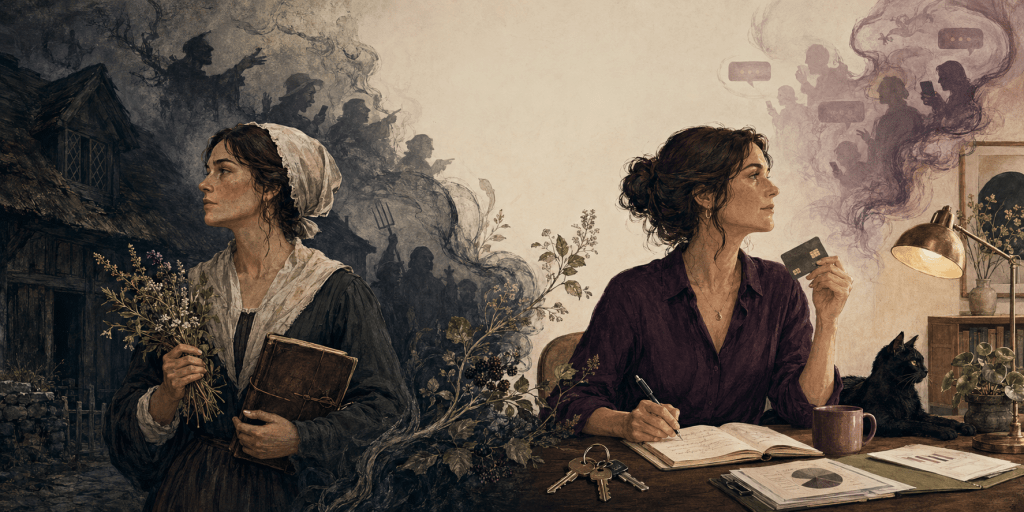
The law no longer hands a woman’s wages and property to her husband. Yet women who live independently are still warned that freedom will leave them lonely, childless and responsible for the decline of civilisation.
Women learn about money from other women.
Not always through formal lessons about savings, pensions or investments. Sometimes the lesson is delivered through a grandmother who never had a bank account of her own. A mother who remained in an unhappy marriage because she could not afford to leave. An aunt who lost her home after a divorce. A friend whose partner controlled every purchase while insisting that he was simply “better with money”.
Women remember what happened to the women before them.
They learn to keep something in their own name. To protect their income. To understand the mortgage. To maintain a pension. To avoid surrendering every part of their financial life to someone they love.
This is sometimes interpreted as cynicism, but it is better understood as historical memory.
For most of British history, financial dependence was not merely encouraged in women. It was enforced.
The wealthy widow who became a witch
In her Guardian article, “What makes a woman a witch? Financial independence”, Lucianne Tonti introduces us to Katherine Harrison, a seventeenth-century widow from Wethersfield, Connecticut.
When Harrison’s husband died, she inherited his farm and became one of the wealthiest women in the community. She chose to manage the property herself. She kept bees, brewed ale, raised livestock, spun yarn and traded what she produced.
These were useful and productive activities. In another person, they might have been admired as evidence of enterprise and skill.
But Harrison was a woman. She was financially independent, outspoken and apparently uninterested in finding another husband to manage either her property or her life.
She was accused of witchcraft.
The allegations against her were largely constructed from jealousy, superstition and mundane disagreements. Men claimed that she had interfered with their work. Her ability as a spinner was treated as suspicious. One tailor reportedly blamed her when he repeatedly sewed the sleeves of a jacket incorrectly.
Behind the supernatural accusations sat a recognisable material conflict. Harrison possessed wealth, knowledge and authority in a society that expected property and power to remain with men.
She also had three daughters and no male heir.
Historian Carol F. Karlsen found that women from families without male heirs were disproportionately represented among those prosecuted for witchcraft in colonial New England. Such women disrupted an inheritance system designed to return property to male hands.
A financially independent woman was not simply unusual. She represented a breach in the established order.
When women’s work became dangerous
Harrison was not an isolated case.
Women who earned money from healing, brewing, dairying, trading, spinning or preparing food could find themselves particularly exposed to accusations. Their work brought them into contact with neighbours, customers and competitors. It also made them vulnerable when ordinary life went wrong.
Milk spoiled. Cheese became contaminated. Wounds became infected. Babies died. Crops failed. Animals became sick.
In a frightened, deeply religious society, misfortune could be attributed to a woman whose knowledge was respected until it became threatening.
The boundary between healer and witch was not determined solely by what a woman did. It was influenced by who possessed the authority to declare her knowledge legitimate.
Women were excluded from universities and professional institutions. Their practical knowledge of childbirth, herbs, illness and the body could be dismissed as ignorance or condemned as magic. Meanwhile, male-dominated institutions increasingly claimed the authority to determine who could practise medicine and profit from it.
The witch accusation, therefore, performed several functions. It punished supposed spiritual wrongdoing, but it could also remove a competitor, discredit female knowledge and return authority to men.
Women’s work was valuable. What was dangerous was allowing women to control its value.
Marriage and the disappearance of a woman’s money
Women’s financial subordination was not an inevitable feature of human society.
Anglo-Saxon women could own property. Elsewhere and in earlier periods, women possessed varying rights to inherit, trade and control assets. History did not move smoothly from universal oppression towards modern equality. Women’s rights expanded and contracted according to who wrote the law and whose interests it protected.
Under the English doctrine of coverture, marriage largely absorbed a woman’s separate legal and financial identity into that of her husband.
A married woman could lose control of her property and earnings. She could not generally enter into contracts or bring legal proceedings independently. The money she earns from her work could become her husband’s to control.
An unmarried woman or a widow might possess rights that a wife did not.
Marriage, presented as a source of protection, created the dependence from which a woman supposedly required protection.
The Married Women’s Property Act 1870 allowed married women to retain their wages and certain property acquired during marriage. The Married Women’s Property Act 1882 went further, enabling married women to own and dispose of property in their own right.
That was only 144 years ago.
Legal change continued slowly. Women gained greater access to professions after the Sex Disqualification (Removal) Act 1919. Property reforms during the 1920s improved their rights to own and inherit assets. The Equal Pay Act was passed in 1970, although its principal provisions did not take effect until 1975.
The Sex Discrimination Act 1975 made discrimination in employment, education and services, including financial services, unlawful.
Women had held bank accounts before 1975, but banks and lenders could openly treat them differently. A woman might be required to provide a husband’s signature or a male guarantor. Her wages might be treated as temporary or less reliable than a man’s, regardless of what she earned.
Even after those reforms, the British tax system continued to treat a married woman’s income as part of her husband’s financial affairs. Independent taxation was introduced only in 1990.
Women in Britain have been independently taxed for just 36 years.
Why women still protect their independence
The legal barriers have largely fallen, but the economic consequences of women’s historical position remain.
Women continue to experience lower earnings, interrupted careers, unequal caring responsibilities and reduced pension wealth. In April 2025, the median gender pay gap among full-time employees was still 6.9 per cent. It was considerably higher among the greatest earners.
Motherhood remains particularly expensive. Women are more likely to reduce their hours, interrupt their employment or reject promotion because childcare and domestic responsibilities still fall disproportionately upon them.
Financial dependence can also become a means of abuse.
An abusive partner may restrict access to accounts, prevent a woman from working, monitor her spending, withhold money for essentials or create debt in her name. He may place the tenancy, mortgage, savings or household bills under his control.
The Domestic Abuse Act 2021 recognises economic abuse as a form of domestic abuse because controlling money can control almost every part of another person’s life.
Without money, leaving may mean debt, homelessness or being unable to provide for children. A woman can recognise that she is in danger and still be unable to see a financially survivable route out.
This is why women tell their daughters to maintain their own accounts.
It is why a woman may insist upon understanding the household finances even within a loving relationship.
It is why financial independence is not merely about ambition or personal wealth.
It is about safety.
What happens when women no longer need to marry?
A woman who can support herself does not need to enter a relationship for financial survival.
She can choose a partner because she wants love, intimacy, companionship and a shared life. She can also decide that remaining single is better than living within an unequal or unsafe relationship.
That freedom changes the expectations placed upon men.
Financial provision is no longer enough to guarantee a wife. A relationship must offer emotional maturity, respect, domestic participation and genuine partnership.
Many men welcome this. They do not want a woman who is compelled to remain with them. They want to be freely chosen.
Others appear to experience female choice as rejection and equality as a loss of male status.
The online manosphere has built an ideology around that resentment. It tells men that feminism has taken something from them. Women have become too independent, too selective and too difficult to control. A woman’s refusal to accept an unsatisfactory relationship is presented as evidence of female selfishness rather than the exercise of personal choice.
Women are then warned that their standards will leave them lonely. The unmarried woman becomes a failed woman. The childfree woman is selfish. The older single woman will supposedly die alone with her cats.
The cat lady is the modern relative of the witch.
Both are women imagined to exist without a man. Both are presented as strange, bitter and unnatural. Both serve as warnings to other women about what will happen if they become too independent.
A new language of reproductive duty
The attempt to frighten women away from independence has now become entangled with anxiety about falling birth rates.
Elon Musk regularly warns that declining fertility threatens civilisation. In one particularly revealing post, he wrote:
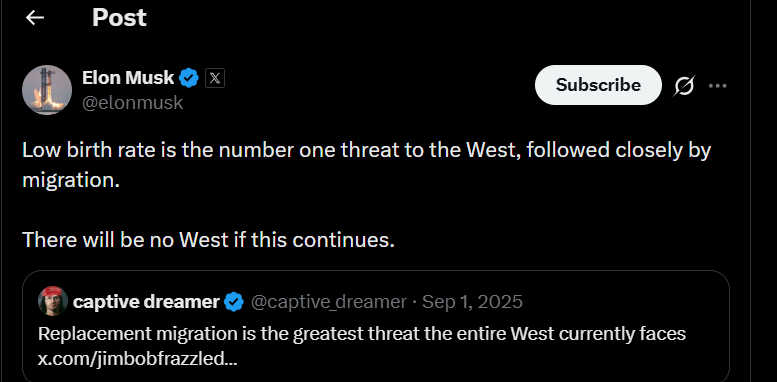
Fertility rates are falling in many countries. Ageing populations create genuine questions about future workforces, pensions, taxation and social care.
But migration can help countries respond to a declining working age population. If the number of people were Musk’s only concern, migration would be part of the solution.
Presenting low birth rates and migration as threats to “the West” suggests a different anxiety. The concern is not simply whether future generations will exist, but which people will comprise them.
Musk does not explicitly state that white women should produce more white children. It would be inaccurate to claim that he does. Nevertheless, the combination of birth rate panic, hostility towards migration and warnings about the disappearance of “the West” gives the argument an unmistakably racialised dimension.
It treats Western identity as though it were biologically inherited rather than created through shared institutions, laws, values and cultures.
It also places responsibility for maintaining this imagined civilisation upon women’s bodies.
A humane discussion about fertility would ask whether people are able to have the children they want. It would address unaffordable housing, childcare costs, insecure employment, maternal healthcare and the continuing inequality of parenting.
Pronatalist panic asks why women are failing to produce the children that society supposedly requires.
The woman is no longer treated as a citizen making decisions about her own life. She becomes an incubator for a nation, a workforce, a bloodline or a billionaire’s vision of civilisation.
The accusation changes, but the purpose remains
The witch possessed knowledge that men could not control.
The widow controlled property that was expected to return to male hands.
The spinster survived without marriage.
The feminist demanded a legal identity of her own.
The childfree woman controls her fertility.
The cat lady chooses peace over an unsatisfactory relationship.
Each represents a woman who cannot easily be compelled through economic necessity.
Women are no longer being burnt at the stake in Britain, but independence can still be punished through ridicule, threats and social exclusion. The law no longer requires a wife to surrender her earnings, so women are told that financial independence has made them undesirable. They are warned that remaining single will make them miserable. They are blamed for declining birth rates and the supposed disappearance of civilisation.
The language has changed.
The anxiety beneath it has not.
Financial independence does not prevent women from loving men, marrying or becoming mothers. It makes those choices meaningful because they can be made freely.
A woman with her own money can love without being trapped.
She can leave without facing immediate destitution.
She can marry without losing her identity in her husband’s financial identity.
She can have children because she wants them, not because her value depends upon motherhood.
She can remain single without being treated as unfinished.
Katherine Harrison’s neighbours did not fear her because she was useless. They feared her because she was capable. She worked, traded, inherited and survived without submitting to the role assigned to her.
Perhaps that is what has always made the independent woman so unsettling.
She has choices.
And she might not choose a man.
Further reading
This article was inspired by Lucianne Tonti’s Guardian feature, “What makes a woman a witch? Financial independence”.
Tonti’s book, Good Witch: In Search of Our Lost Feminine Power, examines the historical devaluation of women’s knowledge, work and power. Availability and purchasing information can be found through the official publisher page.
A fictional echo from Blackthorn Hollow
These same histories inspired my novel, The Witches of Blackthorn Hollow: A Tale of Persecution, Justice and Healing.
Set partly in the late sixteenth century, it follows Eliza, Margaret and Anne Blackthorn, three sisters whose knowledge of herbs, healing and midwifery attracts dangerous suspicion. Centuries later, historian Dr Emily Ward begins uncovering what really happened to them.
The novel is fictional, but the forces surrounding the sisters are painfully recognisable. Women’s knowledge is treated as threatening; healing becomes evidence of witchcraft; superstition conceals jealousy, competition and the desire for control. Like Katherine Harrison and countless accused women, the Blackthorn sisters are endangered not because they lack value, but because their knowledge gives them value beyond the authority of men.
Their story asks what remains after persecuted women have been silenced, and whether truth, memory and justice can survive across generations.
The Witches of Blackthorn Hollow is available from Amazon.
Sources
Domestic Abuse Act 2021, definition of economic abuse.
Handelsbanken Wealth and Asset Management (2024) A Short History of Women and Wealth.
Office for National Statistics (2025) Gender Pay Gap in the UK: 2025.
Ofcom (2025) The Manosphere Unmasked.
Tonti, L. (2026) ‘What makes a woman a witch? Financial independence’, The Guardian, 25 July.
UK Parliament (n.d.) Marriage: Property and Children.
Women’s Aid (2019) The Economics of Abuse.
 Curious Femme
Leave a comment