
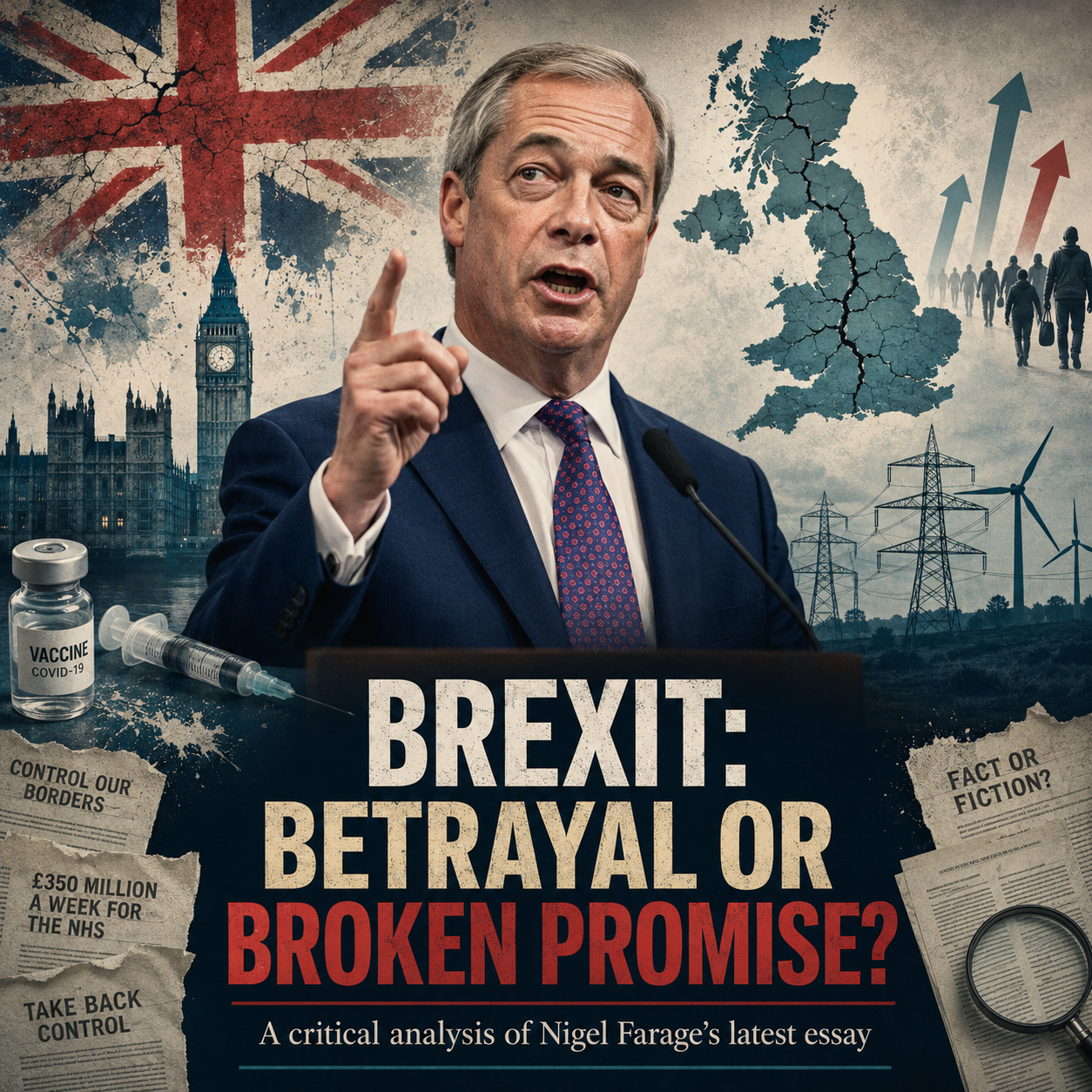
Nigel Farage’s latest essay presents itself as a defence of Brexit and an indictment of the political class. In reality, it is more complicated than that. Some of the figures he uses are accurate. Some of the failures he identifies are real. The problem is the way he turns selective evidence into sweeping political conclusions.
This is not a neutral analysis of Brexit. It is a campaign document. Its purpose is to persuade readers that Brexit was not flawed, only “betrayed”, and that Reform UK is the only party capable of restoring what voters were promised. That framing deserves scrutiny.
1. “I saw off four Prime Ministers”
Farage claims that Britain has gone through six Prime Ministers in seven years and that he personally “saw off” Cameron, May, Sunak and Starmer.
This is political theatre rather than a verifiable fact. David Cameron resigned after losing the Brexit referendum. Theresa May resigned after failing to get her Brexit deal through Parliament. Rishi Sunak lost the 2024 general election. Keir Starmer’s resignation followed wider political pressure and party instability. Farage was part of the political environment surrounding these events, but it is not factually accurate to claim that he personally removed four Prime Ministers.
The statement also has an unmistakably aggressive tone. When Farage says Andy Burnham should heed his demand for an early election, it reads less like democratic accountability and more like an attempt to project dominance over the political system. It is not a legal threat, but it is certainly political intimidation language.
The more accurate conclusion is this: Britain has experienced severe political instability since the Brexit referendum, but that instability was not caused solely by Farage. It was produced by Brexit division, Conservative infighting, weak leadership, economic crisis, public disillusionment and the collapse of trust in both major parties.
2. “The Red Wall has turned turquoise”
Farage argues that the Red Wall turned blue for Brexit, then red again to punish the Conservatives, and has now turned turquoise for Reform UK.
There is some truth here. Reform has made serious gains in recent local elections, and it has clearly broken through in areas that once felt electorally secure for Labour or the Conservatives. That matters. It would be foolish to dismiss Reform’s local election performance as irrelevant.
However, Farage overstates the case. Local elections are not general elections. Turnout is lower, voting behaviour is different, and protest voting is more common. Reform has gained significant local ground, but that does not mean the whole Red Wall has permanently realigned behind Reform. It also ignores Reform’s defeats and weaker performances in some parliamentary contests.
The phrase “the Red Wall has turned turquoise” is therefore better understood as campaign branding rather than a settled political fact. It is designed to create the impression of inevitability.
3. Vaccines and Brexit
Farage claims that Britain’s Covid vaccine success proved the benefits of Brexit. He argues that the European Medicines Agency dragged its feet while the UK’s domestic regulator acted quickly, and that the EU embarrassed itself by threatening vaccine exports and briefly attempting to use the Northern Ireland Protocol to block vaccine shipments.
This section contains some truth. The UK did approve the Pfizer-BioNTech vaccine before the EU’s central authorisation process. It is also true that the European Commission made a serious error in January 2021 when it briefly moved to trigger Article 16 of the Northern Ireland Protocol as part of its vaccine export-control dispute. That decision was widely criticised and quickly reversed.
However, Farage’s conclusion is overstated. The UK’s faster vaccine approval was not simply “because of Brexit”. The MHRA used emergency authorisation powers available under European law before the Brexit transition period ended. EU member states also had emergency-use options, although most chose to follow the EMA route.
The vaccine rollout was a real UK success, but it was not a simple Brexit dividend. It reflected early procurement, regulatory urgency, NHS delivery infrastructure, scientific capacity, political risk-taking and logistical mobilisation. Brexit may have made the politics of independent action easier, but it did not create the legal power from scratch.
Farage is strongest when criticising the EU’s vaccine procurement and Article 16 mistake. He is weakest when he turns that episode into proof that Brexit was responsible for Britain’s vaccine performance.
4. Immigration before Brexit
Farage says that, before the referendum, asylum applications had surged by 29% to around 32,000, and net migration had reached an all-time high of 336,000.
Those figures are broadly accurate. In 2015, asylum applications from main applicants rose by 29% to 32,414, the highest level since 2004. Net migration also reached 336,000 in the year ending June 2015.
However, his interpretation is selective. The 2015 asylum rise happened during a major European and global refugee crisis, driven by war, persecution and instability, particularly in Syria, Afghanistan, Iraq and Eritrea. It was not simply the result of EU membership.
Farage’s use of the “Breaking Point” poster also needs careful scrutiny. The UK was not part of the Schengen passport-free travel area, so it is misleading to imply that Britain had no border controls because of Schengen. The UK retained its own border checks while it was in the EU. What EU membership did involve was free movement rights for EU citizens, which is a different issue from Schengen and asylum.
It is also worth remembering who was in power. In 2015, David Cameron was Prime Minister and Theresa May was Home Secretary. Immigration policy was being managed by a Conservative government. The asylum system, non-EU migration, Home Office administration and border enforcement were all areas where the UK already had significant domestic responsibility.
Farage is right that immigration was a major political issue before Brexit. He is wrong to present the whole issue as something imposed on Britain by Brussels.
5. The “Boriswave” and post-Brexit immigration
Farage’s strongest section is his attack on post-Brexit immigration. Net migration did rise dramatically after Brexit. Revised ONS estimates show that net migration peaked at 944,000 in the year ending March 2023. That is a staggering figure.
However, this actually undermines Farage’s own argument. The post-Brexit immigration surge happened after free movement had ended. The UK’s new points-based immigration system began on 1 January 2021. In other words, this was not EU free movement. This was British government policy.
The relevant Prime Ministers were Boris Johnson, Liz Truss and Rishi Sunak. The Home Secretaries during the period included Priti Patel, Suella Braverman, Grant Shapps and James Cleverly. This was a Conservative-designed, post-Brexit migration system.
The causes of the surge included health and care visas, international students, dependants, family migration, humanitarian routes from Ukraine and Hong Kong, and labour shortages in sectors such as social care. These were not accidental consequences of EU membership. They were the result of domestic policy choices made after Brexit.
This is where Farage’s “betrayal” argument becomes convenient. Brexit did give Britain more legal control over immigration. The problem is that British governments then used that control to create a system that allowed very high levels of non-EU migration.
That does not prove Brexit was betrayed. It proves Brexit was sold as a simple answer to a complex problem.
6. Reform UK’s plan to abolish Indefinite Leave to Remain
Farage says Reform UK would abolish Indefinite Leave to Remain and replace it with a five-year renewable visa. Applicants would face higher salary thresholds, stricter English-language requirements, good-character rules, and no access to welfare or social housing.
This sounds simple, but the impact would be far-reaching.
Indefinite Leave to Remain is not a minor administrative label. It allows people to live and work permanently in the UK and is usually a route towards citizenship. Removing or restricting it would create a large class of people living in Britain long term without secure settlement.
That would not only affect migrants. It would affect British citizens too. British citizens with migrant spouses, parents, adult children, carers, colleagues and employees could all be affected. It could create uncertainty for families, employers, care providers, universities and public services.
Many temporary migrants already have “no recourse to public funds”, meaning they cannot access most welfare benefits or social housing. Therefore, the idea that migrants can simply arrive and immediately rely on the welfare state is misleading.
There is a legitimate debate to be had about low-wage migration, exploitation, salary thresholds and the social care visa route. However, abolishing ILR would be a radical policy with serious risks. It could weaken integration, increase insecurity, trap workers in employer-dependent visa routes, and create more Home Office bureaucracy.
The likely outcome is not simply “lower immigration”. It may also mean more instability for British families, higher care costs, greater staffing shortages and more legal disputes.
7. Illegal migration, the ECHR and the Refugee Convention
Farage argues that Reform would leave the European Convention on Human Rights and the Refugee Convention, immediately detain and deport people arriving illegally, and review refugee status granted in the five years before a Reform government.
This is one of the most serious parts of the essay because it affects far more than asylum policy.
Leaving the ECHR would not only affect asylum seekers. The Human Rights Act currently allows people in the UK to enforce ECHR rights in British courts. These rights affect ordinary citizens in their dealings with police, hospitals, schools, councils, prisons and the state. Removing or weakening those protections would change the relationship between the citizen and the state.
The Refugee Convention issue is also more complex than Farage suggests. Refugees often have to cross borders irregularly because safe and legal routes are limited. Article 31 of the Refugee Convention recognises that refugees should not automatically be penalised for irregular entry when they meet certain conditions. The principle of non-refoulement also prevents states from returning people to places where they face persecution or serious harm.
That does not mean every person arriving irregularly must be granted asylum. It does mean that automatic detention and removal is not as legally simple as Farage presents it.
The proposal would also be operationally expensive. Large-scale detention, appeals, removals and diplomatic agreements require huge administrative capacity. The UK already struggles with asylum backlogs, accommodation costs and Home Office inefficiency. Farage offers certainty, but the machinery required to deliver it would be legally, financially and diplomatically difficult.
The key point for UK citizens is this: leaving the ECHR would weaken rights protections for everyone, not just migrants.
8. Energy and Net Zero
Farage argues that Britain’s energy market is in a dire state, that UK businesses pay extremely high prices, and that Net Zero and EU alignment are making the problem worse.
There is truth in the problem. UK industrial electricity prices are high by international comparison. This matters because expensive energy damages manufacturing, investment, productivity and jobs. Farage is right to identify high energy prices as a serious economic issue.
However, his explanation is too simple. UK energy prices are shaped by gas dependence, international gas markets, Russia’s invasion of Ukraine, marginal pricing, weak storage, grid constraints, ageing infrastructure, policy costs and long-term underinvestment. Net Zero is part of the debate, but it is not the only cause.
Farage also argues that Britain should exploit North Sea oil and gas to deliver cheap, home-grown energy. That is misleading. The North Sea is a mature basin in long-term decline. Additional production would still be sold into international markets, so it would not automatically give British households cheap energy. More drilling may support some jobs and transition revenue, but it is not a magic answer to household bills.
His discussion of Scottish wind, grid constraints and France contains a real issue but uses loaded language. It is true that when the grid cannot move electricity from one region to another, generators may be paid to reduce output while other generators are paid to increase supply elsewhere. That is a problem of grid capacity and market design. But describing this simply as Britain subsidising French electricity consumption is political spin.
Farage is right that energy policy needs reform. He is wrong to imply that abandoning Net Zero and drilling the North Sea would automatically cut living costs.
A serious energy policy would focus on grid upgrades, storage, nuclear, insulation, market reform, cheaper renewables, targeted industrial support and a managed transition for workers in oil and gas.
9. EU energy alignment and the “reset”
Farage claims that the UK’s EU reset would drag Britain back into EU energy law, state aid rules and foreign oversight.
There is some basis for concern about regulatory alignment. UK-EU exploratory discussions on possible participation in the EU internal electricity market include references to dynamic alignment with relevant EU electricity market rules and state aid provisions.
However, Farage presents the most dramatic version of this argument. The issue is not simply “Brussels taking over”. The real question is whether closer electricity-market cooperation would reduce costs and improve energy security, or would restrict UK policy flexibility too much.
That is a serious debate. It should not be reduced to slogans about betrayal.
The UK may benefit from closer energy trade with Europe, especially as electricity systems become increasingly interconnected. But there are democratic and regulatory questions about alignment, enforcement and state aid. Farage is right that those questions should be asked. He is wrong to pretend the answer is obvious before the detail is agreed.
10. Farage’s own EU record
Farage presents himself as an outsider dragged back into politics by Westminster’s failure. That image is only partly true.
He was not outside the system. He was an elected Member of the European Parliament for many years. He built much of his political career from within the very institution he attacked.
It is also fair to scrutinise his record. UKIP MEPs had one of the poorest voting participation records in the European Parliament. Farage has also defended keeping his EU pension after Brexit. That does not invalidate every argument he makes, but it does weaken the image of a man wholly separate from the political establishment.
A careful criticism would be this: Farage spent years attacking the EU from inside its institutions, while benefiting from the platform, salary, profile and pension that came with that role.
That contradiction matters.
Conclusion
Farage’s essay works because it mixes real grievances with exaggerated conclusions.
He is right that the EU made mistakes over vaccine procurement and the Northern Ireland Article 16 episode. He is right that post-Brexit immigration reached extraordinary levels. He is right that UK energy prices are a serious economic problem. He is right that many voters feel betrayed by the political class.
But his conclusion does not follow.
The post-Brexit immigration surge was not caused by EU membership. It happened after free movement ended, under a British-designed points-based immigration system. High energy prices are not solved by slogans about Net Zero. Leaving the ECHR would affect the rights of British citizens, not only asylum seekers. Abolishing ILR could destabilise families, care services, employers and communities.
The central flaw in Farage’s essay is that he presents Brexit as a perfect idea ruined by others. The evidence suggests something more uncomfortable: Brexit gave Britain more control, but control itself does not guarantee competence, fairness, prosperity or lower migration.
That is the argument he avoids.
Brexit was sold as a simple cure for complex problems. Ten years later, Farage is still selling the same cure, only now he is blaming everyone else for the side effects.
reference list
European Environment Agency (2026) Share of energy consumption from renewable sources in Europe. Available at: European Environment Agency website.
Equality and Human Rights Commission (n.d.) The Human Rights Act. Available at: Equality and Human Rights Commission website.
Full Fact (2020) Vaccine approval isn’t quicker because of Brexit. Available at: Full Fact website.
Full Fact (2025) Does the UK have the “most expensive” electricity in the world? Available at: Full Fact website.
GOV.UK (2016) Immigration statistics, October to December 2015: Asylum. Available at: GOV.UK website.
GOV.UK (2021) The UK’s points-based immigration system: information for EU citizens. Available at: GOV.UK website.
House of Commons Library (2021) Northern Ireland Protocol: Article 16 and EU vaccine export controls. Available at: UK Parliament website.
House of Commons Library (2021) Article 31 of the Refugee Convention. Available at: UK Parliament website.
National Energy System Operator (n.d.) What are constraint payments? Available at: NESO website.
Office for National Statistics (2025) Improving long-term international migration statistics: updating our methods and estimates. Available at: ONS website.
Office for National Statistics (2025) The impact of higher energy costs on UK businesses: 2021 to 2024. Available at: ONS website.
Summers, H. (2017) ‘Nigel Farage criticised for saying he will keep EU pension’, The Guardian, 3 December.
VoteWatch Europe, cited in The Independent (2015) ‘UKIP MEPs attend the fewest European Parliament votes of any party in the EU’s 28 countries’, 12 June.
 Curious Femme
Leave a comment