
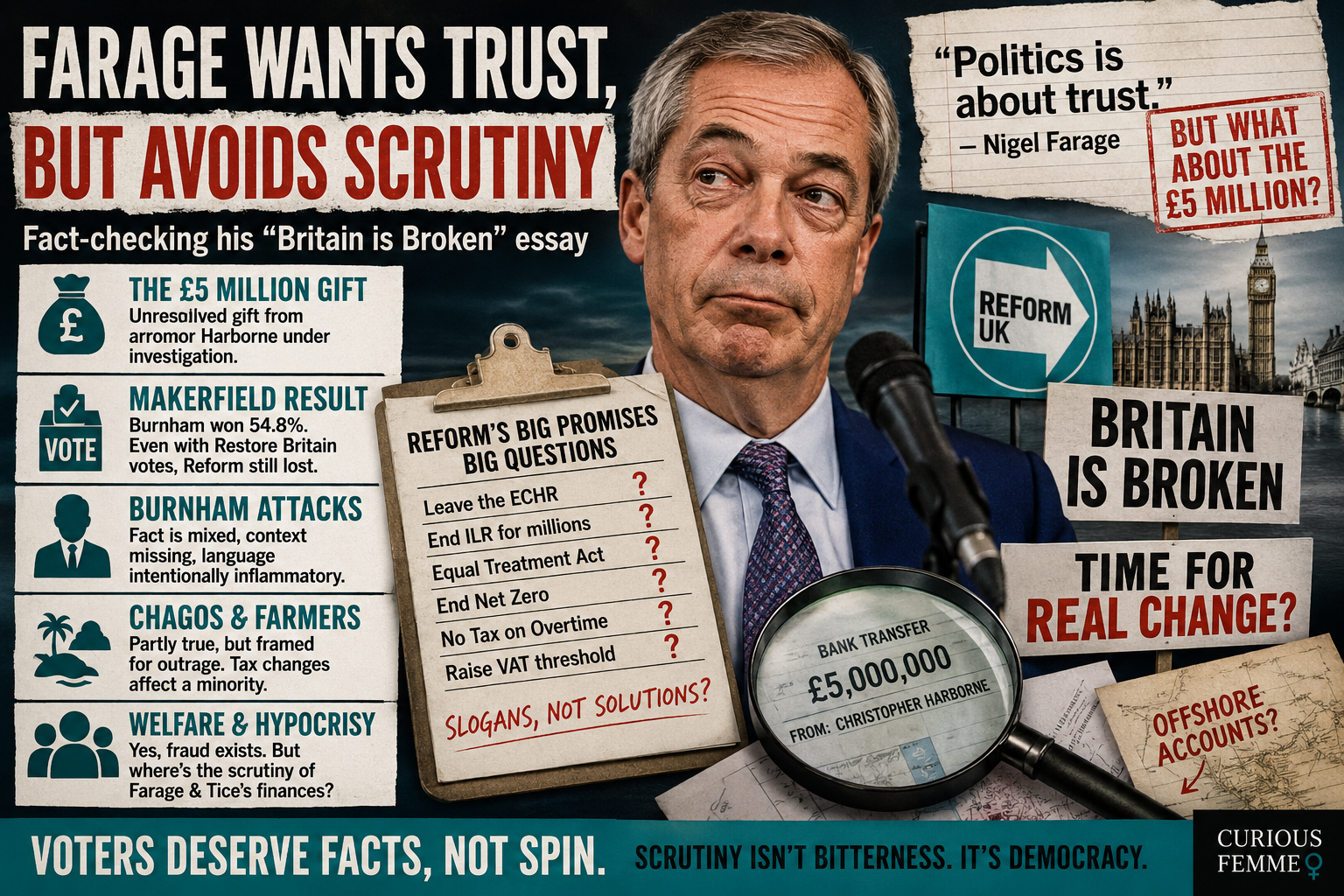
Nigel Farage’s latest Substack essay, Britain is broken, we need an election, is written in the language of democratic outrage. It speaks of betrayal, trust, borders, welfare cheats, farmers, public money, crime, migration and the supposed arrogance of the political class. It is designed to make the reader feel that the country is being stolen from them by an elite that does not listen.
But the central problem with the essay is not simply what Farage says. It is what he leaves out.
Farage repeatedly asks voters to distrust Labour, Andy Burnham, Westminster and the so-called “uniparty”, yet he avoids the most obvious trust question currently attached to his own leadership, the unresolved controversy surrounding the £5 million personal gift he received from billionaire Christopher Harborne before becoming an MP. The Parliamentary Standards Commissioner is investigating whether that gift should have been declared. Reform says it was personal, unconditional and not registrable. Farage has denied wrongdoing. However, for a politician whose essay is built almost entirely around “trust”, the omission is glaring (Reuters, 2026a; Tax Policy Associates, 2026a).
This is not a neutral political essay. It is a campaign document. It contains some claims that are factually grounded, but it uses selective evidence, loaded language and strategic omission to create a moral contrast between Reform and everyone else. When scrutinised carefully, that contrast becomes much weaker.
The politics of “trust”, and the £5 million question
Farage writes that “politics is about trust” and accuses the political class of taking voters for fools (Farage, 2026). That is a powerful line. It is also risky, because it invites the reader to apply the same standard to him.
The £5 million gift from Christopher Harborne is now one of the most important transparency questions in British politics. Reuters reported that Farage described the money as a “reward” for his Brexit campaigning, after previously saying it related to personal security. The Parliamentary Standards Commissioner is investigating whether the gift should have been declared under parliamentary rules (Reuters, 2026a).
Tax Policy Associates has argued that, on the currently available facts, Farage probably does not owe tax on the £5 million if it was a genuine gift. That distinction matters. This is not currently a proven tax issue. However, Tax Policy Associates also noted that Farage’s later description of the payment as a “reward” raises complex questions about the nature of the payment (Tax Policy Associates, 2026a).
The stronger criticism, therefore, is not “Farage has definitely broken the law”. It is this: a politician cannot build an essay on public trust while failing to address a massive personal payment already under formal scrutiny. Transparency is not optional when you are asking the country to believe that you alone represent honesty.
Makerfield was not the mandate Farage wanted it to be
Farage’s essay is clearly shaped by disappointment over Makerfield. Andy Burnham won the by-election with a significant majority. The official parliamentary result shows that Burnham won 24,927 votes, 54.8 per cent of the vote, while Reform’s Rob Kenyon received 15,696 votes, 34.5 per cent. Restore Britain received 3,111 votes, 6.8 per cent. Turnout was 58.7 per cent (Members.parliament.uk, 2026).
This matters because some of Farage’s framing implies that Reform was unfairly blocked or that anti-Labour votes were simply split. That argument does not stand up fully in Makerfield. Even if every Restore Britain vote had gone to Reform, Burnham would still have won.
However, Makerfield does reveal a problem for Reform. Restore Britain can damage Reform from the right by appealing to voters who think Farage is not hardline enough. At the same time, Reform still has to win over moderate voters, women voters and those who may be sympathetic to anti-establishment politics but are uncomfortable with sexism, inflammatory rhetoric or weak candidate vetting. That is a strategic problem. If Reform moves further towards Restore Britain’s territory, it risks alienating voters it would need to form a government.
Farage frames Makerfield as a symptom of Labour manoeuvring. It may be better understood as a warning about Reform’s ceiling. The party can mobilise anger, but it also attracts resistance.
Burnham is attacked for experience, while Reform struggles with competence
Farage presents Andy Burnham as a stale professional politician. It is true that Burnham has spent much of his life in politics. He served under Gordon Brown, held senior ministerial roles and has been Mayor of Greater Manchester since 2017 (Harvard Kennedy School, 2022). Farage also correctly notes that Burnham voted for the Iraq war, a fact recorded by TheyWorkForYou (TheyWorkForYou, 2026).
However, Farage uses experience as though it is automatically disqualifying. That is politically convenient, but intellectually weak. Burnham’s record can be criticised, and should be scrutinised, but he has far more direct governing experience than many Reform candidates and councillors.
That contrast matters. Reform has repeatedly presented itself as the party of efficiency and common sense. Yet Reform-led councils have already faced criticism over spending on political advisers. Warwickshire Reform councillors were criticised after voting to spend £150,000 on political advisers, despite campaigning against waste. Kent Reform councillors were also criticised over expenditure on political assistants (Guardian, 2025a; Guardian, 2025b).
This does not mean every Reform councillor is incompetent. It does mean that Reform’s anti-waste rhetoric should be tested against its behaviour in office. It is easy to shout “waste” from the sidelines. It is harder to govern legally, competently and transparently when statutory duties, budgets, scrutiny committees, adult social care, children’s services and local government finance are involved.
Farage’s Burnham claims: some true, some simplified, some loaded
Farage’s attack on Burnham contains several claims that need separating.
First, Burnham did serve in Gordon Brown’s government. That is true (Harvard Kennedy School, 2022).
Second, Burnham did vote for the Iraq war. That is also true (TheyWorkForYou, 2026).
Third, Burnham previously took a more liberal position on “no recourse to public funds”, particularly in relation to homelessness and destitution among migrants. He has since softened or shifted that position under political pressure (Guardian, 2026a). Farage’s wording, however, reduces a complex policy debate about homelessness, destitution and immigration status into the more inflammatory phrase “migrants to have access to public money”.
Fourth, Farage’s claim that Burnham supported trans women using women’s toilets has a basis in reported comments, but the language is deliberately provocative. LBC reported that Burnham said trans women should be able to use female toilets, and later reported his clarification around single-sex spaces (LBC, 2026a; LBC, 2026b). The policy and legal context is complex, especially following the UK Supreme Court ruling on the meaning of sex in the Equality Act. Farage’s phrasing is not designed to clarify that complexity. It is designed to provoke.
This is a common feature of the essay. Farage does not always invent facts. Instead, he strips them of context, loads them emotionally and uses them to build a character attack.
Chagos: partly factual, but framed for outrage
Farage writes that the Chagos Islands were “nearly handed over at a cost to the taxpayer” (Farage, 2026). There is a factual basis here, but the framing is incomplete.
The House of Commons Library explains that the UK-Mauritius treaty provides for Mauritius to exercise sovereignty over the Chagos Archipelago, while the UK retains rights over Diego Garcia for an initial 99 years. The government says this resolves a long-running sovereignty dispute while protecting the military base. The cost has been estimated at an average annual payment of around £101 million, with a net present value of around £3.4 billion (House of Commons Library, 2025a).
So yes, there is a taxpayer cost. But “handed over” omits the retained Diego Garcia arrangement and the international legal context. The issue is controversial and deserves scrutiny, but Farage’s phrasing turns a complicated sovereignty, defence and diplomatic settlement into a simple betrayal story.
Farmers and the so-called “death tax”
Farage also says farmers were hit by a “death tax” (Farage, 2026). This is emotive language for changes to inheritance tax reliefs, specifically Agricultural Property Relief and Business Property Relief.
From April 2026, 100 per cent relief applies to the first £2.5 million of combined agricultural and business property. Above that, 50 per cent relief applies (House of Commons Library, 2026a). The government has said that around 85 per cent of estates claiming Agricultural Property Relief in 2026 to 2027 are forecast to pay no more inheritance tax as a result of the reforms (HM Treasury, 2025).
That does not mean the policy is harmless. Asset-rich, cash-poor farms may face genuine succession difficulties. Some families may be forced into difficult financial decisions. The farming sector’s anger should not be dismissed. However, calling it simply a “death tax” erases the relief threshold and the fact that the majority of estates claiming agricultural relief are forecast not to pay more.
A serious critique would ask whether the policy is well-designed, whether it protects working family farms, and whether it distinguishes sufficiently between active farmers and large landowners who use farmland as a tax shelter. Farage does not do that. He chooses the slogan.
Welfare cheats, public money and selective morality
Farage attacks Labour for allegedly failing to act against “welfare cheats” (Farage, 2026). Welfare fraud and error are real. DWP statistics for the financial year ending 2026 estimate that £9.9 billion, around 3.2 per cent of benefit expenditure, was overpaid due to fraud and error. Fraud overpayments were estimated at 2.2 per cent (DWP, 2026).
But two details matter.
First, the figure includes fraud, claimant error and official error. It is not all “cheating”.
Second, some overpayments are recovered. The DWP statistics distinguish between gross overpayments and net loss after recoveries (DWP, 2026).
There is a legitimate debate to be had about fraud prevention, administrative error and public money. But Farage’s essay frames the welfare system as a moral battlefield between strivers and scroungers. That is politically useful, but socially corrosive. It turns complex systems into cultural resentment.
The selective morality is also striking. Farage presents himself as the guardian of public money while failing to address the £5 million gift. Reform’s deputy leader, Richard Tice, has also faced scrutiny. Tax Policy Associates alleged that Tice’s company failed to withhold approximately £120,000 of tax on dividends paid to him and his offshore trust. It also reported a separate potential corporation tax issue involving companies in the Quidnet group. Tice has denied wrongdoing and has rejected criticism, so these points must be described carefully as allegations and expert analysis, not as court-proven tax evasion (Tax Policy Associates, 2026b; Tax Policy Associates, 2026c).
The issue is hypocrisy. Reform speaks the language of ordinary taxpayers, but its senior figures have faced serious questions about gifts, declarations, offshore structures and tax arrangements. Those questions do not disappear because Farage points at benefit fraud.
ECHR and ILR: the slogan hides the consequences
Farage says Reform would “take back control of our borders by leaving the ECHR and ending ILR for millions of low-skilled migrants” (Farage, 2026).
This is one of the essay’s most significant claims. It is also one of the least developed.
Leaving the European Convention on Human Rights would not magically create border control. It would remove or weaken one legal framework used in immigration and deportation cases, particularly where Article 3 and Article 8 arguments arise. However, immigration decisions also depend on domestic law, Home Office capacity, detention space, casework quality, appeal systems, international agreements, returns arrangements and diplomatic cooperation (House of Commons Library, 2025b).
Ending or restricting Indefinite Leave to Remain is even more serious. ILR, also called settlement, gives people the right to live, work and study in the UK indefinitely and to apply for benefits if eligible. It is also a route towards citizenship (Gov.uk, 2026a). The Migration Observatory has noted that settlement rules affect not only future migration but people already living and working in the UK (Migration Observatory, 2026).
If Reform attempted to end ILR for millions of people, the likely consequences would include legal challenges, insecurity for lawful residents, disruption to employers, family separation risks, pressure on local authorities and further administrative strain on the Home Office. It could also affect people who have built lives, paid taxes, raised children and worked in essential sectors.
Calling people “low-skilled migrants” does not remove the complexity. Many so-called low-skilled workers keep care homes, hospitality, logistics, food production and cleaning services functioning. Reform’s slogan treats them as a removable category, not as human beings embedded in communities and labour markets.
The “Equal Treatment Act” sounds simple, but what would it remove?
Farage says Reform would introduce an “Equal Treatment Act” to restore “ancient rights to equal treatment before the courts” (Farage, 2026). That sounds appealing because equality before the law is a foundational democratic principle.
But the UK already has the Equality Act 2010, which protects people from discrimination on the grounds of age, disability, gender reassignment, marriage and civil partnership, pregnancy and maternity, race, religion or belief, sex and sexual orientation (Equality Act 2010; Gov.uk, 2026b).
The question, therefore, is not whether “equal treatment” sounds good. The question is what Reform’s Act would repeal, weaken or replace. Would it remove protections? Would it narrow discrimination law? Would it affect women, disabled people, minority ethnic groups, gay people, religious minorities or gender-critical belief protections? Would it alter the public sector equality duty?
Without draft legislation, the phrase is a slogan, not a policy. Voters should ask: equal treatment for whom, under what law, and at whose expense?
Net Zero, motorists and the fantasy of cost-free politics
Farage promises to end Net Zero and the “war on motorists” (Farage, 2026). Again, this is slogan politics.
There are serious questions about the cost of Net Zero, how fairly those costs are distributed, whether low-income households are protected and whether rural communities are being asked to change without adequate transport alternatives. Those questions deserve proper policy debate.
But “ending Net Zero” does not abolish energy costs, climate risk, infrastructure needs or international market pressures. It may also create uncertainty for businesses investing in clean energy, housing standards, transport infrastructure and green technologies. Farage’s essay offers grievance, but little detail on replacement policy.
No tax on overtime: popular, but costly and open to abuse
Farage’s “No Tax on Overtime” policy is designed to sound pro-worker. The emotional appeal is obvious. People working extra hours feel they should keep more of what they earn.
However, Tax Policy Associates has criticised Reform’s proposal, arguing that it could lead to modest additional output, large-scale relabelling of existing hours as overtime and a cost significantly above Reform’s estimate. Its central estimate placed the cost at around £14 billion, compared with Reform’s lower estimate (Tax Policy Associates, 2026d).
There are also fairness questions. Workers in salaried roles, care roles, teaching, insecure work or jobs without overtime opportunities may gain little or nothing. Employers may restructure pay arrangements. Higher earners with access to overtime may benefit more than those in lower-paid jobs with fixed hours.
A policy can sound pro-worker while still being poorly designed.
Raising the VAT threshold: helpful for some, but not a magic answer
Farage also promises to raise the VAT threshold for small businesses and sole traders (Farage, 2026). This could help some small firms by reducing administrative burden and allowing them to keep more income before registering for VAT.
However, the VAT threshold already creates a cliff edge. Some businesses deliberately restrict growth to stay below it. Raising the threshold could help some businesses, but it could also increase the point at which that cliff edge bites. Without detail on costing, behavioural effects and lost revenue, the promise remains incomplete.
Can Farage force a general election?
Farage calls for a general election “at the soonest possible date” (Farage, 2026). Politically, he can demand one. Constitutionally, he cannot force one.
The Institute for Government explains that general elections must be held no more than five years apart, but the timing is otherwise determined by the Prime Minister. The Dissolution and Calling of Parliament Act 2022 restored the Prime Minister’s ability to request dissolution at a time of their choosing (Institute for Government, 2026; House of Commons Library, 2022).
That means Farage’s demand is political pressure, not a mechanism. A change of Prime Minister does not automatically trigger a general election. Many people may think it should. That is a legitimate democratic argument. But it is not the current constitutional rule.
The deeper problem: Farage’s essay is anti-establishment theatre
The essay works because it tells a simple story. Britain is broken. Labour betrayed you. Burnham is fake. Westminster is corrupt. Reform is ready. The people have been ignored. Trust Farage.
But a serious reading reveals something else. Farage attacks welfare cheats while avoiding his own unresolved gift controversy. He attacks Burnham’s political career while his own party struggles to demonstrate consistent competence in local government. He criticises public money while Reform-linked figures face scrutiny over advisers, savings claims and tax-related questions. He attacks elite politics while relying on billionaire backing and populist media spectacle.
This is not evidence-led reform. It is anti-establishment theatre.
That does not mean every concern Farage raises is invalid. Many people are genuinely worried about public services, migration, housing, taxation, energy bills, crime and democratic legitimacy. Those concerns should not be dismissed. But voters deserve solutions, not slogans. They deserve policy detail, not emotional shortcuts. They deserve transparency from those who claim to speak for them.
Conclusion: trust cannot be demanded while scrutiny is dodged
Farage’s essay asks voters to distrust everyone except Reform. But trust is not built by shouting louder than everyone else. It is built through transparency, consistency, competence and accountability.
The £5 million gift matters because it exposes the gap between Farage’s rhetoric and his own unresolved questions. The Makerfield result matters because it shows Reform can be beaten, even in a political climate full of anger. Restore Britain matters because it shows Reform is now being squeezed from the right as well as challenged from the centre and left. The ECHR and ILR proposals matter because they would have enormous legal, social and economic consequences that Farage does not properly explain.
Farage may be right that many voters feel betrayed. But betrayal is not solved by replacing one form of elite politics with another wrapped in a turquoise rosette.
If politics is about trust, then Farage must answer the same question he asks of everyone else: who benefits, who pays, and what are you not telling us?
References
Department for Work and Pensions (2026) Fraud and error in the benefit system: financial year ending 2026 estimates. London: Department for Work and Pensions.
Equality Act 2010, c.15. London: The Stationery Office.
Farage, N. (2026) ‘Britain is broken, we need an election’, Nigel Farage Substack, 22 June.
Gov.uk (2026a) Check if you can get indefinite leave to remain. London: UK Government.
Gov.uk (2026b) Types of discrimination: protected characteristics. London: UK Government.
Guardian (2025a) ‘Reform councillors criticised after voting to spend £150,000 on political advisers’, The Guardian, 23 July.
Guardian (2025b) ‘Reform councillors in Kent condemned for spending thousands on political assistants’, The Guardian, 20 December.
Guardian (2026a) ‘Burnham steps back from past calls to end immigration benefits restriction’, The Guardian, 28 May.
Harvard Kennedy School (2022) Andy Burnham: Britain’s growing regional divides. Cambridge, MA: Harvard Kennedy School.
HM Treasury (2025) Inheritance tax reliefs threshold to rise to £2.5m for farmers and businesses. London: HM Treasury.
House of Commons Library (2022) Dissolution and Calling of Parliament Act 2022: Progress through Parliament. London: House of Commons Library.
House of Commons Library (2025a) 2025 treaty on the British Indian Ocean Territory/Chagos Archipelago. London: House of Commons Library.
House of Commons Library (2025b) Immigration and the ECHR. London: House of Commons Library.
House of Commons Library (2026a) Changes to agricultural and business property reliefs for inheritance tax. London: House of Commons Library.
Institute for Government (2026) Calling a general election. London: Institute for Government.
LBC (2026a) ‘Andy Burnham said trans women should be able to use female toilets’, LBC, 20 May.
LBC (2026b) ‘Burnham clarifies stance on single-sex spaces after backlash’, LBC, 22 May.
Members.parliament.uk (2026) Election result for Makerfield: 2026 by-election. London: UK Parliament.
Migration Observatory (2026) Changes to settlement: what do they mean? Oxford: University of Oxford.
Reuters (2026a) ‘UK’s Farage describes $7 million gift as a reward for Brexit’, Reuters, 13 May.
Tax Policy Associates (2026a) Nigel Farage’s £5m gift: why tax is probably not due. London: Tax Policy Associates.
Tax Policy Associates (2026b) Richard Tice’s property company failed to pay £120,000 of tax. London: Tax Policy Associates.
Tax Policy Associates (2026c) Richard Tice signed accounts wrongly claiming £98k tax exemption. London: Tax Policy Associates.
Tax Policy Associates (2026d) Reform UK overtime tax cut: ten better tax cuts. London: Tax Policy Associates.
TheyWorkForYou (2026) The Iraq war votes for Andy Burnham. London: mySociety.
 Curious Femme
Leave a comment