
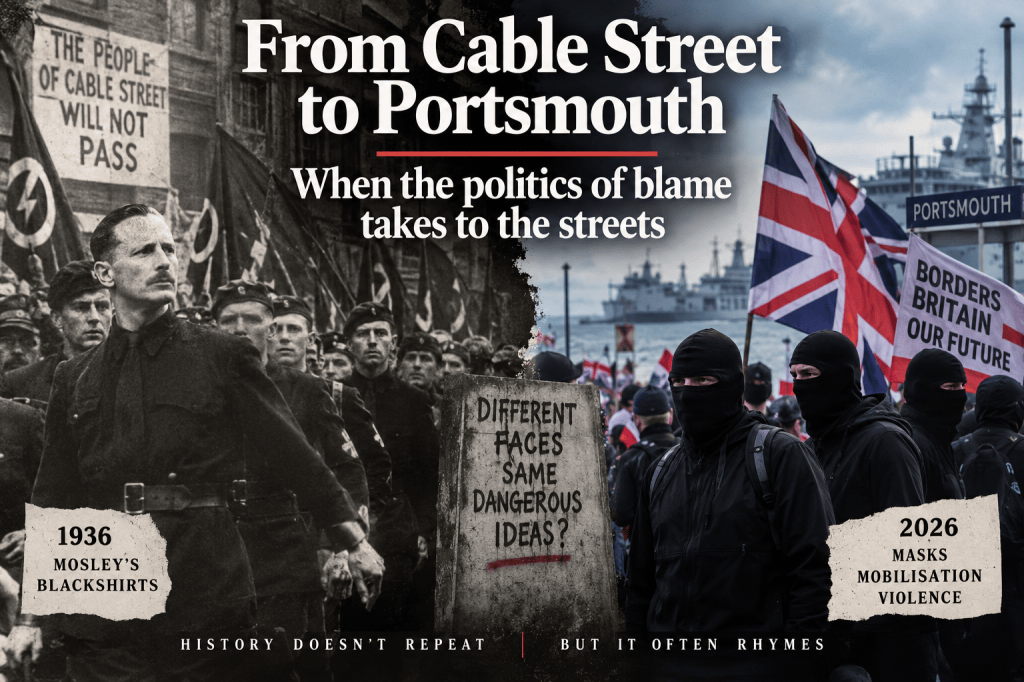
On 4 October 1936, Oswald Mosley planned to march the British Union of Fascists through London’s East End, home to a large Jewish population.
His followers were known as the Blackshirts.
Local Jewish people, trade unionists, communists, socialists, anarchists, Irish residents and other anti-fascists blocked the route.
There is an important historical detail here. The famous fighting at Cable Street was principally between the anti-fascist crowd and Metropolitan Police officers trying to clear a route for Mosley’s march. The Blackshirts themselves were ultimately turned away.
That distinction matters because history becomes useless if we simplify it to make a modern political point.
But so does what happened before Cable Street.
Ninety years later, masked men dressed predominantly in black have appeared at organised anti-migration actions in Dover and Portsmouth.
On 6 September 2026, after a small boat arrived at Eastney Marina in Portsmouth, a crowd of approximately 200 gathered. Hampshire police describe what followed as violent public disorder. Several police, Coastguard and Border Force vehicles were damaged. Officers were injured. Criminal charges followed.
Among those mobilising in Portsmouth were members of Patriot Platform, a new anti-migration network widely described as far-right, whose activists have appeared in coordinated black clothing and balaclavas.
Its leader, Daniel “Danny Tommo” Thomas, had told followers shortly beforehand:
“Groups of men all across the United Kingdom are joining up as one, as one group of resistance.”
That does not make Patriot Platform the British Union of Fascists.
Nor does it make Nigel Farage Oswald Mosley.
But it does make the history worth examining.
Because Cable Street did not begin at Cable Street.
Before the Blackshirts came the crisis
Britain entered the 1930s in severe economic distress.
By 1932 unemployment had climbed to almost 3.5 million. The National Archives notes that the government’s apparent inability to solve unemployment helped extremist political movements attract attention.
But most unemployed people did not become extremists.
They wanted jobs.
That matters enormously to any comparison with the present.
Economic hardship does not automatically produce fascism, racism or political extremism.
It produces grievances.
Politics helps determine how those grievances are explained.
Oswald Mosley himself had travelled through mainstream politics. He had been a Conservative MP, then a Labour politician and a minister in Ramsay MacDonald’s government.
In 1930 he resigned after his proposals for tackling unemployment were rejected, telling Parliament that he believed he had offered a “more effective alternative”.
He subsequently broke with Labour, formed the New Party and in 1932 founded the British Union of Fascists.
The transformation matters.
Mosley’s response to what he saw as the failure of conventional politics ceased to be simply a different economic programme. It became an explicitly fascist movement whose members wore paramilitary-style black shirts and became associated with organised street confrontation.
By 1936, Historic England describes the BUF as Britain’s largest organised antisemitic force.
Then came the enemy within
By the mid-1930s BUF propaganda was openly antisemitic.
Its material attacked “Jews and aliens” and promoted conspiracy theories about “Jewish Bolshevism”.
A complicated collection of economic, political and social problems could now be incorporated into a much simpler story:
Britain is in trouble because of them.
This is where historical comparison requires precision.
Britain’s Muslims and migrants in 2026 are not in the same historical position as British Jews under organised fascism in the 1930s.
But the political mechanism can still be examined.
A complicated national problem can be converted into a story about a threatening group.
Consider Nigel Farage’s own words.
During a Sky News interview in May 2024, Farage said:
“We have a growing number of young people in this country who do not subscribe to British values. In fact, loathe much of what we stand for.”
Trevor Phillips asked:
“We are talking about Muslims here?”
Farage replied:
“We are.”
Farage subsequently qualified this by saying he was referring to “elements” within the Muslim community rather than Muslims as a whole.
That qualification matters.
So does what followed.
In March 2026, following a peaceful Ramadan gathering in Trafalgar Square, Farage said that as prime minister he would stop mass Muslim prayer events at historic sites.
He described the gathering as an attempt to:
“overtake, intimidate and dominate our way of life”.
Reuters reported that the event itself was peaceful and attended by hundreds of people breaking their Ramadan fast.
That language goes beyond an argument about immigration numbers.
It constructs the public presence of a religious minority as a challenge to a national way of life.
That is a political mechanism worth examining historically.
Real problems. Political explanations.
None of this means Britain’s problems are invented.
Housing is unaffordable for millions. NHS services are under pressure. Wages and productivity have grown painfully slowly. Councils are struggling. Irregular Channel crossings are a genuine policy problem.
But real problems do not arrive with labels telling us whom to blame.
That part is political.
The 2026 British Social Attitudes research is revealing.
Sixty per cent of Reform supporters are very dissatisfied with the NHS, compared with 51 per cent of the public overall.
Three quarters believe migrants undermine British culture, compared with 35 per cent of the wider population.
Education also shows a striking divide. Forty per cent of people whose highest qualification is below A level support Reform, compared with 9 per cent of graduates. Education, of course, is not the same thing as intelligence.
NatCen found something deeper.
For decades, British Social Attitudes has measured views about traditional values, obedience to authority, punishment, censorship and the law on what it calls a libertarian-authoritarian, or social liberal-social conservative, scale.
Among the most libertarian third of respondents, 5 per cent supported Reform.
Among the most authoritarian third, that rose to 34 per cent.
And 60 per cent of Reform supporters themselves fell within that most-authoritarian third.
That does not mean 60 per cent of Reform supporters are extremists.
It means support is particularly concentrated among respondents expressing stronger authoritarian and socially conservative attitudes on the questions NatCen measures.
There is also a wider psychological literature on authoritarianism and extremism. A meta-analysis of 67 studies involving more than 84,000 participants found a modest association between lower cognitive ability and stronger right-wing ideological attitudes, particularly authoritarianism and ethnocentrism.
Separate research into extremism has associated cognitive inflexibility with stronger extremist attitudes and greater willingness to endorse ideologically motivated violence.
That does not allow us to infer someone’s intelligence from their politics.
It tells us something more useful.
How people process complexity matters.
Politics becomes particularly powerful when economic insecurity, distrust and cultural anxiety can be compressed into a simple story:
Britain is going backwards.
The establishment has failed you.
These people are responsible.
And once that explanation becomes established, the category of who is to blame can begin to widen.
Few cases demonstrate that process more clearly than what has happened to the RNLI.
When the lifeboat becomes part of the enemy
In July 2021, Nigel Farage accused the RNLI of increasingly becoming a:
“taxi service for the illegal gangs pushing migrants across into the English Channel”.
He also described the charity as effectively becoming “an arm of Border Force”.
The RNLI does not determine immigration policy.
It does not decide asylum applications or determine who can remain in Britain.
It is one of HM Coastguard’s declared search-and-rescue assets. When Coastguard tasks a lifeboat because people are in danger at sea, its volunteers respond.
And the numbers put the political rhetoric into perspective.
In 2025, RNLI crews launched 109 times to small boats in the Channel.
That was 1.2 per cent of all RNLI launches.
They rescued 2,353 people, representing 5.7 per cent of those recorded making small-boat crossings that year. The remaining 94.3 per cent were assisted by other agencies.
Yet Channel rescues came to dominate the political image of the RNLI within parts of the anti-migration debate.
Then the hostility stopped being theoretical.
In September 2026, volunteers were filmed and targeted online. Abuse spread through social media. Additional security measures were introduced.
Portsmouth lifeboat station was temporarily taken out of service while the safety and wellbeing of volunteers were reviewed. Search-and-rescue cover continued through contingency arrangements.
Consider what that means.
A British lifeboat station had to change its operations because volunteers whose job is to prevent people drowning had themselves become targets of political hostility.
Then the argument moved another step.
During a discussion published by Jeremy Vine On 5, journalist Lowri Turner argued that the RNLI should not be sent to rescue migrants crossing the Channel and advocated pushing boats back, suggesting that the Royal Navy should instead deal with border enforcement.
Presenter Alexis Conran asked:
“People in the water. What do you do with them?”
That question strips the argument back to physical reality.
There can be legitimate disagreement about immigration limits, asylum law and border enforcement.
But once human beings are in danger at sea, border policy encounters an immediate question of life and death.
And something significant has happened when the political argument progresses from:
The migrant is the problem.
to:
The organisation rescuing the migrant is helping the problem.
then:
The rescuers themselves become targets.
and finally:
Perhaps the rescue should not happen.
There is no evidence of a simple causal chain running from one Farage interview in 2021 to abuse of RNLI volunteers five years later.
There does not need to be one for the development of the political narrative to matter.
Ideas spread through repetition.
A charity whose purpose is to save lives at sea was repeatedly reframed as an organisation facilitating unwanted migration.
Once the rescuer becomes part of the immigration problem, hostility towards the rescuer becomes easier to rationalise.
And in Portsmouth, political hostility did not remain online.
From grievance to the street
On 6 September 2026, approximately 200 people gathered at Eastney Marina following the arrival of a small boat.
Hampshire and Isle of Wight Constabulary describes what followed as violent public disorder.
Police, Coastguard and Border Force vehicles were damaged. Officers were injured. Criminal charges followed.
Among those mobilising in Portsmouth were members of Patriot Platform.
The movement emerged from attempts by Daniel Thomas to bring disparate far-right and anti-migration groups together.
Its appearance was deliberate:
black clothing;
balaclavas;
coordinated arrival;
regional organisation;
attempts to impose discipline;
rapid mobilisation through social media.
Reporting described the operation as disciplined, organised and militaristic, with masked activists arriving through coordinated mobilisation.
This is where the comparison with Mosley’s Blackshirts becomes more serious than a superficial similarity in clothing.
The Blackshirts used uniform, collective identity and organised street presence to turn political ideology into a visible demonstration of strength.
Patriot Platform is not the British Union of Fascists. It does not have the BUF’s documented party structure or historically established fascist programme.
But identical organisations are not required before political behaviour can be compared.
The historical echo lies in something more specific:
grievance becoming organised street presence;
the outsider becoming a national threat;
uniform-like appearance creating collective identity;
intimidation becoming part of political mobilisation;
and confrontation becoming violent.
There is an important factual distinction.
Police evidence does not establish that everybody who committed violence at Portsmouth belonged to Patriot Platform, nor that Thomas ordered that violence.
What it establishes is that members of the movement were involved in the mobilisation and that the wider event descended into violent disorder.
That is the point where the politics described earlier stops being only about speeches, polling and social-media posts.
It takes physical form on the street.
And where does Reform fit?
This boundary is neither as simple as “Reform controls the extremists” nor as clean as “there is no relationship at all”.
There is no evidence that Reform UK directs Patriot Platform.
Nigel Farage condemned the masked appearance, saying:
“Nobody, at any political protest, whether they’re on the left or right, should be wearing balaclavas. It is wrong, it’s horrible.”
But other interactions complicate the picture.
Daniel Thomas subsequently confronted Reform’s home affairs spokesperson Zia Yusuf in Portsmouth and challenged Farage’s criticism. Yusuf said Thomas had made his argument respectfully.
Other figures within Reform expressed sympathy with the protesters’ aims, producing an internal dispute over how the movement should be treated.
At least five Reform councillors were also identified as members of a Facebook group linked to Patriot Platform. Some later distanced themselves or said they had joined for monitoring purposes.
Membership of a Facebook group is not proof of endorsement.
But taken together these developments demonstrate a porous political boundary.
On one side is an electoral party seeking power through elections.
Alongside it are harder anti-migration networks seeking mobilisation on the street.
They are not the same organisation.
But they can inhabit the same political environment, speak to overlapping audiences, draw upon similar grievances and disagree about where acceptable protest ends.
That is more important than searching for a conspiracy.
The question is what happens when electoral rhetoric, harder political activism and organised street mobilisation begin operating within the same ecosystem of grievance.
From propaganda to the feed
Mosley understood amplification.
For a period in 1934, Lord Rothermere openly supported the British Union of Fascists. His Daily Mail article carried the infamous headline:
“Hurrah for the Blackshirts.”
Rothermere withdrew that support later that year, a detail that matters historically. But the episode demonstrates something fundamental: extremist political ideas do not spread by speeches alone. They need distribution.
The technology today is completely different.
A television appearance can become a clip on X within minutes.
The clip becomes a TikTok.
A provocative sentence is separated from the discussion around it.
An allegation becomes a graphic.
A statistic loses its denominator.
And repetition can give a claim the appearance of truth long before anybody encounters the underlying evidence.
Farage himself has occupied both electoral politics and broadcasting.
That is not prohibited in itself. Ofcom explicitly allows politicians to present current-affairs programmes, subject to broadcasting rules. Politicians are generally prohibited from acting as newsreaders, reporters or interviewers in news programmes unless exceptionally justified.
Ofcom revised its guidance in October 2025 because the boundary between news and current affairs had become increasingly blurred and politician-presenters had become a more established part of broadcasting.
That distinction is worth understanding rather than simply declaring a broadcaster “propaganda”.
The deeper question is about amplification.
When the same political narrative can move between politician, broadcaster, influencer, social-media account and street activist, ideas no longer require a formal organisation to travel between them.
That is one of the biggest differences between 1936 and 2026.
It may also be one of the most important.
Then comes the question of power
Street movements are one part of this story.
State power is another.
On 20 September 2026, Farage appeared at an event in the United States alongside Tom Homan, a central figure in Donald Trump’s immigration enforcement programme.
Farage told the audience:
“I’ve got terrible news for you. We’re hijacking Tom Homan and taking him back with us to secure our borders.”
That remark does not establish that Reform intends to reproduce the American immigration enforcement system in Britain.
Farage did not specify precisely which powers or methods he wanted to import.
And that is exactly why the next questions matter.
What expertise does he want?
Which enforcement methods?
What legal powers would be required?
Would enforcement be limited to the border or extend into communities?
What safeguards would apply?
What role would courts and judicial review retain?
How would mistakes be challenged?
Those questions are more useful than simply attaching the word “authoritarian” to a politician.
Authoritarianism is ultimately about the exercise of power: how much coercive authority the state claims, how it treats legal restraints, what protections remain for individuals and minorities, and whether institutions capable of challenging government continue to function independently.
The historical comparison therefore changes at this point.
Earlier in this article the issue was rhetoric.
Then it became amplification.
Then organised street mobilisation.
The next question is what happens when political ideas move from describing a national threat to proposing what the state should be empowered to do about it.
Back to Cable Street
And that brings us back to 4 October 1936.
Cable Street is often remembered as a photograph.
Blackshirts.
Police horses.
Barricades.
“They shall not pass.”
But Cable Street was not the beginning of the story.
Before the planned march came economic insecurity.
Before the street mobilisation came profound dissatisfaction with conventional politics.
Before the Blackshirts came the argument that mainstream government had failed.
Before antisemitic mobilisation came genuine social problems.
Before a minority could be treated as an enemy, it had to be described as a threat.
Before political violence came propaganda, organisation and repetition.
And before all of that came choices about how real grievances should be explained.
That is why the comparison with Britain in 2026 is worth making.
Not because history has reproduced Oswald Mosley perfectly.
It has not.
Not because Reform UK and the British Union of Fascists are interchangeable.
They are not.
And not because everyone worried about immigration is an extremist.
They are not.
The comparison matters because some political mechanisms can be examined across time:
economic insecurity;
loss of trust in established politics;
stories of national decline;
minorities presented as culturally threatening;
complex problems reduced to identifiable enemies;
institutions helping those groups becoming targets themselves;
media amplification;
harder movements developing around shared grievances;
uniform-like street mobilisation;
and political confrontation becoming violent.
There are also crucial differences.
Britain remains a pluralist parliamentary democracy.
Reform participates in elections.
Farage condemned masked protesters.
Most political disagreement remains peaceful.
Those facts matter every bit as much as the similarities.
Historical comparison is useful precisely because it forces us to examine both.
The lesson of Cable Street is therefore not that every period of political anger inevitably becomes the 1930s.
History itself proves otherwise.
The more useful lesson is that political systems can change through accumulation.
A grievance.
An explanation.
An enemy.
A repeated story.
A harder movement.
A street presence.
A demand for greater power.
None of those stages, on its own, tells us where a country is going.
But history gives us good reason to notice when they begin appearing together.
So perhaps the question Cable Street leaves for Britain ninety years later is not:
“Is this exactly the same as 1936?”
It is something harder:
At what point would we recognise those mechanisms if they began assembling again?
References
Curtice, J., Morton, G. and Swan, J. (2026) ‘Who supports Reform?’, in Clery, E., Curtice, J. and Jessop, C. (eds.) British Social Attitudes: The 43rd Report. London: National Centre for Social Research. Published 2 June 2026. NatCen report
Emmerson, C., Johnson, P. and Ridpath, N. (2024) The Conservatives and the Economy, 2010–24. London: Institute for Fiscal Studies. Published 3 June 2024. Institute for Fiscal Studies
Farage, N. (2024) Interview with Trevor Phillips, Sunday Morning with Trevor Phillips, Sky News, 26 May. Reported in Culbertson, A. (2024) ‘Nigel Farage called out for “blanket accusation” as he says “growing number” of Muslims “loathe” British values’, Sky News, 27 May. Sky News report and video
Greenslade, R. (2011) ‘Don’t damn the Daily Mail for its fascist flirtation 80 years ago’, The Guardian, 6 December. [Used for Lord Rothermere’s 1934 “Hurrah for the Blackshirts” support and its subsequent withdrawal.] The Guardian
Hampshire and Isle of Wight Constabulary (2026) ‘Man charged following violent disorder at Eastney Marina’, 11 September. Police statement
Historic England (n.d.) ‘Battle of Cable Street, East London’, 100 Places: Power, Protest & Progress. Historic England
Morris, S. (2026) ‘Lifeboat station in Portsmouth forced to temporarily shut after far-right action’, The Guardian, 17 September. The Guardian
National Archives (n.d.) Thirties Britain. The National Archives, Kew. [Used for unemployment, economic conditions and the growth of extremist politics in the 1930s.] The National Archives
National Archives (1937) ‘Political uniforms’, extract from Action, 14 August 1937, Home Office file HO 45/24999. [Primary BUF material containing references to “Jews and aliens” and “Jewish Bolshevism”.] The National Archives document and transcript
NationalWorld (2021) ‘RNLI responds to Nigel Farage calling charity “migrant taxi service”’, 29 July. [Contemporary report of Farage’s comments describing the RNLI as becoming a “taxi service” and effectively an “arm of Border Force”.] NationalWorld report
Ofcom (2025) ‘Ofcom updates guidance around politicians presenting news’, 20 October. London: Office of Communications. Ofcom guidance
Onraet, E., Van Hiel, A., Dhont, K., Hodson, G., Schittekatte, M. and De Pauw, S. (2015) ‘The association of cognitive ability with right-wing ideological attitudes and prejudice: A meta-analytic review’, European Journal of Personality, 29(6), pp. 599–621. doi:10.1002/per.2027. Wiley journal article
Quinn, B. and Gohil, N. (2026) ‘Reform UK beset by internal row over response to Dover and Portsmouth protests’, The Guardian, 11 September. The Guardian
Quinn, B. (2026) ‘At least five Reform councillors joined Facebook group linked to far-right Patriot Platform’, The Guardian, 16 September. The Guardian
Reuters (2026) ‘UK’s Farage would ban mass Muslim prayer events near historic British sites’, 19 March. Reuters
RNLI (2026) Why does the RNLI launch to small boats in the English Channel? Royal National Lifeboat Institution. [Primary source for the 109 launches, 1.2%, 2,353 rescues and 5.7% figures for 2025.] RNLI data and explanation
Syal, R. (2021) ‘RNLI hits out at “migrant taxi service” accusations’, The Guardian, 28 July. The Guardian
The Guardian (2026) ‘How a black-clad Christian vigilante group swarmed Portsmouth’, 8 September. [Investigation into Patriot Platform, Daniel Thomas, organisation, clothing, mobilisation and the language of “resistance”.] The Guardian investigation
The Guardian (2026) ‘From black-clad agitators to an appeal for “Tommo’s Mum”: an unsettling week with the Patriot Platform’, 12 September. [Further investigation into the organisation, mobilisation and relationship with Reform figures.] The Guardian investigation
The Guardian (2026) ‘Farage says he wants to “hijack” Trump’s ICE czar to help secure UK border’, 20 September. [Reporting Farage’s comments concerning Tom Homan and US immigration enforcement.] The Guardian
Turner, L. and Conran, A. (2026) Discussion on Jeremy Vine On 5, Channel 5. [Primary video source for the discussion over whether the RNLI should rescue people crossing the Channel and Conran’s question, “People in the water. What do you do with them?”] Jeremy Vine On 5 video
UK Parliament (1930) ‘Chancellor of the Duchy of Lancaster (Resignation)’, Hansard, HC Deb, 21 May, vol. 239. [Mosley’s resignation statement and reference to a “more effective alternative”.] Historic Hansard
Zmigrod, L., Rentfrow, P.J. and Robbins, T.W. (2019) ‘Cognitive inflexibility predicts extremist attitudes’, Frontiers in Psychology, 10, article 989. doi:10.3389/fpsyg.2019.00989. Peer-reviewed article
 Curious Femme
Leave a comment