
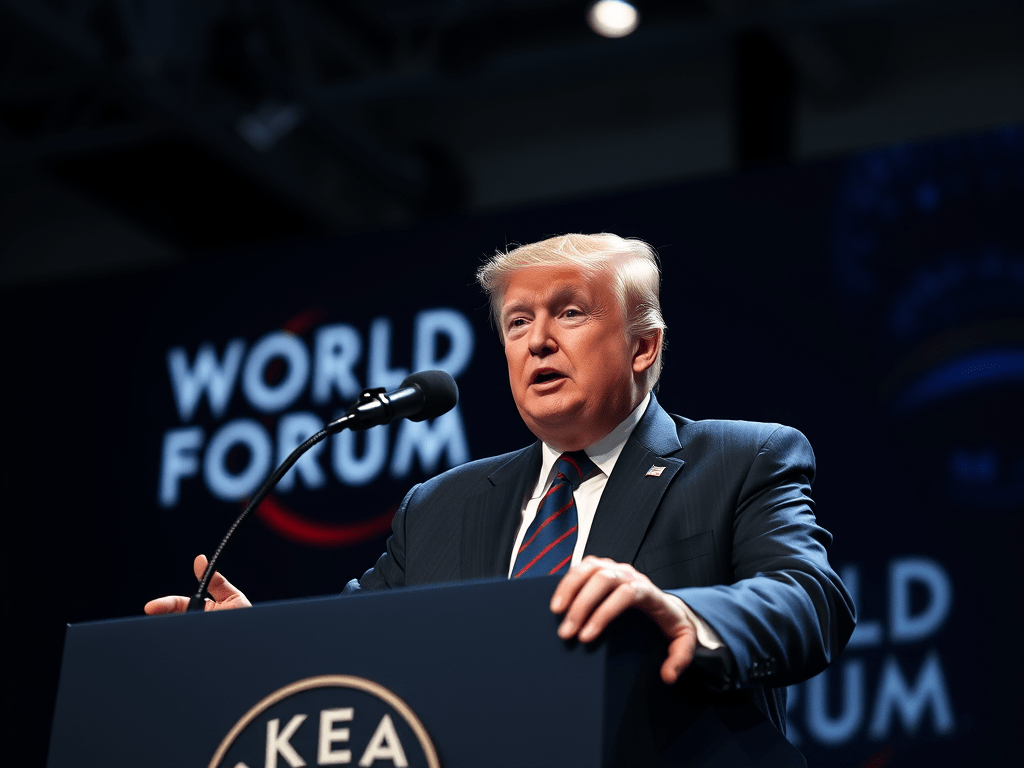
Image AI generated
When a leader rewrites allied sacrifice, it is not politics as usual, it is a breach of trust with families who paid the highest price.
Why I am writing this
In the UK, public debate is increasingly shaped by high confidence claims delivered at speed, often with minimal evidence. Davos 2026 gave us a concentrated example, a major political figure delivering a rapid sequence of assertions on NATO, Greenland, energy, elections, and the wider question of who is “owing” whom in international relationships.
The World Economic Forum published a full transcript of President Trump’s Davos 2026 address and stated it was generated using AI, then edited for clarity without changing the substance. That matters because this is not a media paraphrase. It is a direct record of what was said.
This piece separates what can be verified as accurate, what is demonstrably false, and what is misleading or unsupported. It also explains why these claims do real harm, not only to political discourse, but to alliances built on shared sacrifice.
Why this matters more than a single speech
Political speeches are not just words. In alliances, words become signals. They shape whether partners trust one another in a crisis. They shape whether deterrence holds. They shape whether the sacrifices of soldiers and their families are honoured or casually rewritten.
That is why this matters. The Davos transcript, combined with Trump’s remarks about NATO troops in Afghanistan, triggered sharp backlash in the UK and across allied circles. This is not hypersensitivity. It is what happens when a leader chooses to advance narratives that can be disproved, on subjects where the human cost is measured in dead and injured service personnel.
Fox News: Afghanistan, and why an apology is the minimum
Trump’s remarks suggesting NATO allies “stayed off the frontlines” in Afghanistan have been condemned by the UK Prime Minister as “insulting” and “frankly appalling”, with explicit calls for an apology.
This is not simply political disagreement. It is an allegation that diminishes the service of allied personnel who fought, were injured, and died. The UK’s official death toll is not a matter of opinion. The House of Commons Library reports 457 UK personnel died while deployed to Afghanistan, with 405 killed due to hostile action, Reuters reporting also referenced the 457 figure in the context of the diplomatic response.
When a US president implies allies did not fight, it lands directly on families who buried loved ones, and on veterans living with injury and trauma. An apology is not theatre, it is basic responsibility. If you benefit from alliance solidarity in war, you do not get to rewrite the record for domestic applause.
Burden sharing is a legitimate policy debate. Disparaging the dead to score a rhetorical point is not.
The claims, and the verdicts
To avoid getting lost in noise, here are the core Davos claims that can be checked.
- The US “gave Greenland back” to Denmark after WWII, false. The US never owned Greenland; it operated there under defence arrangements while Danish sovereignty remained intact.
- The US was paying “virtually 100% of NATO”, false. NATO common funded budgets are cost shared, the US share is about 14.9% in 2026.
- The US “never got anything out of NATO”, false. NATO invoked Article 5 after 11 September; allies supported US led operations and NATO missions.
- China makes wind turbines but has no wind farms, false. China is a leading wind power user and installer.
- Germany generates 22% less electricity than 2017, directionally true but imprecise. Fact checks cite a reduction closer to 25% from 2017 to 2025.
- Germany’s electricity prices are 64% higher than 2017, false. Fact checks cite increases nearer 29% to 35%, depending on dataset and time window.
- The UK produces about one third of the total energy from all sources compared with 1999, partly supported but potentially misleading due to definitional issues about “total energy” versus specific measures.
- The 2020 US election was rigged, false. Multiple investigations found no evidence of widespread fraud at the scale claimed.
- He has “settled eight wars”, misleading. Some ceasefires and agreements have occurred, but attribution and durability are contested, and several conflicts cited remain active or unstable.
What is demonstrably false, and why it is used
Several claims are not grey area arguments. They are straightforwardly false, and they follow a persuasive pattern.
Greenland, “we gave it back”
The US did not own Greenland, so it could not “give it back”. The rhetorical function is not accuracy. It is moral ownership, followed by grievance, we protected you, therefore you owe us.
NATO funding, “we paid 100%”
This is category confusion. It blends the fact that the US is the largest national defence spender with the false claim that the US pays for NATO itself. NATO has common funded budgets separate from national defence budgets; the US share is nowhere near 100%. This matters because blurring categories creates the illusion of betrayal, then justifies coercion or withdrawal as “fairness”.
China and wind power, “they do not use what they build”
This is a simple falsehood used to ridicule renewables by suggesting even the manufacturer will not adopt them. The problem is, China does have substantial wind deployment, so the claim collapses.
The 2020 election, “rigged”
This has been examined repeatedly by courts and investigations. Repeating it is not new information, it is a strategy: undermine trust in institutions, then reframe all counter evidence as part of the conspiracy.
This claim is contradicted by basic realities of the energy system. Fact-checkers cite sector reports showing that China leads global wind power installations and capacity. “China has five pilot floating wind projects in operation. The most recent
is Mingyang’s 16.6 MW V-shaped OceanX, which was installed in waters off Guangdong. In 2024, CRRC launched its 20 MW floating turbine, which was installed at an onshore testing site in Shandong province in early 2025.” See page 90 of the report.
The persuasive function here is to ridicule renewable energy by portraying it as something even the manufacturer will not use. The problem is, the claim is false.
4. “The 2020 election was rigged”
This is a repeat of a claim already examined extensively by courts and investigations. TIME summarises the position clearly, there is no evidence supporting the claim of a rigged election at the scale asserted
What is misleading or selectively framed
Not every line is invented. The more effective method is to mix a real trend with inflated numbers and simplified causality.
Germany’s energy claims illustrate this. Electricity generation is lower than 2017, but the headline figure appears selectively chosen. Electricity prices are higher, but the 64% increase figure does not match the datasets cited by fact checkers. The missing piece in speeches is context and causality, including the role of gas shocks linked to Russia’s full scale invasion of Ukraine.
This is persuasive misinformation. It does not rely on being wrong about everything. It relies on being right often enough that the audience carries the emotional conclusion, even when the numbers are distorted.
Why this accelerates separation from the US
Alliances depend on trust and predictability. When a leader repeatedly insults allies, distorts shared wartime history, and treats longstanding arrangements as though they were US property, allies begin to plan around volatility.
That planning does not always look like a dramatic rupture. It looks like quiet redundancy, more European procurement without US reliance, more contingency planning that assumes US support may be conditional, and more public hedging.
The effect is cumulative. Each episode makes the next one easier, because confidence does not reset automatically once it has been damaged.
What this means for the UK
The UK is currently living through heightened tension on migration and national identity, and you can see how international rhetorical patterns feed domestic debate. Frames like “we pay for everyone”, “we get nothing back”, and “they are freeloaders” travel fast and attach themselves to UK arguments about public spending, borders, and who counts as “deserving”.
The practical lesson is simple. When you hear a sweeping claim with a neat number, ask what is being measured, what definitions are being used, and what has been excluded to make the claim sound clean.
Fitness for office, the responsible way to frame it
No serious writer should diagnose a person’s mental health from speeches and clips, and I will not do that.
What we can assess is fitness for office in terms of judgement, restraint, and adherence to truth in matters of state. On that narrower, legitimate definition, Davos raises credible concerns.
- Repeated falsehoods that are corrected by multiple independent fact checks suggest disregard for accuracy or indifference to correction.
- Disparaging allied war dead damages the relationships the US relies on for global power projection, that is not only rude, it is strategically self harming.
- Treating alliances as transactional protection rackets encourages adversaries to test the seams, because adversaries notice disunity, and they exploit it.
So the more defensible question is not whether he is mentally fit. It is whether he demonstrates the judgement required for alliance leadership, especially when alliances are the architecture of deterrence.
Why these lies damage international relationships
The harm is concrete.
First, they insult allies and their citizens, creating political pressure inside allied democracies to distance themselves from Washington.
Second, they erode operational trust, because militaries must plan around political unpredictability.
Third, they poison negotiations, because partners harden positions and add verification steps when they believe facts will be misrepresented.
Fourth, they weaken deterrence by advertising disunity. Deterrence relies on the belief that allies will act together when it matters. Public contempt for allies chips away at that belief and invites adversaries to test the cracks.
The apology that should happen
If Trump wants to stabilise relations, he should apologise directly, explicitly, and without qualification to the families of allied personnel killed in Afghanistan, including British families, and to veterans who served alongside Americans. Not because Britain needs validation, but because truth and respect are the minimum moral currency of an alliance built on shared sacrifice.
If he cannot do that, he is signalling publicly that allied losses are negotiable and partnership is conditional. Europe will respond accordingly, by planning for greater distance and greater self reliance.
How to fact check speeches without losing your mind
A simple method:
- Extract only claims that are testable.
- Check whether the claim confuses categories, NATO budgets versus national defence spending is a prime example.
- Prefer primary documents and reputable fact checkers.
- Separate false from misleading. They require different responses.
- Do not argue with vibe, argue with definitions, datasets, and timelines.
References, short list
World Economic Forum (2026) Davos 2026 special address transcript.
Full Fact (2026) US contribution to NATO common funding.
House of Commons Library (latest briefing) Afghanistan statistics, UK deaths and casualties.
Euronews (2026) Fact checking Trump’s Davos speech.
TIME (2026) Fact checking Trump’s Davos speech and claims.
The Guardian (2026) Fact checking coverage of Davos claims.
 Curious Femme
Leave a comment