
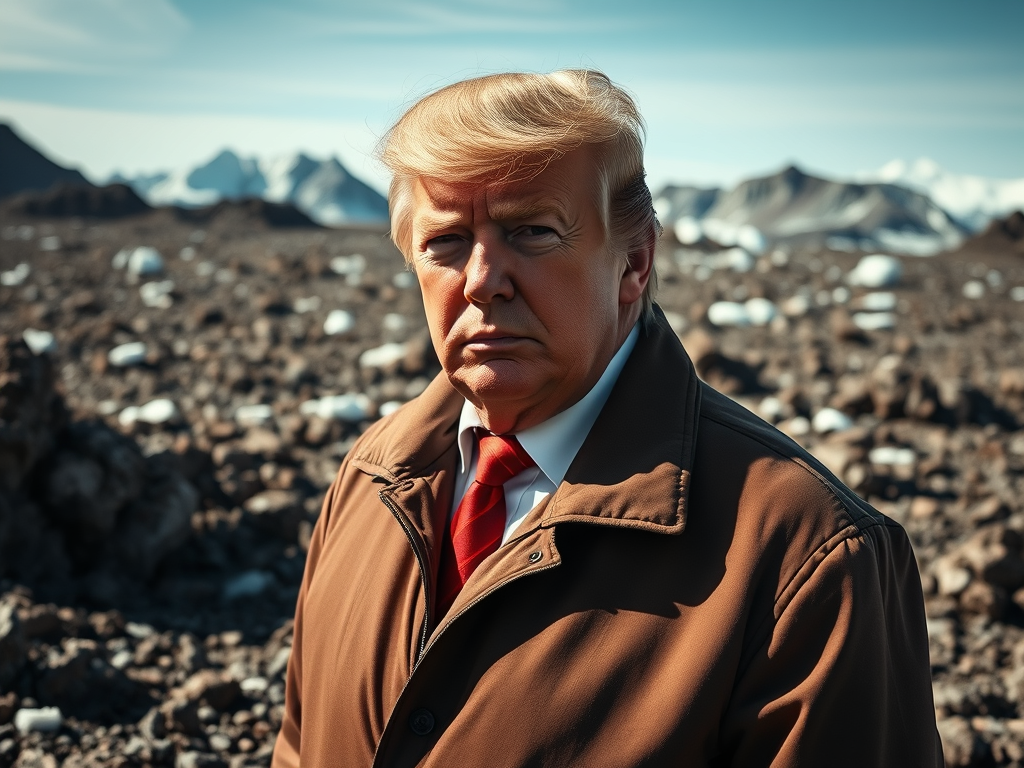
Image AI-generated
Greenland, Trump, and the Real Prize Under the Ice
When Donald Trump revived the idea that the United States should “get” Greenland, it is not a harmless provocation. It tests whether Western democracies will treat sovereignty as non-negotiable, or as a bargaining chip when strategic resources are involved. It also matters because it signals a broader shift in global politics: critical minerals and supply chains are becoming what oil once was, the material basis of power.
To analyse Trump’s fixation properly, it helps to separate what can be achieved through ordinary alliance cooperation from what requires something more, ownership, leverage, or control over licensing.
What Greenland has, and why it matters
A Reuters analysis notes that a 2023 survey found 25 of the 34 minerals classed by the European Commission as “critical raw materials” are present in Greenland. That matters because these materials sit at the heart of electrification, advanced manufacturing, and defence capability.
Key minerals and what they enable
Rare earth elements (REEs)
- Used for high-performance permanent magnets
- Essential for: wind turbines, electric vehicle motors, guidance systems, radar, precision electronics
- Strategic issue: global processing and supply chains are highly concentrated, creating vulnerability to export restrictions and geopolitical leverage
Graphite
- Crucial for battery anodes
- Relevant to: electric vehicles, energy storage, grid resilience
Copper and nickel
- Copper underpins electrification and grid expansion
- Nickel supports high-density batteries and industrial alloys
Zinc
- Central for galvanising steel and infrastructure durability
- Vital for construction and industrial resilience
Uranium
- Politically contentious in Greenlandic regulation, but strategically significant in energy and national capability debates
Gold and other metals
- Industrial and monetary value, plus electronics applications
Transition point: these minerals do not only “add value”, but they also shape who controls the upstream inputs for defence and the green transition. That is why the EU signed a strategic partnership with Greenland explicitly focused on raw materials and value chains.
Why Musk’s renewed alignment with Trump fits the minerals story
There is no evidence that Elon Musk has renewed ties with Donald Trump because of Greenland specifically. Framing the issue in those terms risks oversimplification. What matters more is the structural alignment of interests that has emerged as critical minerals replace oil as the strategic resource of the era.
Musk’s industrial model is fundamentally mineral-dependent. Tesla relies on lithium, nickel, graphite, copper, and rare earth magnets for electric vehicles and batteries. SpaceX depends on specialised alloys and strategic metals for launch systems and satellite infrastructure. Musk himself has repeatedly described mineral supply as a bottleneck for technological progress and has argued that extraction should be prioritised over environmental or political constraints.
Trump’s approach to Greenland maps neatly onto this worldview. His fixation is not on alliance management or incremental cooperation, but on ownership, leverage, and control. That logic is far more coherent in a resource frame than a defence one. Military access can be expanded through agreements, as Denmark has made clear. Control over mineral licensing, environmental thresholds, and long-term extraction policy cannot.
Seen through this lens, Musk’s softening towards Trump does not require coordination or conspiracy. It reflects a shared material logic: that strategic minerals justify deregulation, state intervention, and a loosening of traditional limits around sovereignty and consent. In a political economy increasingly shaped by supply chains, alignment follows incentives rather than values.
This does not make Musk the architect of Trump’s Greenland rhetoric, nor does it make Greenland the reason for their convergence. It simply places both actors within the same structural moment, one where control of upstream resources is treated as power, and where democratic norms are increasingly secondary to extraction.
The security argument, and why it is not enough on its own
There is a genuine strategic dimension to Greenland. The US operates Pituffik Space Base, which supports missile warning and missile defence through an upgraded early-warning radar system. That role is described directly by the US Space Force.
So a balanced analysis must acknowledge this: Greenland is not only about minerals, but it is also embedded in Arctic defence architecture.
However, the key critical thinking question is this: if Trump’s primary motive were defence, what would we expect him to prioritise?
We would expect him to prioritise alliance mechanisms that deliver defence outcomes without destabilising sovereignty.

Denmark’s position: a defence solution was available
Denmark’s public position has been consistent: Greenland is not for sale, and Arctic security should be strengthened through allied cooperation. Recent reporting indicates that Denmark is increasing military activity and investment around Greenland in response to the security environment.
Euronews captures the practical implication clearly: Denmark can authorise a substantial US troop presence and security arrangements on Greenland without any change in sovereignty
This becomes the hinge of the argument. If US security needs can be met through an expanded allied footprint and modernised agreements, then ownership of defence is not required.
Transition point: at this stage, the minerals explanation begins to outperform the security explanation because it explains why “more basing” is not a satisfying endpoint for Trump.
Why acquisition talk fits minerals better than defence
Defence access is typically achieved through agreements. Mineral control is governed by something else entirely.
Defence access can be secured via
- basing agreements
- joint surveillance and exercises
- shared infrastructure and interoperability
- defence treaties and compacts
Mineral leverage requires
- influence over licensing and regulation
- long term control over extraction decisions
- leverage over environmental constraints and project approvals
- power over which countries and firms develop, process, and export the material
This is why, when Denmark offers more security cooperation, it does not address the resource objective. Security can be expanded without ownership. Resource sovereignty cannot.
Counterarguments, and how strong they are
A credible post should stress test the minerals’ first conclusion
Counterargument 1: Trump is primarily motivated by Arctic defence and missile warning
This is plausible because Pituffik’s missile warning function is real, and Trump has explicitly claimed Denmark cannot be relied upon to protect Greenland.
Assessment: Defence relevance exists, but Denmark and NATO pathways already provide a route to deepen defence cooperation. The insistence on acquisition goes beyond what defence logic requires.
Counterargument 2: It is a bargaining tactic for basing rights or favourable agreements
Trump may be using maximalist rhetoric to force concessions.
Assessment: That may explain some rhetoric, but it still reinforces the minerals argument: the concessions most strategically valuable are likely to be investment and extraction-friendly conditions rather than purely military access, which the US already has
Counterargument 3: It is political theatre for domestic audiences
It may be designed to project strength.
Assessment: Even if true, it does not negate material incentives. Political theatre frequently selects targets that have real strategic value. Greenland’s critical mineral profile makes it a credible stage for that performance
Conclusion: the clearest takeaway
A balanced reading is:
- Greenland has real defence significance, including missile warning functions at Pituffik.
- Denmark is already increasing Arctic defence activity and has routes to expand US presence without any transfer of sovereignty.
- Trump’s continued focus on acquisition makes more sense as a minerals-and-leverage strategy than as a defence necessity, because defence can be secured through agreements, while mineral sovereignty cannot.
If you want the one-sentence summary: when a stated defence concern has an available allied solution, but the demand remains ownership, it is rational to suspect the real objective is control of what lies beneath the ground.
Sources used
Chatham House (2026) ‘If Trump wants 2026 to be a year of critical minerals collaboration, he must stop imperialist rhetoric on Greenland’. Available at: Chatham House website.
European Commission (2023) ‘EU and Greenland sign strategic partnership’. Available at: European Commission Press Corner.
Reuters (2025) ‘Denmark says it has neglected Greenland defence for years’. Available at: Reuters.
Reuters (2025) ‘Greenland’s rich, largely untapped mineral resources’. Available at: Reuters.
Reuters (2026) ‘Trump reiterates desire for Greenland following high stakes meeting’. Available at: Reuters.
Financial Times (2026) ‘Nato troops to be in Greenland on more permanent basis’. Available at: Financial Times.
Euronews (2026) ‘Mining, climate and smokescreens: What’s driving Trump’s interest in Greenland’. Available at: Euronews.
CSIS (2026) ‘Greenland, Rare Earths, and Arctic Security’. Available at: Center for Strategic and International Studies website.
Make a one-time donation
Make a monthly donation
Make a yearly donation
Choose an amount
Or enter a custom amount
Your contribution is appreciated.
Your contribution is appreciated.
Your contribution is appreciated.
DonateDonate monthlyDonate yearly Curious Femme
Leave a comment