
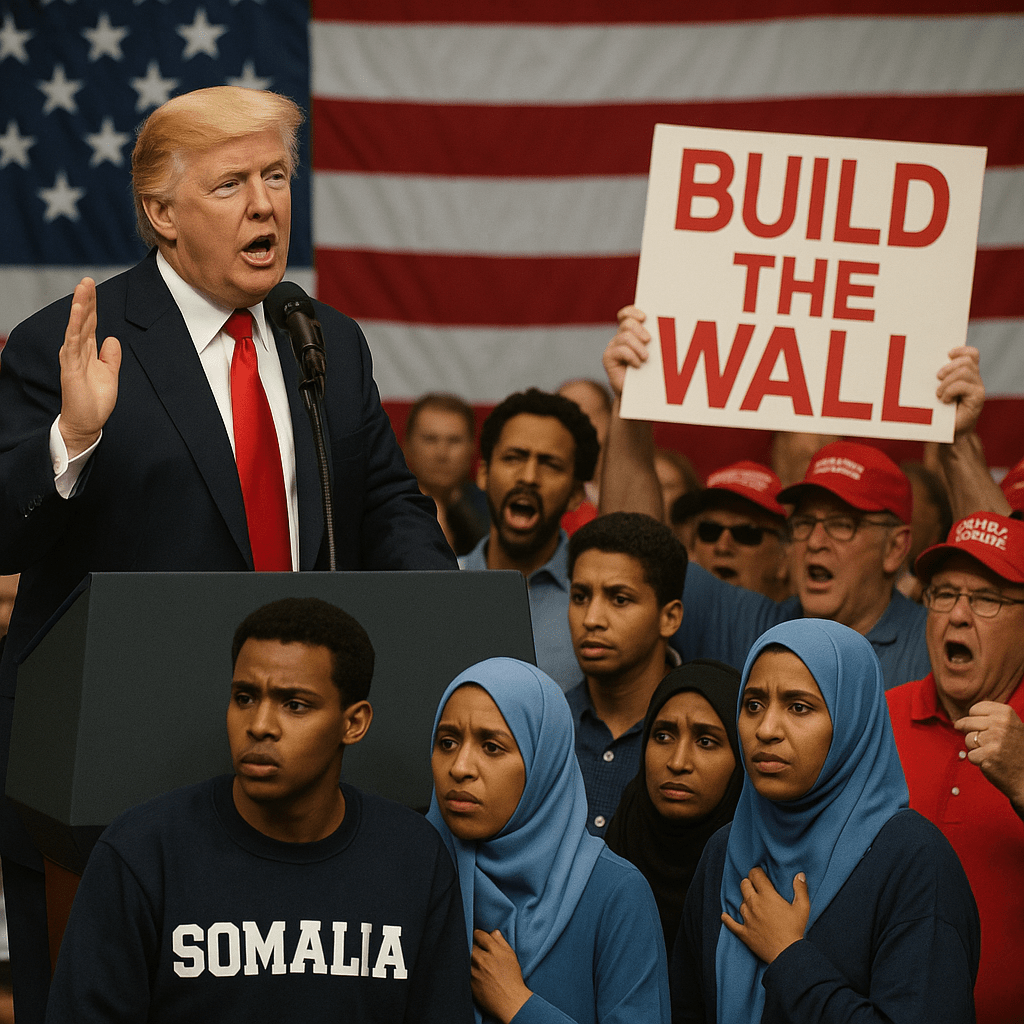
Donald Trump’s rhetoric about Somalia and Somali Americans has long been a flashpoint in American political life. From describing African nations as “shithole countries” to repeatedly singling out Somali communities in Minnesota, Trump has positioned Somalia as a symbolic threat to American identity, security, and cultural stability. Yet this political obsession with Somalia cannot be explained by crime statistics, security data, or public opinion. Instead, it reflects a broader political strategy rooted in populism, racial hierarchy, and fear-based mobilisation.
This article examines why Somalia became a focal point in Trump’s political messaging and how recent research (2020–2025) helps us understand the mechanisms behind such rhetoric.
1. Populism, Fear, and the Construction of an “Enemy”
Populist leaders often rely on constructing an external or internal threat to mobilise supporters. Immigration becomes a powerful political tool, particularly when linked to narratives of cultural erosion and national decline. According to recent analyses of populist discourse, anti-immigrant rhetoric is increasingly used in Western democracies as a way to harness fear, resentment, and perceived loss of social status (Erudit, 2025).
Trump’s political strategy fits squarely within this framework. By depicting Somalia as chaotic, dangerous, or culturally incompatible with the United States, he created a symbolic enemy that could unify certain voter blocs. Importantly, Somalia was not chosen because of any unique threat it poses, but because it served a rhetorical function: a majority-Muslim, Black African nation with a significant refugee diaspora.
2. Somalia and the “Muslim Ban”: Constructing the Myth of Dangerous Refugees
Early in Trump’s presidency, Executive Order 13769, widely known as the “Muslim Ban”, restricted immigration from several Muslim-majority countries, including Somalia. Somalia remained on every iteration of the ban.
The justification offered by Trump officials centred on claims of national security risk. However, independent analysis contradicts this. A comprehensive review by the Cato Institute found that no Somali refugee had committed a lethal terrorist attack on US soil, and the overall terrorism risk posed by refugees was statistically negligible (Nowrasteh, 2017).
The inclusion of Somalia therefore appears to reflect political signalling, rather than evidence-based risk assessment. It allowed Trump to reinforce the idea that he was defending the nation from dangerous outsiders.
3. Targeting Somali Americans: Crime, Culture, and the Politics of Fear
Throughout his campaigns, Trump frequently referenced Somali American communities, particularly in Minnesota. These remarks typically portrayed Somali refugees as burdensome, criminal, or culturally incompatible with American society.
In the last five years, researchers have documented the increasing toxicity of immigration discourse on digital platforms. A 2025 study analysing over 4 million social media posts on US immigration found that fear-based, dehumanising, and conspiratorial narratives tend to expand over time, crowding out more balanced or factual discussions (Joh, Li and Hemsley, 2025).
This phenomenon creates a feedback loop:
- Politicians use inflammatory language about immigrants.
- Social media amplifies and distorts these claims.
- Heightened public hostility then justifies further political escalation.
Somali Americans are particularly vulnerable in this environment because they embody identities, Black, Muslim, immigrant, that the far-right often portrays as incompatible with American culture. Online hostility directly reinforces Trump’s rhetorical framing, creating a sense of crisis that does not exist in reality.
rump repeatedly invoked Somali American communities in Minnesota when discussing crime, integration, and national identity. He asserted that Somali refugees were responsible for rising crime, social disorder, or cultural fragmentation. These claims were politically effective in appealing to voters anxious about demographic change, particularly in Midwestern states.
However, evidence does not support these assertions. Longitudinal criminological studies demonstrate that immigrants, documented or undocumented, commit fewer violent crimes than native-born Americans (Light and Miller, 2018). Local Minnesota crime statistics also show no disproportionate criminal activity linked to Somali residents.
The narrative of Somali criminality therefore serves a symbolic function rather than a factual one. It allows political actors to frame multicultural communities as destabilising, irrespective of data.
4. The “Shithole Countries” Comment: Racial Hierarchies in Foreign Policy
In January 2018, during a closed-door immigration meeting, Trump reportedly referred to Somalia, Haiti, and several African nations as “shithole countries.” Multiple officials confirmed the statement (Dawsey, 2018).
Analysts widely interpret this remark through a racial lens. It contrasted “undesirable” African and Caribbean immigrants with those from Norway, a predominantly white nation Trump explicitly praised during the same discussion. This reflects a racialised hierarchy of immigrant desirability, rooted in notions of whiteness and Western superiority.
Such rhetoric is not unique to Trump; it reflects a broader populist trend of depicting non-Western nations as inherently inferior, thereby justifying restrictive immigration policies (Wodak, 2015). However, Trump’s phrasing was unusually explicit in revealing the underlying racial logic.
5. Electoral Strategy: Mobilising Fear to Win Votes
The intensification of Trump’s rhetoric against Somalia coincided with election cycles. This is noteworthy, as populist candidates often amplify narratives of crime and cultural threat to mobilise voter turnout (Norris and Inglehart, 2019).
Somali refugees became a political device used to:
- portray Democrats as reckless on immigration
- invoke fear around terrorism and crime
- symbolise cultural transformation in “heartland” America
- reinforce Trump’s role as a defender of “traditional America”
This strategy relies on othering—portraying a minority group as incompatible, dangerous, or alien. Somali Americans were positioned as the embodiment of these narratives.
6. Why Somalia Specifically? Symbolism and Scapegoating
While many countries could have been targeted, Somalia occupies a symbolic place in Trump’s rhetoric:
- A predominantly Muslim country
- Historic conflict and state instability
- A visible refugee population in the US
- A Black, Muslim, immigrant congresswoman (Ilhan Omar) representing a major Somali American district
Trump’s rhetoric about Somalia intensified significantly following the election of Ilhan Omar, a Somali-born Muslim woman representing Minnesota’s 5th congressional district. Omar embodies intersecting identities that challenge traditional power structures, immigrant, Black, Muslim, refugee, and progressive.
Her presence in Congress became a flashpoint for Trump, who repeatedly used her political visibility to energise his base. In this context, Somalia functioned not merely as a country but as a proxy for Omar’s identity. Attacks on Somalia and Somali Americans allowed Trump to attack Omar indirectly while reinforcing narratives about loyalty, integration, and Americanness (Beauchamp, 2019).
7. Consequences for Somali Americans: Real-World Harm
The consequences of this rhetoric are tangible. Hate crimes against African immigrants and Muslims rose during Trump’s presidency (FBI, 2018; 2019). Somali Americans reported increased harassment, employment discrimination, and fear in public spaces.
The Somali community has long contributed to American society through entrepreneurship, public service, and cultural life. Yet Trump’s rhetoric painted them as perpetual outsiders, undermining their sense of belonging and exposing them to greater risk.
Rhetoric has power. It shapes policy, influences policing, legitimises hostility, and alters the social environment in which marginalised groups must navigate their daily lives..
8. Public Opinion Is Not as Hostile as Trump Claims
A recent study analysing 2024 US election data found that public attitudes toward immigration are not uniformly negative. In fact, individuals who are more politically engaged tend to express more positive views on legal immigration, regardless of party affiliation (Afzal and Omosun, 2025).
This finding disrupts the narrative that harsh immigration rhetoric reflects broad public consensus. Instead, it suggests that anti-Somali messaging is amplified by political elites, not demanded by the electorate. While some segments of the population resonate with fear-based narratives, they do not represent the majority.
Conclusion
Donald Trump’s targeting of Somalia and Somali Americans cannot be explained by national security concerns or crime statistics. Instead, it reflects a calculated political strategy rooted in racialised narratives, populist mobilisation, and the use of fear to consolidate support.
Somalia became a symbol, a canvas onto which broader anxieties about immigration, Islam, Blackness, and multiculturalism were projected. The “shithole countries” remark, far from an isolated insult, exposes the underlying worldview shaping Trump’s immigration policy: a vision of America defined by exclusion, hierarchy, and racialised boundaries of belonging.
Understanding this rhetoric is essential in resisting its effects and recognising the ways political leaders deploy language to marginalise vulnerable communities.
References (Harvard Style)
Afzal, M.H.B. and Omosun, F. (2025) Who Gets to Come In? How Political Engagement Shapes Views on Legal Immigration. Available at: https://arxiv.org/abs/2504.03768 (Accessed: December 2025).
Beauchamp, Z. (2019) ‘Trump’s attacks on Ilhan Omar, explained’, Vox, 30 July.
Dawsey, J. (2018) ‘Trump derides protections for immigrants from “shithole” countries’, The Washington Post, 12 January.
Erudit (2025) Navigating Immigration in an Era of Rising Populism. Journal of Contemporary Immigration Management, 28(1), pp. 1–21.
FBI (2018) Hate Crime Statistics 2017. Washington, DC: US Department of Justice.
FBI (2019) Hate Crime Statistics 2018. Washington, DC: US Department of Justice.
Joh, U., Li, Y. and Hemsley, J. (2025) How Growing Toxicity Manifests: A Topic Trajectory Analysis of U.S. Immigration Discourse on Social Media. Available at: https://arxiv.org/abs/2507.21418 (Accessed: December 2025).
Iyengar, S. and Massey, D. (2019) ‘Scientific communication in a post-truth society’, PNAS, 116(16), pp. 7656–7661.
Kinder, D. and Kam, C. (2017) Us Against Them: Ethnocentric Foundations of American Opinion. Chicago: University of Chicago Press.
Light, M. and Miller, T. (2018) ‘Does undocumented immigration increase violent crime?’, Criminology, 56(2), pp. 370–401.
Mudde, C. and Kaltwasser, C. (2017) Populism: A Very Short Introduction. Oxford: Oxford University Press.
Nowrasteh, A. (2017) ‘Terrorism and immigration: A risk analysis’, Cato Institute Policy Analysis, no. 798.
Norris, P. and Inglehart, R. (2019) Cultural Backlash: Trump, Brexit, and Authoritarian Populism. Cambridge: Cambridge University Press.
Perry, B. (2018) ‘Hate crime in Trump’s America’, Journal of Hate Studies, 14(1), pp. 11–40.
Wodak, R. (2015) The Politics of Fear: What Right-Wing Populist Discourses Mean. London: Sage.Afzal, M.H.B. and Omosun, F. (2025) Who Gets to Come In? How Political Engagement Shapes Views on Legal Immigration. Available at: https://arxiv.org/abs/2504.03768 (Accessed: December 2025).
 Curious Femme
Leave a comment