
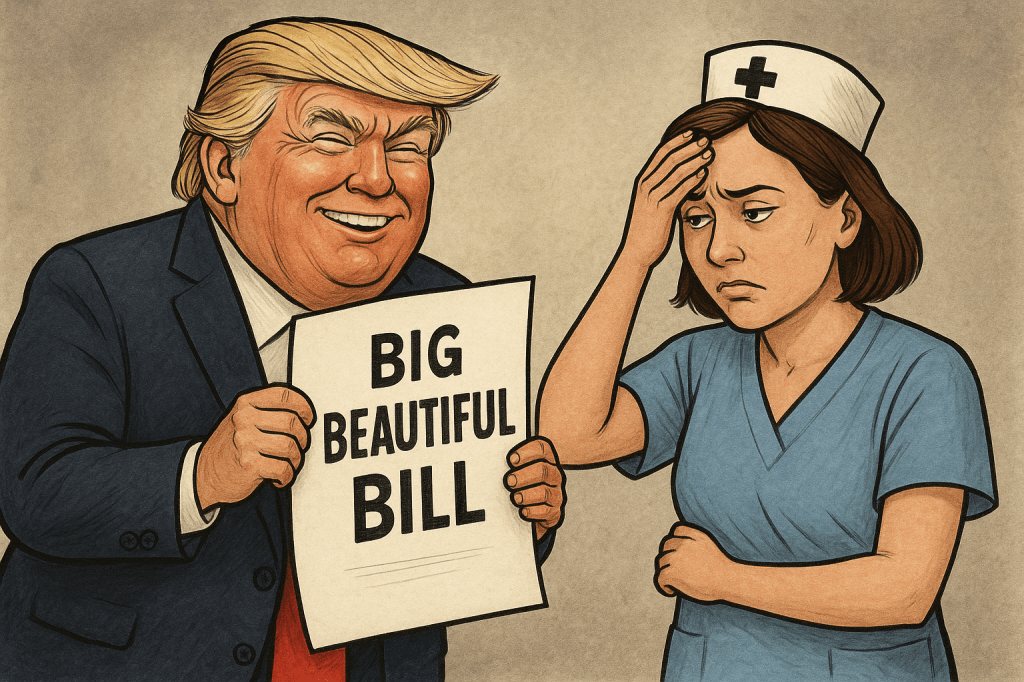
The U.S. Department of Education under the Trump administration has proposed revisions to graduate student lending that will significantly change how students finance advanced degrees. These changes classify eleven fields, including medicine, dentistry, pharmacy and veterinary medicine, as “professional degrees”, giving them higher borrowing caps of up to US$50,000 per year and US$200,000 in total. All other graduate programmes are capped at US$20,500 per year and US$100,000 overall. Notably, nursing is excluded from the list of professional degrees, and this decision has prompted concern across the health sector and raised questions about gendered value in professional education.
Background: The Professional Degree Framework
The Department’s proposal distinguishes “professional degrees” as programmes that require extensive academic preparation and direct professional licensure. Its list includes medicine, dentistry, law, veterinary medicine, pharmacy, optometry, osteopathic medicine, podiatry, chiropractic, naturopathic medicine and clinical psychology. These fields retain access to higher federal loan limits, while graduate programmes outside this list, such as nursing, social work and engineering, face restricted borrowing. The Department has defended the framework by noting that around 95 per cent of nursing students already borrow less than the new cap, arguing that the new limits are not value judgements about these professions but a mechanism to encourage institutions to contain tuition costs.
Impact on Nursing Education and the Health Workforce
Excluding nursing from the professional degree category has immediate implications for those pursuing advanced practice degrees. Master’s and doctoral nursing programmes often cost over US$40,000 per year, a figure that exceeds the proposed loan cap. The American Association of Colleges of Nursing (AACN) warns that capping borrowing will constrain opportunities for nurse practitioners, nurse midwives and nurse anaesthetists, roles that require graduate education and are essential to meeting healthcare demand, particularly in rural communities. Nurse shortages are already acute, with forecasts indicating deficits of tens of thousands of nurses in several states. Limiting financial aid risks deterring prospective students from entering or advancing within the profession.
A Feminist Perspective: Gendered Valuation of Care Work
Nursing is one of the most female‑dominated professions. A Royal College of Nursing report notes that the profession emerged from a gendered division of labour in which medicine was framed as men’s work and nursing was coded as an extension of women’s domestic duties. Early definitions of nursing emphasised obedience and moral virtue, reinforcing a hierarchical relationship with physicians and legitimising low wages and limited professional autonomy. Contemporary gender norms continue to affect perceptions of nursing. Women account for around 70 per cent of the global health workforce and 89 per cent of nurses, yet they hold only 25 per cent of senior leadership positions and experience a 24 per cent gender pay gap. Public narratives that undervalue nursing as “women’s work” discourage both men and women from entering the fieldand perpetuate the idea that caring and emotional labour are less worthy of investment.
From this perspective, the Department’s decision to exclude nursing from professional status echoes a long‑standing tendency to privilege male‑dominated, ‘scientific’ professions over female‑dominated care work. By granting higher borrowing limits to medicine, dentistry and engineering while restricting loans for nursing, the policy reinforces hierarchies that undervalue the knowledge and autonomy of nurses. Critics such as the American Nurses Association argue that advanced nursing practice requires rigorous training, licensure and clinical judgement akin to other health professions; excluding it from professional classification undermines parity and could exacerbate existing gender inequities.
Wider Societal Effects and Advocacy
The decision has sparked a groundswell of opposition from nursing schools, professional associations and student groups. Beyond individual students, the policy poses risks to public health, particularly in rural and underserved areas where advanced practice nurses provide vital primary care. Failure to invest in nursing education could widen health disparities and impede efforts to improve maternal health, mental health and chronic disease management.
Advocates urge the Department to recognise nursing as a professional degree, emphasising that it meets the criteria for licensure and direct patient care. They note that the regulation has not yet taken effect and may be revised following public comment. There is also a call for broader cultural change: recognising the intellectual and emotional labour of nursing, increasing representation of women in leadership across the health sector, and addressing structural biases that perpetuate pay gaps and inequities.
Conclusion
Trump’s Department of Education reforms on student lending introduce a new hierarchy of professions that distinguishes between those deemed “professional” and those that are not. By excluding nursing from the professional category, the policy not only limits financial aid for future nurses but also reflects a deeper societal pattern of undervaluing women’s work. A feminist lens highlights how such policies intersect with longstanding gender norms, reinforcing a hierarchy that privileges predominantly male professions and obscures the expertise and autonomy inherent in nursing. To ensure an equitable and sustainable healthcare workforce, policymakers should re‑evaluate the classification of professional degrees, address gender biases in valuation and invest in pathways that support nurses at all levels of education.
 Curious Femme
Leave a comment