
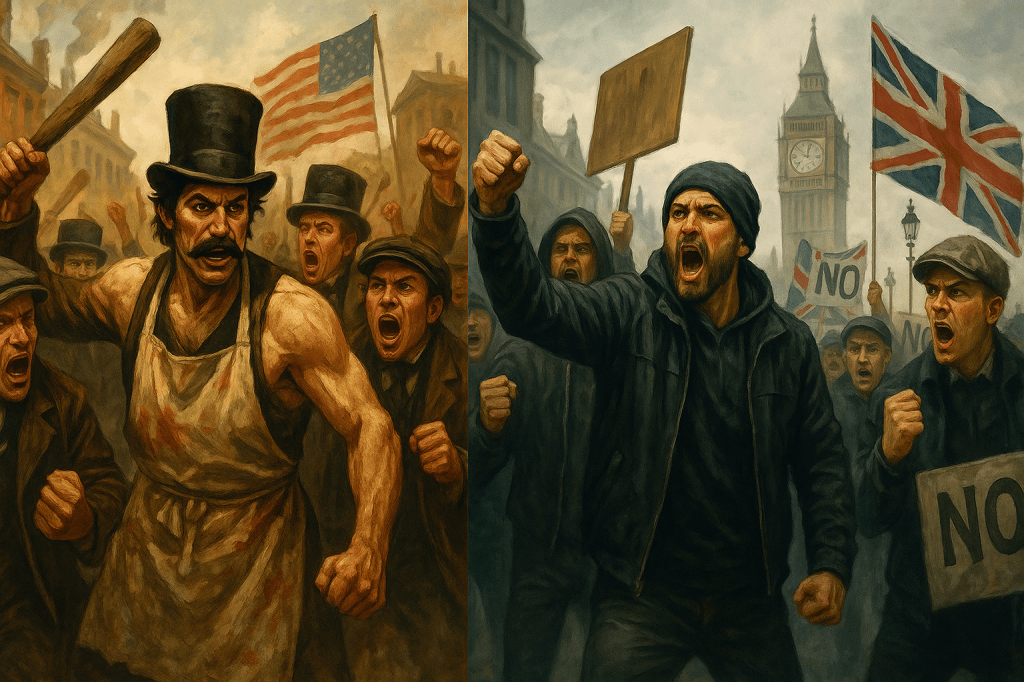
I was watching the film Gangs of New York and could not help but notice the comparisons with today’s politics. So I decided to do some research. The film’s violent antagonist, “Bill the Butcher,” was inspired by a real historical figure, William Poole, who led a nativist gang in mid-19th-century New York City. In the 1800s, Poole became notorious for his anti-immigrant crusade against Irish Catholic newcomers. Today, similar anti-immigration sentiments have resurfaced in the United Kingdom, where a mass protest in London in 2025 highlighted the growing boldness of far-right, anti-migrant movements. This article examines William Poole’s brand of American nativism and compares it with contemporary British anti-immigration movements, focusing on the 2025 London protest. Despite the vastly different contexts, the parallels in rhetoric, fears and nationalist fervour are striking, even as significant differences remain. The aim is to maintain an accessible discussion with scholarly rigour, showing how history can illuminate present challenges.
William Poole and 19th‑Century American Nativism
William Poole (1821–1855), nicknamed “Bill the Butcher,” embodied the fierce nativist backlash against immigration in mid-19th-century America. He presented himself as a “home-born” American and rallied like-minded young men into the Bowery Boys gang, which harassed and attacked recently arrived immigrants, especially Irish Catholics. In the wake of Ireland’s Great Famine, Irish Catholic immigration to the U.S. surged; by the 1850s, more than half of New York City’s population was Irish Catholic. Nativists like Poole feared that these Catholic “papists” would “undermine [Protestant] liberty” and outnumber America’s old Protestant stock. They spread wild conspiracy theories, such as the hoax that Catholic priests were raping nuns and burying their illicit offspring, to stoke public hysteria. The nativists’ core conviction was that the country “was pretty well full, so that newcomers were not welcomed”, an early expression of the “immigrants will overwhelm us” mentality.
Poole was more than just a street brawler; he became a local political enforcer for the nativist movement. He and his Bowery Boys were allied with the secretive Order of the Star-Spangled Banner, better known as the Know Nothing movement, America’s first major anti-immigrant political party. The Know Nothings believed that only native-born Protestant Americans should wield power, and they sought to disenfranchise immigrants and Catholics by extending citizenship waiting periods and barring Catholics from public office. Members swore oaths and, if asked about the party’s activities, would coyly answer “I know nothing,” giving the movement its nickname. At its mid-1850s height, the American Party (also known as the Know-Nothings) elected dozens of U.S. congressmen, several governors, and city officials, riding a wave of anti-immigrant sentiment. As one historian noted, Know Nothing leaders promised to restore an idealised vision of America “ruled by…Protestant…virtues”, effectively aiming to “Make America Great Again” by focusing on immigration as the nation’s chief threat.
Violence and vigilantism accompanied this nativist upsurge. Poole’s gang engaged in frequent street fights and even full-scale riots against Irish immigrant gangs like the “Dead Rabbits” in New York slums. He earned fame as a bare-knuckle boxer and was known for extremely brutal tactics, including eye-gouging and knifings, which made him a celebrity in the penny press. Nativist gangs intimidated immigrant voters at polling places and attacked immigrant businesses. Certain politicians tacitly accepted this thuggery. Poole himself briefly held a local office (a ward constable and later a Board of Education post) and was the Whig Party’s nominee for alderman in his district, showing how nativist sentiment penetrated even mainstream politics.
Poole’s death turned him into a martyr of the nativist cause. In early 1855, he was shot by an Irish-born rival and died, reportedly declaring, “Goodbye boys, I die a true American”. At his funeral, a massive procession of 155 carriages and some 6,000 mourners, including sympathetic politicians and firemen, followed his flag-draped coffin through New York’s streets. The slogan “I die a true American!” was emblazoned on his hearse, encapsulating nativists’ self-image as patriots defending their country’s purity. Newspapers noted that New York had “never before seen such an occasion” for a fallen gang leader. Poole’s admirers hailed him as a hero who had “sacrificed his life to protect fellow citizens from the perils of Catholic immigration”, in the words of one contemporary tribute. In reality, Poole was a violent vigilante, but to his followers, he became the symbol of a movement that saw immigrants as an existential threat to the American way of life.
Historians have characterised the ideology underpinning Poole’s nativism as a blend of xenophobia, religious intolerance and exaggerated nationalism. The Know Nothings insisted that Catholic immigrants were beholden to a foreign pope and incapable of loyalty to American democracy. They warned that an “alien riffraff” of poor immigrants would take jobs from native workers and degrade Protestant moral standards.
Notably, these nativists did not oppose all immigration; they originally welcomed Protestant immigrants from England or Germany, for instance, but they drew the line at groups they considered “alien” in religion or culture. The Irish, being both Catholic and largely impoverished, fit the bill as the prime enemy. This prejudiced worldview led to discriminatory proposals: the Know Nothings pushed to enforce 21-year residency requirements for citizenship, to bar naturalised citizens from voting or holding office until they had “proven” themselves, and to subject Catholic churches and convents to invasive government inspections. In 1854–55, the Know Nothing Party actually seized power in several states (including Massachusetts) and enacted some of these harsh measures. Although the party collapsed by 1856 due to internal divisions (especially over slavery), its brief success demonstrated how quickly a populist anti-immigrant movement could disrupt American politics. The “immigration panic” of the 1850s was the Western world’s first major outbreak of nativist politics, and it left a legacy of xenophobic rhetoric that would recur in later eras.
Contemporary Anti‑Immigration Movements in the UK
In recent years, the United Kingdom has witnessed a surge of anti-immigration sentiment and far-right activism that echoes some of the themes of 19th-century nativism, albeit in a new guise. Especially by the mid-2020s, immigration has become one of the most polarising political issues in Britain, fuelled by anxieties over refugees and asylum seekers arriving in record numbers and by populist rhetoric in politics and media. Mainstream politicians have themselves pushed hard-line messages; for example, the slogan “Stop the Boats” became a government rallying cry to halt asylum seekers crossing the English Channel, creating an atmosphere in which far-right groups feel emboldened to take even more extreme action (Addley 2025). Observers describe this period as “a dangerous moment” in which nationalist and xenophobic elements are unusually confident, waving flags and staging demonstrations with relatively little pushback from the political establishment (Addley 2025). The result has been a sharp increase in anti-migrant street protests and even outbreaks of disorder across the UK.
One flashpoint has been the use of hotels and former military bases to house asylum seekers. Since 2021, small local protests against these accommodations began occurring, but by 2023–2025, they coalesced into a national wave of anti-asylum demonstrations (Malik 2025). Far-right organisations seized on isolated incidents, for example, the arrest of an asylum seeker in Epping for an alleged crime, to paint all refugees as dangerous and to mobilise residents against nearby migrant housing. In early 2023, an anti-refugee protest outside a hotel in Knowsley turned into a riot that saw a police van torched and officers injured. By 2025, such protests had spread to dozens of sites, from small towns to major cities, often under banners like “[Town] Says No” or “Mass Deportations Rally” in a tour organised by fringe political parties. These demonstrations typically featured crowds of local residents alongside hardcore far-right activists from groups such as Britain First, Patriotic Alternative and others that openly espouse anti-immigrant, ethno-nationalist views (Addley 2025). In other words, much as Poole’s nativists co-opted local frustrations in the 1850s, today’s extremist groups have piggybacked on community concerns (about housing, resources or isolated criminal cases) to advance a broader xenophobic agenda.
A hallmark of the modern movement is the role of misinformation and online propaganda. Whereas 19th-century nativists relied on lurid pamphlets and tabloids, today’s agitators exploit social media to amplify fears about immigrants. False rumours about asylum seekers, painting them all as criminals, terrorists, or a threat to British children, spread rapidly on Facebook, Telegram and X (formerly Twitter), often encouraged by far-right influencers (Malik 2025). Notably, tech mogul Elon Musk used his platform in 2024–25 to promote alarmist narratives about immigration, even tweeting that “civil war is inevitable” in Britain amid refugee-related unrest (Malik 2025). This is strikingly reminiscent of the conspiracy thinking of Poole’s era, such as the “Papist plots” trope; in both cases, reality is distorted to portray immigrants as invaders destroying the nation from within. Gary Younge, a British sociologist, observed that while not all modern xenophobia is explicitly racial, “in Britain, race and immigration have always been linked”, meaning anti-immigrant campaigns inevitably fuel racist abuse, especially against non-white or Muslim minorities (Malik 2025). For instance, a supposedly localised protest about a migrant hostel often comes laced with Islamophobic rhetoric and sometimes spills over into harassment of longstanding minority communities. This broad-brush targeting of anyone perceived as “other” mirrors the way 19th-century nativism, ostensibly about religion or politics, fed into a wider prejudice against the Irish as an ethnic group.
Politically, the UK’s anti-immigration wave has found both fringe and mainstream outlets. On the fringe, figures like Tommy Robinson (real name Stephen Yaxley-Lennon), previously known for leading the English Defence League street movement, have rebranded themselves as leaders of a self-styled “patriotic” resistance to immigration. At the same time, the legal political party Reform UK has capitalised on anti-immigrant sentiment to achieve unexpected popularity in opinion polls (Al Jazeera, 2025). By late 2025, some polls even suggested Reform UK could become the largest party in a new election, capitalising on public dissatisfaction with both the government and opposition’s immigration policies (Al Jazeera 2025). This has parallels to the Know Nothing political insurgency of the 1850s, which disrupted established party loyalties by making anti-immigration fervour a galvanising electoral issue (Connolly 2022). Just as the Know Nothings arose rapidly and won offices on the back of nativist anger, we see today a reshaping of Britain’s political landscape where a significant segment of voters prioritise anti-immigration policies, pressuring even mainstream parties to harden their stances.
The 2025 London Protest: A Modern Nativist Rally
These trends culminated dramatically in a major protest in London on 13 September 2025, which underscored the scale and organisation of Britain’s contemporary anti-immigration movement. On that day, an estimated 110,000 to 150,000 people marched through central London under the banner “Unite the Kingdom,” in one of the largest far-right demonstrations in modern British history (Al Jazeera 2025). The event, organised by Tommy Robinson and his supporters, far exceeded authorities’ expectations and required 1,600 police officers to manage. Clashes erupted as some protesters attempted to breach police lines, resulting in 26 officers injured (with several serious injuries, including concussions and broken bones) and at least 25 arrests (Al Jazeera 2025). These scenes, masses of flag-waving protesters and outbursts of violence against law enforcement, were eerily reminiscent of the street brawls and riots that characterised Poole’s era, though on a much larger scale.
The symbolism and rhetoric on display in London would have been familiar to a 19th-century nativist. Demonstrators carried a sea of national flags, not only the Union Jack and the English flag of St. George, but strikingly also a number of American flags and even Israeli flags, reflecting a transnational alliance of rightwing causes (Al Jazeera 2025). Some attendees wore red “Make America Great Again” caps, explicitly echoing the slogan of former U.S. President Trump as a badge of anti-establishment, anti-immigrant sentiment (Al Jazeera 2025). This nod to American-style nativism is notable: it shows British activists identifying with a broader Anglophone far-right narrative, almost as if today’s British movement sees itself as an heir to the nativist tradition that Poole once embodied. One could not ask for a more literal parallel than MAGA caps at an anti-immigrant rally – given that back in 1856, Poole’s Know Nothing followers were essentially claiming to “make America great” by purging it of supposedly disloyal immigrants.
Speakers at the London rally painted a dire picture of a nation under siege from immigration. Tommy Robinson declared to the crowd, “Today is the spark of a cultural revolution in Great Britain. This is our moment”, insisting that “a show of patriotic unity” on this scale had never been seen before in the country (Reuters 2025). He and others railed against the government’s handling of immigration, accusing authorities of betraying the British people. Robinson claimed migrants had more rights in court than native Britons and that “the people that built this nation” were being silenced, a rhetoric clearly designed to cast immigrants as undeserving usurpers of the nation’s heritage (Al Jazeera 2025). Such rhetoric closely mirrors the populist demagoguery of Poole’s time, when nativists argued that Irish Catholics, beholden to “foreign” values, would undermine American democracy and needed to be kept out of power. In both cases, the narrative is “We (the real citizens) are being displaced in our own country by them (the foreign invaders), and we must ‘take our country back.’”
The London demonstration also had an international cast. In a surreal turn, Elon Musk addressed the rally via video link, lending his support to the protesters and calling for Britain’s government to be changed (Al Jazeera 2025). French far-right politician Éric Zemmour spoke about the discredited “Great Replacement” conspiracy theory, claiming that white Europeans are being deliberately “replaced” by non-white, Muslim immigrants, drawing loud approval from the crowd (Al Jazeera 2025). This theory, in essence, a modern re-packaging of the old nativist fear of being demographically overrun, has become a rallying cry for far-right movements globally. Indeed, as historian Sean Connolly notes, “Where modern polemicists warn of a Great Replacement, 19th-century American nativists [similarly] painted lurid pictures of an America conquered for the Catholic Church” – the underlying fear of societal annihilation is the same (Connolly 2022). Hearing Zemmour in London in 2025, one is reminded of the Know Nothing pamphleteers who warned that a Catholic-controlled empire would take over the United States. The continuity of these paranoid fantasies, from “Papists stealing our country” in 1855 to “Muslim migrants replacing us” in 2025, underscores how deep-seated and recurrent nativist tropes can be.
Multiple far-right factions unified for the London march. Anti-immigrant activists from across England, Scotland and even abroad converged, ranging from veteran street agitators to ordinary citizens radicalised online. Joe Mulhall of the anti-racist group Hope Not Hate observed that it was “probably… the largest far-right demonstration ever in Britain,” uniting “multiple factions within the far-right” as well as new recruits (Al Jazeera 2025). This is reminiscent of how disparate nativist gangs and political actors in the 1850s coalesced under the Know Nothing umbrella – putting aside other differences to form a united front against immigrants.
The scale of 110,000+ protesters also invites comparison to Poole’s time: while New York’s population in 1850s was much smaller, the nativist movement then also mobilised large numbers, for example, Poole’s funeral drew thousands, and Know Nothing rallies filled halls with supporters. Both then and now, we see that anti-immigrant sentiment, when sufficiently stoked, can move masses of people into the streets, not merely fringe extremists.
At the London event, the crowd’s attitudes ranged from peaceful to overtly aggressive. Many protesters carried placards reading “Send them home” and chanted hostile slogans about refugees (Reuters 2025). A number of participants, interviewed by the media, framed their motivation in terms of patriotism and self-defence: “We want our country back; we want our free speech back,” one woman told a reporter, while another said she came because “They need to stop illegal migration into this country” (Reuters 2025). The refrain “We believe in Tommy” was also heard, effectively serving as a personal loyalty pledge to Robinson as a folk hero (Reuters, 2025). In this personality cult aspect, one might even liken Robinson to William Poole, who in his day was lionised by followers as the champion of “real Americans.”
Meanwhile, counter-protesters from anti-racist groups (such as Stand Up To Racism) held a much smaller rally of around 5,000 nearby, carrying signs like “Refugees Welcome” and “Smash the Fascists” (Al Jazeera 2025). They were kept apart from Robinson’s marchers by police, but even so, there were reports of counter-demonstrators being assaulted by some of the far-right attendees (Al Jazeera 2025). This dynamic – two opposing camps shouting past each other – highlights how divisive the issue has become in Britain. It also echoes the fiercely partisan climate of Poole’s New York, where immigrant-backed Tammany Hall Democrats and nativist gangs like the Bowery Boys were literally at each other’s throats.
The aftershocks of the London rally continue to reverberate in British politics. In its wake, politicians debated how to respond to the far-right’s newfound boldness. The leader of the opposition Labour Party, Keir Starmer, felt compelled to publicly state that Britain “will never surrender [the Union] flag to the far-right”, signalling a need to reclaim patriotism from extremists (Elgot 2025). This was an acknowledgement that Robinson’s movement had successfully wrapped itself in national symbols, including the flag, remembrance poppies, and even appropriated veterans’ causes, much as nativists in Poole’s time draped themselves in the American flag and revolutionary lore. The challenge for modern Britain is how to address legitimate public concerns about immigration without validating the hate and misinformation propagated by the far right. In October 2025, authorities even banned a planned follow-up “anti-immigration” march in one London borough due to fears of serious disorder (BBC News 2025), a sign that the state is grappling with how to contain this phenomenon.
Parallels and Differences Between Past and Present
Parallels: The comparison between William Poole’s 19th-century nativism and today’s British anti-immigration movement reveals clear through lines. In both cases, we see populist demagogues whipping up fear that immigrants will destroy the nation’s identity and security. The targets may differ, Irish Catholics then, Muslim refugees now, but the accusations (that the newcomers are untrustworthy, violent, incompatible with the native culture, and part of a nefarious plot) are astonishingly similar. The Know Nothing slogan of “America for Americans” finds its modern echo in chants of “Take our country back” on British streets. Both movements wrapped themselves in nationalism: Poole’s followers touted their Protestant Anglo-Saxon heritage and carried American banners; Robinson’s followers likewise brandished British flags and spoke of a patriotic “cultural revolution.” Each era’s anti-immigrant vanguard has portrayed itself as the true guardians of the nation, bravely confronting traitorous elites who are supposedly selling out the country to foreign hordes. This narrative casts the in-group as victims-turned-heroes, a potent self-image that justifies extreme words or deeds in the name of self-defence.
Another parallel is the resort to street mobilisation and violence. The anti-Irish nativists of the 1850s not only campaigned at the ballot box but also formed street gangs that engaged in brawls, riots and intimidation. Likewise, Britain’s anti-migrant activists have taken to the streets in large numbers, and a faction of them has readily turned to aggression, whether harassing asylum seekers at hotels or fighting police at rallies. The willingness to use extrajudicial force “to protect our community” is a hallmark of nativist thinking in both contexts. It stems from a distrust in the authorities: 19th-century nativists thought the government was failing to safeguard American values (or even infiltrated by Catholic agents), so they took matters into their own hands. Now, too, far-right Britons often claim the state isn’t doing its job (to stop immigration), thus “ordinary people must stand up” and act, even if that means vigilantism. For example, some 2025 protesters framed their actions as protecting local women and children from dangerous asylum seekers, where the government would not (Addley 2025). This mirrors how Poole’s men fancied themselves a self-appointed militia defending Protestant New Yorkers from Catholic “predators.” In both cases, the perception of immigrants as an imminent physical threat rationalises violence in the minds of the perpetrators.
The use of scapegoating and conspiracy also connects the past and present. Nativists in Poole’s era earnestly believed (or claimed to believe) that the Catholic Church was conspiring to take over America – a theory propagated through fake exposes like Maria Monk’s Awful Disclosures and other propaganda Today’s far-right agitators circulate equally outlandish conspiracies: the “Great Replacement” myth (that shadowy globalists are replacing Europeans with immigrants), or the idea that the United Nations/EU is forcing “mass migration” to erase national identities. Both then and now, complex social issues are reduced to paranoid narratives of an enemy within. The effect is to dehumanise the immigrant group and cast the conflict in stark us-versus-them, good-versus-evil terms. As Connolly (2022) observes, the core prejudices “recur, over and over again, in different time periods against different groups”; the language of defending civilisation from barbarism, of natives from invaders, remains a powerful constant (Connolly 2022). This historical repetition serves as a caution, revealing how easily irrational fears can sway public opinion during times of rapid change or crisis.
Furthermore, both movements enjoyed a degree of political success that alarmed the establishment. The mid-1850s Know Nothings came from nowhere to win state and congressional offices, disrupting the two-party system. Similarly, anti-immigration sentiment in Britain has influenced elections and referendums, most notably the 2016 Brexit vote, which was partly driven by promises to control immigration. By 2025, the rise of Reform UK and the radicalisation of segments of the Conservative base indicate that the far right’s anti-immigrant message has shifted the Overton window. What was once fringe (calls for near-total halt to immigration, mass deportations, etc.) is now part of mainstream debate.
This compares with how Know Nothings forced mainstream politicians in the 1850s to address nativist demands or risk losing votes. The “emboldening of Britain’s far right” in 2025 (Addley 2025) thus has a historical parallel in the sudden clout of nativists in the 1850s. Both episodes demonstrate that economic or social stress (be it industrialisation and mass migration then, or globalisation and refugee crises now) can ignite a populist backlash that realigns politics around identity and scapegoating.
Key Differences: Despite these similarities, it’s important to note some differences in context that temper the comparison. Firstly, the identity of the targeted immigrant group is different in ways that affect the dynamics. The Irish in 1850s America belonged to the same racial group as the Anglo-American majority (both groups were predominantly white Europeans by today’s standards) and spoke English, albeit as a second language for some. Their Catholic faith and poverty were the primary divisions. In contrast, Britain’s recent immigrants and asylum seekers are often people of colour, from South Asia, Africa or the Middle East, and many are Muslim or speak foreign languages. This means contemporary xenophobia is often entwined with racism in a more explicit way than 19th-century American nativism was. Victorian anti-Irish sentiment certainly had racialised undertones; cartoonists depicted the Irish as ape-like, “Celtic” inferiors, yet the Irish eventually could assimilate into whiteness in America.
Modern Britain’s non-white immigrants face a racial barrier that Irish Catholics did not. Gary Younge points out that in Britain, “talking about immigration… [has] been a way of talking about race” (Malik 2025). Thus, while the old nativism and the new both exploit an in-group vs out-group mentality, the out-group today is even more conspicuously marked by skin colour and culture, which may intensify the prejudice and make resolution harder.
Secondly, the state and social safety net context has changed. In the 1850s, America was a young, expanding country desperate for labour; there were no welfare systems, so immigrants were not seen as “draining public resources” in the modern sense. Nativist fears were more about cultural/political takeover than about economic burden. In today’s UK, anti-immigration arguments often focus on the strain that newcomers purportedly place on housing, schools, healthcare, and welfare. Protesters argue that Britain is “full”, a notion that nativists in a sparsely populated 19th-century America (with a frontier still open) could not credibly make. Indeed, Britain in 2025 is a densely populated nation with austerity-weakened public services, so anti-immigrant campaigners tap into real frustrations about scarce resources. This doesn’t excuse the scapegoating, but it differs from the 1850s nativists who, in a land of ample opportunity, framed their opposition in more purely ideological or religious terms. Modern anti-immigrant leaders cleverly blend cultural fear with economic fear (e.g., claiming migrants will bankrupt the system or take jobs, as well as destroy British culture). The 2025 London rally, for instance, featured signs about veteran homelessness and cost of living, implicitly blaming refugees for these issues – a complexity mostly absent in Poole’s time.
Another difference lies in the scale and sources of immigration. The mid-19th-century U.S. saw enormous numbers of European immigrants (not just Irish but German, etc.) arriving in a short span, something historically unprecedented, which fed the panic. Today’s UK is also seeing significant inward migration (including many fleeing wars and instability), but the UK government strictly controls legal immigration, and asylum numbers are comparatively modest relative to the population. The perception of crisis, however, may be similar or even heightened now due to instant media. In 1854, 315,000 immigrants arrived in the U.S. (a country of ~27 million people). In recent years, the UK (pop ~67 million) has seen net immigration figures in the hundreds of thousands annually (including EU movement pre-Brexit) and tens of thousands of asylum seekers. Thus, proportionally, the influx is not entirely different; yet modern nativists often feel as if “millions” are invading, perhaps due to relentless news coverage and social media images (some of which are misleading). There is also a globalisation of the issue now – far-right figures in different countries coordinate messaging, as seen with Americans and Europeans joining the UK rally. Nativism in Poole’s era, by contrast, was a more insular, national phenomenon (though there were parallel movements in Britain and elsewhere, they did not coordinate internationally as today’s far right often does via the internet).
Finally, a difference can be noted in the outcome and evolution of the movements. The 19th-century nativist spasm in the U.S. eventually subsided; the Irish and other once-demonised immigrant groups were gradually accepted into the fabric of American society (and new immigrant “enemies” were found, such as the Chinese or Southern Europeans later). The Know Nothing Party collapsed, and by the late 19th century, overt nativism had waned for a time. In Britain today, it is unclear if the current wave of anti-immigrant nationalism will likewise ebb, or if it represents a more enduring realignment. The presence of social media “echo chambers” and transnational networks may sustain modern nativist sentiments in a way that the localised, secret-society Know Nothings could not sustain after a few years. Moreover, contemporary liberal democracies like the UK must actively decide how to address the grievances feeding anti-immigrant populism (economic inequality, cultural anxieties) lest the movement grow further. In mid-19th-century America, the coming of the Civil War and the need for national unity against the Confederacy largely sidelined the nativist issue (many Irish immigrants proved their loyalty by fighting for the Union). One wonders, what “greater cause” or societal change might defuse the current far-right fervour in Britain?
Conclusion
The story of William Poole and the Know Nothings, as dramatised in Gangs of New York, offers a sobering historical mirror to our present. It reveals that the fundamental narrative of nativism, native-born patriots versus foreign invaders, is not new, and that economic or social upheaval can trigger strikingly similar backlashes across centuries. Both 1850s America and 2020s Britain saw segments of society conclude that newcomers threatened “our way of life,” and both saw populist firebrands harness that fear into mass movements. The 2025 London protest, with its unprecedented scale and inflammatory rhetoric, underscored how far such movements can go in a democratic society, testing the limits of free speech and public order. Yet history also teaches us that nativist panics are often driven by “crude prejudices” and exaggerated threats that later prove unfounded (Connolly 2022). The Irish immigrants of Poole’s day, once demonised as un-American, became integral to the United States, just as many immigrants in Britain today will undoubtedly integrate and contribute, given the chance. Recognising the repetitive pattern of nativism should encourage leaders and citizens alike to address real issues, such as social integration, resource allocation, and mutual understanding, rather than succumbing to fear-mongering. As I reflect on the film that sparked this inquiry, I’m struck by one final parallel: in Gangs of New York, amid the chaos of riot and revenge, a wiser voice observes that “America has been forged in the crucible of conflict among outsiders.” Likewise, Britain’s future identity will be shaped by how it navigates diversity and dissent. If we can learn anything from 1850s New York, it’s that scapegoating immigrants is a violent dead-end. The true test of patriotism, then and now, is not how fiercely one can oppose the “other,” but how confidently and fairly a nation can uphold its values for all who call it home.
Bibliography:
Addley, E. (2025) ‘A dangerous moment: the emboldening of Britain’s far right’, The Guardian, 24 August.
Al Jazeera (2025) ‘Clashes in London as 110,000 join far-right rally against immigration’, Al Jazeera News, 13 September.
Connolly, S. (2022) ‘Our immigration panic mimics the scare over Irish newcomers in the 1850s’, The Washington Post, 6 October.
Harskamp, J. (2023) ‘Bill the Butcher: A Nativist “Know Nothing” Movement Martyr’, New York Almanack, 28 November.
Malik, N. (2025) ‘Why this moment of rightwing racism feels so different – and how we can resist it’, The Guardian, 10 September.
Reuters (2025) ‘Police and protesters scuffle as 110,000 join anti-migrant London protest’, Reuters, 13 September.
Williams, J. (2019) ‘The Real Bill The Butcher From “Gangs Of New York” Was A Xenophobic Pugilist With A Short Temper’, All That’s Interesting, 3 October.
 Curious Femme
Leave a comment