
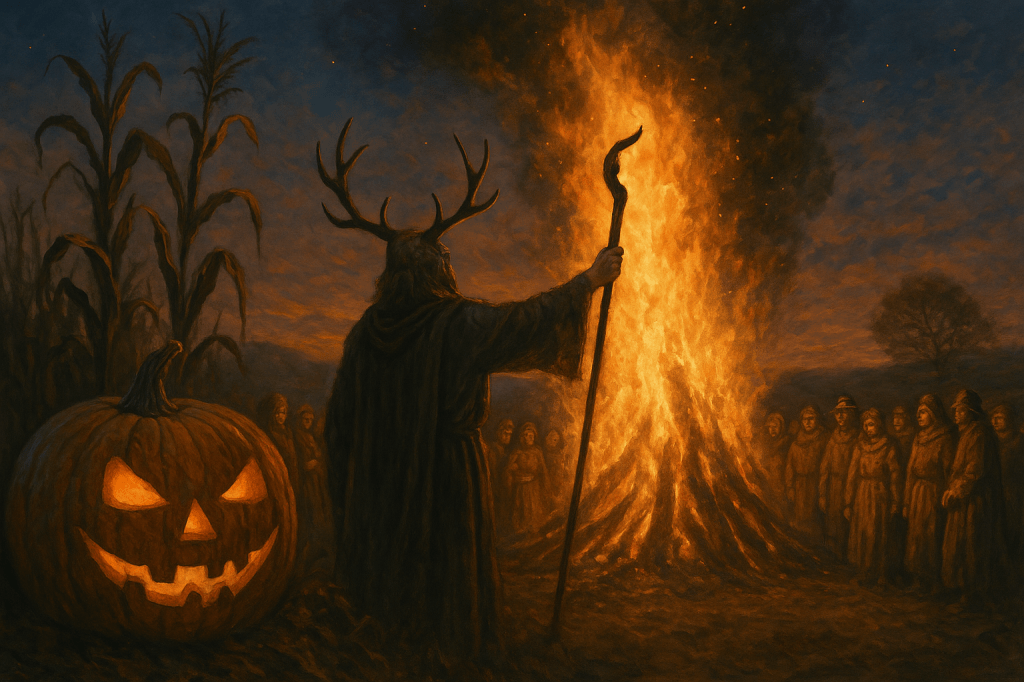
Modern Halloween, with its costumes, sweets, and seasonal festivities, may appear as a light-hearted annual event. However, beneath the commercial surface lies a complex history interwoven with ancient Celtic belief systems, Christian reinterpretations, and cultural transformations over centuries. Understanding the true roots of Halloween requires a return to Samhain, the ancient festival that marked the threshold between life and death, summer and winter.
Samhain: The Celtic New Year
The earliest and perhaps most profound origins of Halloween are found in Samhain (pronounced “Sow-in”), an ancient Gaelic festival celebrated by the Celts of Ireland, Scotland, and parts of Britain. Samhain traditionally took place around 31 October to 1 November and marked the end of the harvest and the beginning of winter. It was believed to be a liminal time, during which the boundary between the world of the living and the world of spirits became thin, allowing supernatural beings and the souls of the dead to cross into the human realm (Heritage Ireland, 2023; Brewminate, 2021).
According to Irish mythological texts, Samhain was associated with gatherings at significant sites such as the Hill of Tara and Tlachtga, where communal bonfires were lit and rituals were conducted (Irish Myths, 2022). The practice of lighting fires was thought to protect communities from evil spirits and to honour the dead. Offerings of food and drink were often left out to appease wandering souls, and people disguised themselves with masks or costumes to ward off or confuse malevolent entities (Fimi, 2019).
Samhain also held political and social significance. It was a time for tribal gatherings, feasting, and the settling of debts or disputes before the long winter. Some scholars argue that Samhain represented a Celtic new year, symbolising death and rebirth within the cycle of nature (Rogers, 2002).
The Christian Reframing: All Hallows and the Suppression of Pagan Belief
As Christianity spread through the British Isles during the early medieval period, pagan festivals such as Samhain were not eradicated but rather incorporated into the Christian liturgical calendar. In the 8th century, Pope Gregory III designated 1 November as All Saints’ Day, also known as All Hallows. The evening before, 31 October, became All Hallows’ Eve, which later evolved into Halloween (Rogers, 2002).
This Christian observance aimed to honour saints and martyrs and was part of a broader effort to substitute Christian meanings onto pre-existing seasonal festivals. Despite this, many Samhain customs survived in altered forms. The concept of the dead returning, the lighting of candles, the wearing of disguises, and the belief in spirits remained embedded in folk practice, especially in rural areas of Ireland and Scotland (Hutton, 1996).
Folklore, Fear, and Festival in the Early Modern Period
By the early modern period, Halloween began to take on more folkloric and social characteristics. In Britain and Ireland, children and adults engaged in “guising”, visiting homes in costume and reciting verses or songs in exchange for food. A related practice, souling, involved going door-to-door and offering prayers for the dead in exchange for soul cakes. These traditions echoed earlier Samhain rituals of hospitality and spiritual appeasement (Historic UK, n.d.).
In this period, Halloween was also associated with divination and fortune-telling. People used apples, mirrors, and nuts in games designed to reveal the identity of a future spouse or to predict events for the coming year. Such customs reflected a lingering belief in the supernatural and the importance of the spirit world during this liminal time (BU Today, 2019).
Transatlantic Transformation: Halloween in the New World
The modern form of Halloween owes much to the transatlantic migration of Irish and Scottish communities in the 19th century. These immigrant groups brought their customs to North America, where Halloween gradually shifted into a community-centred celebration. By the early 20th century, American towns and cities began organising public events, parades, and parties aimed at children. The practice of trick-or-treating emerged during this period, influenced by older European traditions of souling and guising (Skal, 2002).
Pumpkins, native to the Americas, replaced traditional turnips as the material for carving jack-o’-lanterns, a custom linked to an Irish folktale about a trickster named Stingy Jack (Rogers, 2002). Over time, Halloween in the United States became increasingly commercialised, especially after the mid-20th century, as costume manufacturers, confectionery companies, and entertainment media turned it into a profitable seasonal event.
Cultural Memory and Commercial Appropriation
While Halloween has become a multi-billion dollar industry in the West, its deeper meanings often remain obscured. The ancient rituals of Samhain were rooted in survival, remembrance, and the natural cycle of death and renewal. Today’s Halloween may appear secular and playful, but it still contains traces of its earlier spiritual and symbolic meanings. The persistence of imagery associated with death, darkness, and the supernatural suggests an unconscious cultural memory of Samhain’s original significance (Daily JSTOR, 2021).
Critically, Halloween also raises questions about cultural appropriation and historical erasure. The transformation of Samhain into a commodified spectacle prompts reflection on how dominant cultures have often co-opted and diluted indigenous and pagan traditions, reframing them in ways that support capitalist or religious agendas (Skal, 2002; Rogers, 2002).
Conclusion: Rituals That Refuse to Die
Halloween is far more than a night of costumes and sweets. It is a modern mask worn by an ancient ritual. Behind its playful surface lies a cultural history concerned with change, loss, survival, and the human desire to understand what lies beyond the veil. By exploring the true origins of Halloween in Samhain, one uncovers a ritual that continues to evolve while never truly letting go of its past.
References
BU Today (2019) How did Halloween get started? Available at: https://www.bu.edu/articles/2019/how-did-halloween-get-started/ (Accessed: 18 October 2025).
Brewminate (2021) Samhain: The Celtic Inspiration for Modern Halloween. Available at: https://brewminate.com/samhain-the-celtic-inspiration-for-modern-halloween/ (Accessed: 18 October 2025).
Daily JSTOR (2021) Halloween’s Goblins of Meaning. Available at: https://daily.jstor.org/halloweens-goblins-of-meaning/ (Accessed: 18 October 2025).
Fimi, D. (2019) Samhain or Halloween? The Ancient Celtic Year in Contemporary Children’s Fantasy. Available at: https://dimitrafimi.org/2019/10/28/samhain-or-halloween-the-ancient-celtic-year-in-contemporary-childrens-fantasy/ (Accessed: 18 October 2025).
Heritage Ireland (2023) Samhain: The Roots of Halloween. Available at: https://heritageireland.ie/2023/09/samhain-the-roots-of-halloween/ (Accessed: 18 October 2025).
Historic UK (n.d.) Halloween: The Origins of the Festival. Available at: https://www.historic-uk.com/CultureUK/Halloween/ (Accessed: 18 October 2025).
Hutton, R. (1996) The Stations of the Sun: A History of the Ritual Year in Britain. Oxford: Oxford University Press.
Irish Myths (2022) Samhain Mythology: Irish Legends and Meaning. Available at: https://irishmyths.com/2022/08/21/samhain-mythology/ (Accessed: 18 October 2025).
Rogers, N. (2002) Halloween: From Pagan Ritual to Party Night. Oxford: Oxford University Press.
Skal, D. J. (2002) Death Makes a Holiday: A Cultural History of Halloween. New York: Bloomsbury.
 Curious Femme
Leave a comment