
Introduction
Aims of the Study
This book examines the history of single women from the medieval period to the present, exploring how they have been defined, represented, and positioned within social, legal, and economic structures. The study argues that single women have historically embodied a paradox: while they often retained more legal autonomy than married women, they were simultaneously subjected to cultural stigma, economic marginalisation, and moral scrutiny. By tracing this history, the book situates singleness not as an anomaly but as a continuous and significant thread in women’s history.
Historiographical Context
Much of traditional women’s history has been framed through marriage and family. Marriage was long constructed as women’s natural destiny, central to their economic survival, moral worth, and social identity (Shanley, 1989). Unmarried women were often relegated to the margins of historical accounts, described as anomalies or failures.
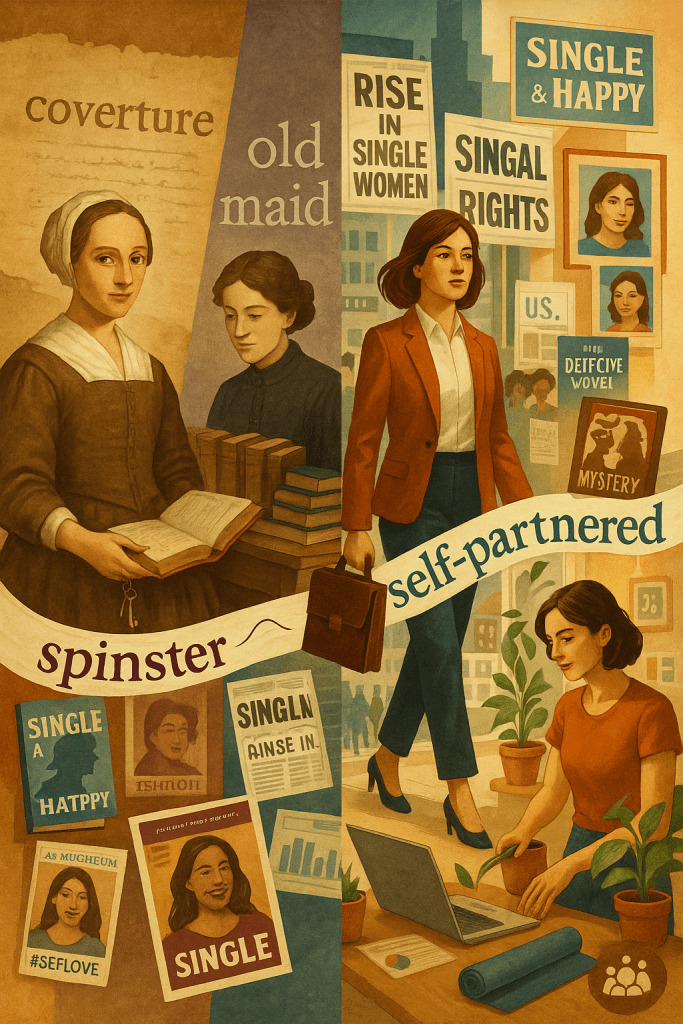
Feminist scholarship has challenged these assumptions. Studies such as Bennett’s (1996) work on female brewers and Erickson’s (1993) research on women’s property have demonstrated that unmarried women were not passive or marginal but active participants in commerce and economic life. Beattie (2007) shows how the category of “singlewoman” was itself a tool of governance, used to regulate women’s status and moral reputation in late medieval England. In cultural history, the evolution of the term “spinster” from neutral occupational label to pejorative marker illustrates how language encoded anxieties about female independence (Wills, 2019).
More recently, scholars in sociology and psychology have examined contemporary singleness as an identity and lifestyle. Reynolds and Wetherell (2003) argue that single women must negotiate social discourses that position marriage as normative, while Budgeon (2016) identifies how single women navigate both empowerment and stigma in the 21st century.
This book builds on these traditions, bringing together legal, economic, demographic, and cultural histories to create a continuous narrative of single women’s lives over eight centuries.
Methodological Approach
The study is interdisciplinary. Legal history provides a framework for understanding how single and married women were differentiated through the doctrines of feme sole and feme covert. Economic and social history reveal the occupations, businesses, and survival strategies of unmarried women across time. Demographic studies highlight the prevalence of singlehood, especially in the North-West European marriage pattern, which was characterised by late marriage and significant proportions of lifelong spinsters (Hufton, 1984). Cultural history and feminist theory expose the narratives, stereotypes, and language that shaped perceptions of single women.
Throughout, the book critically evaluates not only the opportunities available to single women but also the structural constraints, reputational risks, and cultural scripts that limited them.
Outline of Chapters
- Chapter 1 explores unmarried women in the medieval economy, focusing on their roles in brewing, textiles, petty retail, and religious communities such as the beguines.
- Chapter 2 examines early modern transformations, including the rise of capitalism, the shift in the meaning of “spinster,” and women’s roles as petty creditors and investors.
- Chapter 3 analyses the eighteenth century, when demographic visibility and urban economic opportunities intersected with intensifying cultural stigma.
- Chapter 4 considers the nineteenth century, focusing on coverture, the Married Women’s Property Acts, and the cultural politics of spinsterhood.
- Chapter 5 explores the twentieth century, from the “surplus women” of post-WWI Britain to feminist redefinitions of singlehood.
- Chapter 6 analyses the 21st century, highlighting autonomy, demographic change, reproductive freedoms, and cultural ambivalence.
- Chapter 7 addresses the role of abuse and trauma in shaping some women’s decisions to remain single.
- Chapter 8 examines financial freedoms, showing how women’s independence from men for survival was secured through education, employment, welfare, and access to credit.
- Chapter 9 compares “spinster” and “bachelor,” exposing the gendered asymmetry of these cultural categories.
- Chapter 10 concludes, arguing that single women have always been integral to social and economic life, embodying both autonomy and stigma, and that their history reveals wider patterns of gendered inequality and resistance.
Argument
The central argument of this book is that the single woman is neither a marginal nor accidental figure in history. She has been integral to economies, communities, and cultural narratives across centuries. Single women’s experiences expose the ways in which gendered power has been structured: law gave them more independence than wives, yet culture constructed them as incomplete. By recovering their history, we also recover alternative models of womanhood that resisted or redefined marriage as the only path to respectability and security.
References (Harvard style)
- Beattie, C. (2007) Medieval Single Women: The Politics of Social Classification in Late Medieval England. Oxford: Oxford University Press.
- Bennett, J.M. (1996) Ale, Beer and Brewsters in England: Women’s Work in a Changing World, 1300–1600. Oxford: Oxford University Press.
- Budgeon, S. (2016) ‘The “problem” with single women: Choice, accountability and social change’, Journal of Social and Personal Relationships, 33(3), pp. 401–418.
- Erickson, A.L. (1993) Women and Property in Early Modern England. London: Routledge.
- Hufton, O. (1984) ‘Women without Men: Widows and Spinsters in Britain and France in the Eighteenth Century’, Journal of Family History, 9(4), pp. 355–376.
- Reynolds, J. and Wetherell, M. (2003) ‘The discursive climate of singleness: The consequences for women’s negotiation of a single identity’, Feminism & Psychology, 13(4), pp. 489–510.
- Shanley, M.L. (1989) Feminism, Marriage, and the Law in Victorian England, 1850–1895. Princeton: Princeton University Press.
- Wills, M. (2019) ‘Original spin: On the history of the spinster’, JSTOR Daily, 23 September. Available at: https://daily.jstor.org/original-spin-history-spinster/
 Curious Femme
Leave a comment