
Introduction
The twentieth century brought profound transformations in the lives of single women. Demographic upheavals, particularly following the two World Wars, produced large populations of unmarried women who could not marry due to the loss of men in combat. These so-called “surplus women” challenged established gender norms by remaining visible in employment, education, and civic life. Later in the century, the expansion of the welfare state, reproductive rights, and feminist activism reshaped the meanings of singlehood. By the 1970s, singleness was increasingly framed as a choice rather than a failure. Yet stigma persisted, as cultural scripts continued to contrast the “lonely spinster” with the “eligible bachelor.”
The “Surplus Women” of the Interwar Years
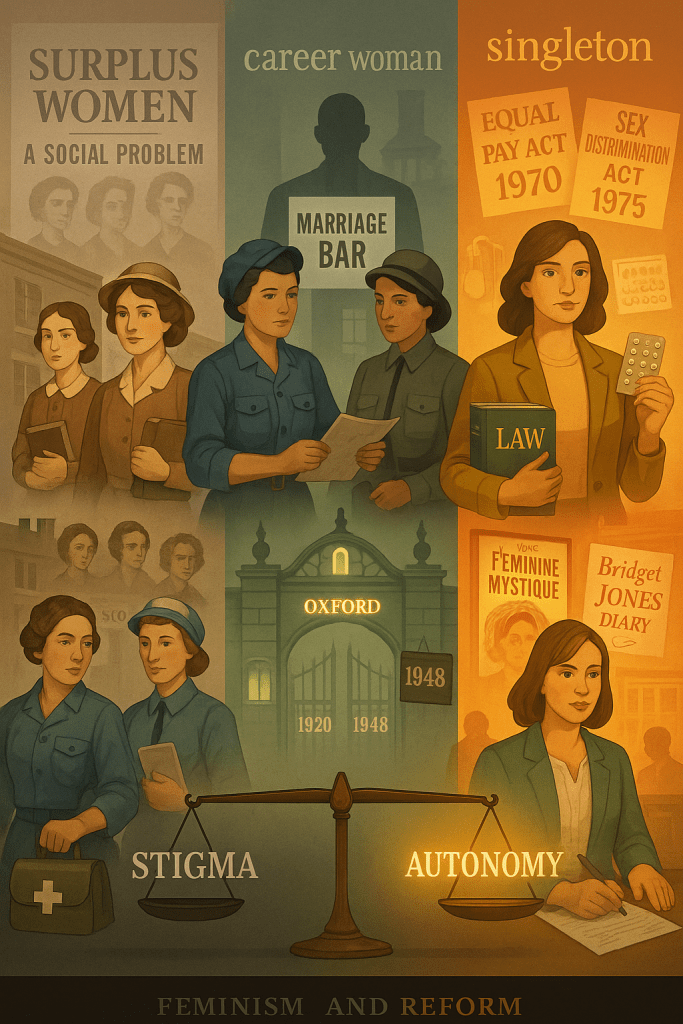
The First World War created a dramatic gender imbalance in Britain. The 1921 Census revealed over a million more women than men, leaving large numbers of women unable to marry (Dyhouse, 1989). Newspapers and social commentators referred to them as “surplus women,” framing them as a social problem.
These women were often portrayed as tragic, their lives depicted as incomplete without husbands. Yet in practice, many embraced work, community involvement, and education. They staffed schools, hospitals, and offices, and some became pioneers in professions such as law and medicine after restrictions were lifted by the Sex Disqualification (Removal) Act 1919 (Goodman, 2013). Their lives reveal the contradiction between cultural pity and practical independence.
Higher Education and Professional Credentials
The late nineteenth-century reforms that had permitted women into universities culminated in degree recognition during the twentieth century.
- Oxford began to award degrees to women in 1920, formalising the status of students at Somerville, Lady Margaret Hall, and other women’s colleges.
- Cambridge withheld degrees until 1948, despite Girton (1869) and Newnham (1871) having trained women for decades.
These milestones legitimised women’s intellectual achievements and opened professional careers that required degree certification. For single women, in particular, higher education became the most reliable pathway to economic security and independence (Dyhouse, 2013).
Work, Marriage Bars, and Economic Independence
Throughout much of the twentieth century, many professions imposed “marriage bars” which forced women to resign upon marrying. Teaching, clerical work, and the civil service were particularly affected (Lewis, 1992). Single women therefore became a significant presence in these occupations, often developing long-term careers denied to married women.
This created an ironic reversal: while wives were expected to withdraw from work, single women became the backbone of feminised professions. Their wages, though lower than men’s, gave them financial independence, allowing them to live alone or with other women. Yet this also reinforced stereotypes of spinsters as economically capable but socially incomplete.
The teaching bar was abolished during the 1940s, and the Home Civil Service marriage bar ended in 1946. These reforms enabled women to pursue continuous employment, accumulate pensions, and gain promotion. For single women, this strengthened their independence, but it also reinforced stereotypes that spinsters were industrious yet socially incomplete.
The Second World War and Aftermath
The Second World War again mobilised women into industry, administration, and auxiliary services. Single women were particularly prominent in munitions factories, civil defence, and nursing. Wartime propaganda celebrated their contributions, but post-war reconstruction quickly reasserted domestic ideals. Women were encouraged to return to the home, and single women who remained in the workforce were often treated as placeholders until men returned (Braybon, 1989).
Despite this, the experience of war left a legacy of expanded horizons. Many single women retained employment, lived independently, and developed networks of friends and colleagues. Their visibility reinforced the normalisation of female employment beyond marriage.
Welfare State and Policy Gaps
The Beveridge Report of 1942 laid the foundations for the post-war welfare state. While it promised universal provision, its assumptions were rooted in the male breadwinner model. Women were largely viewed as dependants of husbands, and single women without children were rendered almost invisible in policy (Lewis, 1992).
Nevertheless, single women benefited from free healthcare under the NHS, state pensions, and educational opportunities. These provisions reduced the economic risks of remaining unmarried, even as cultural expectations remained centred on family life.
Banking, Credit, and Financial Autonomy
Even after gaining property rights in the nineteenth century, women faced barriers in banking. Until the 1960s, many banks required a father’s or husband’s guarantor for loans or mortgages. By the 1970s, single women could open accounts and access mortgages independently, a change reinforced by the Sex Discrimination Act 1975, which outlawed sex-based discrimination in services (Hollowell, 2018). For single women, this marked the first time they could establish households and assets without male mediation.
Women in Science: Participation and Erasure
Although universities now admitted women, recognition lagged behind achievement. Several prominent examples reveal how women’s discoveries were overlooked or minimised:
- Hertha Ayrton (1854–1923), a pioneer in electrical science, was denied Royal Society fellowship in 1902 on the grounds that married women were not legal “persons.” She later received the Hughes Medal (1906).
- Rosalind Franklin (1920–1958), whose X-ray crystallography revealed DNA’s structure, was sidelined when her data were shared with Watson and Crick, whose 1953 model became world-famous.
- Jocelyn Bell Burnell (b. 1943) discovered pulsars in 1967, but the 1974 Nobel Prize was awarded to her male supervisor and colleague.
These cases illustrate how women’s intellectual labour was essential yet undervalued, reflecting institutional sexism even after formal educational equality.
Boxed Timeline: Education and Science Milestones
- 1869: Girton College, Cambridge founded.
- 1871: Newnham College, Cambridge founded.
- 1878: University of London awards degrees to women.
- 1889: Universities (Scotland) Act admits women.
- 1893: First female graduates at Edinburgh.
- 1895: Durham awards degrees to women.
- 1920: Oxford awards degrees to women.
- 1948: Cambridge awards degrees to women.
- 1902: Hertha Ayrton nominated for Royal Society, rejected.
- 1953: Rosalind Franklin’s DNA data informs Watson and Crick’s model.
- 1967: Jocelyn Bell Burnell discovers pulsars, Nobel awarded to male colleagues.
Feminism, the Pill, and Cultural Shifts
The 1960s and 1970s brought a new cultural climate. The introduction of the contraceptive Pill in 1961 gave women unprecedented reproductive autonomy. Combined with expanding higher education, this enabled women to pursue careers without immediate marriage (Dyhouse, 2013).
Second-wave feminism reframed singleness as a site of autonomy and resistance to patriarchy. Writers such as Betty Friedan (1963) critiqued the “feminine mystique” that confined women to domestic roles. In Britain, feminists argued that women should not be defined by marital status but by education, work, and personal fulfilment (Rowbotham, 1979).
Legislative reforms reflected these shifts. The Divorce Reform Act 1969 liberalised divorce, while the Equal Pay Act 1970 and the Sex Discrimination Act 1975 secured workplace rights. These reforms eroded the assumption that marriage was women’s economic destiny, making singleness a more viable and respected choice.
Persistent Stigma and Media Tropes
Despite reforms, cultural stereotypes endured. The figure of the “lonely spinster” remained in jokes, films, and popular novels. In contrast, male bachelors were often portrayed as independent, charming, or eligible. This asymmetry underscores how deeply entrenched gendered double standards were in the cultural imagination.
By the late twentieth century, new cultural tropes emerged, such as the “career woman” who supposedly sacrificed marriage for work, or the “singleton” epitomised by Helen Fielding’s Bridget Jones’s Diary (1996). These representations continued to frame singleness in terms of lack, even as they acknowledged female agency.
Critical Evaluation
The twentieth century highlights the complex interplay of autonomy and stigma. Single women gained visibility, economic independence, and new rights, particularly in the post-war decades. Yet cultural narratives remained ambivalent, often depicting them as tragic or deficient.
Three factors were decisive. First, demographic imbalance after the World Wars created large populations of unmarried women, making their presence unavoidable. Second, the welfare state and workplace reforms reduced the economic risks of singleness. Third, feminist activism reframed singlehood as choice and empowerment. Yet the persistence of cultural stigma shows that legal and economic changes did not immediately transform societal attitudes.
Conclusion
In the twentieth century, single women were recognised as autonomous citizens with educational credentials, workplace rights, and financial freedoms. Their contributions to education, healthcare, and the professions were significant, and feminist reforms further expanded their freedoms. The structural reliance on men for survival had ended.. Yet cultural ambivalence lingered, with singlehood framed both as liberation and as lack. This duality would continue into the twenty-first century, when declining marriage rates and new reproductive technologies reshaped the meaning of singleness.
References (Harvard style)
- Braybon, G. (1989) Women Workers in the First World War. London: Routledge.
- Dyhouse, C. (1989) Feminism and the Family in England 1880–1939. Oxford: Blackwell.
- Dyhouse, C. (2013) Girl Trouble: Panic and Progress in the History of Young Women. London: Zed Books.
- Friedan, B. (1963) The Feminine Mystique. New York: W. W. Norton.
- Goodman, J. (2013) Women and Education, 1800–1980. London: Palgrave Macmillan.
- Hollowell, S. (2018) Women and Finance: A History of Women and Financial Independence. London: Bloomsbury.
- Lewis, J. (1992) ‘Gender and the development of welfare regimes’, Journal of European Social Policy, 2(3), pp. 159–173.
- Rowbotham, S. (1979) The Past is Before Us: Feminism in Action Since the 1960s. London: Pandora.
 Curious Femme
Leave a comment