
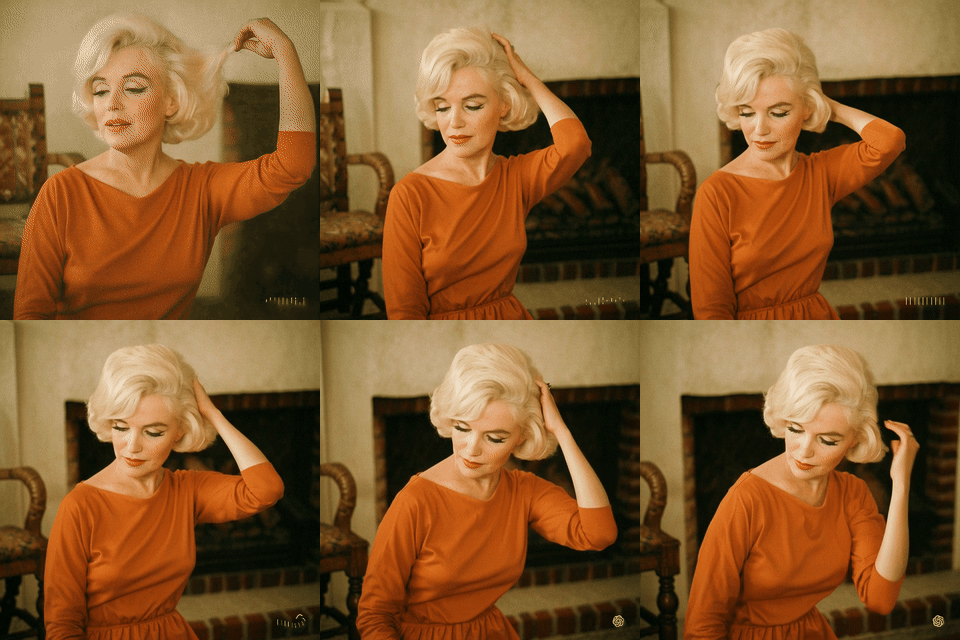
(Moving image created by AI)
Beauty, vulnerability and the political economy of stardom
Standfirst: Marilyn Monroe’s cultural power does not rest on “looks” alone. It is an assemblage of facial symmetry and photogenic technique, meticulously produced glamour, a performed vulnerability that generates intimacy, and a publicity machine that converted private wounds into public myth. This article maps that assemblage and evaluates which contemporary figures echo parts of it within today’s platform-driven celebrity ecology.
Introduction
Marilyn Monroe endures as a cultural force because she fused classic beauty with an unusual capacity to transmit feeling through the camera. Her image was jointly authored by studios, photographers and journalists, but also by her own aesthetic labour in hair, make-up, wardrobe and light (Dyer, 1979; Banner, 2012). She exemplified both purity and sensuality and, crucially, a visible fragility that intensified audience attachment, a dynamic early theorists described as para-social intimacy (Horton and Wohl, 1956). This essay outlines the core components of the “Monroe archetype,” then analyses contemporary figures who echo elements of that template in radically changed media conditions shaped by platforms, metrics and postfeminist discourse (Gill, 2007; Marwick, 2013; Banet-Weiser, 2018).
The components of the Monroe archetype
1. Aesthetic legibility: symmetry, photogenicity, technique
Empirical work links attractiveness to facial symmetry, averageness and sexual dimorphism (Rhodes, 2006; Little, Jones and DeBruine, 2011). Monroe’s balanced features and heart-shaped face exemplify this. Photogenic impact is not anatomy alone. It is a learned capacity to modulate micro-expressions, gaze and head angle so that emotion reads at photographic scale (Dyer, 1979).
2. Performed femininity and authorship
Monroe’s star text sits within the classic regime of the gaze, in which femininity is staged for visual pleasure (Mulvey, 1975). Yet she co-produced her image through craft with make-up artist Allan “Whitey” Snyder and through strategic wardrobe choices that heightened softness and luminosity. This is aesthetic labour that later scholarship identifies as central to feminine work under neoliberalism (Elias, Gill and Scharff, 2017).
3. Vulnerability as affective capital
The breathy voice, hesitant cadence and open-mouthed smile delivered a recognisable vulnerability that became part of her economic value because it intensified attachment and protectiveness in audiences (Ahmed, 2004; Banner, 2012). Her wounds were legible, even when untold, and they produced myth.
4. Myth-making infrastructures
Studios, magazines and paparazzi produced coherence across disparate appearances, allowing a stable “Monroe” to circulate globally (Marshall, 1997; Rojek, 2001). In Benjamin’s terms, the endless reproductions did not destroy aura because the reproduction trafficked in authenticity as wound, not as documentary fact (Benjamin, 1936/2008).
What has changed since Monroe
Today’s stardom is platformised. Visibility is negotiated with algorithms and metrics while intimacy is performed and monetised at scale (Senft, 2008; Abidin, 2016; Bishop, 2019). Postfeminist culture reframes self-branding and sexual display as entrepreneurial choice and self-care (Gill, 2007; Gill and Scharff, 2011). Emotional disclosure is common, but it is narrativised as resilience rather than tragedy, which changes how vulnerability works as capital (Illouz, 2007). Under these conditions, the precise alchemy that made “Marilyn” is difficult to reproduce.
Contemporary echoes of Monroe
No single contemporary condenses all of Monroe’s attributes. Several women articulate strong facets of the archetype in different proportions.
A. Classic beauty with camera intelligence: Margot Robbie and Ana de Armas
Robbie exhibits symmetrical, classically “legible” beauty and a deft command of lenses, combining playfulness with control that reads on camera (Rhodes, 2006; Dyer, 1979). Ana de Armas’s performance in Blonde (2022) attempted to re-stage the Monroe wound–glamour dialectic, but the film has been widely criticised. Though de Armas’s craft was praised, Blonde fictionalised Monroe’s life, presenting graphic trauma without context, and blurred fact with invention in ways that degraded her image. Many fans and scholars have condemned the film for exploiting Monroe’s suffering rather than honouring her complexity, with some audiences mistaking its inventions for biography (Banner, 2012; Churchwell, 2004). The controversy illustrates how Monroe’s myth remains hotly contested terrain rather than settled cultural memory.
B. Vulnerability aestheticised as style: Lana Del Rey
Del Rey’s melancholic vocals, retro iconography and repeated motifs of longing perform vulnerability as a carefully authored aesthetic that invites para-social closeness while retaining authorship, a power Monroe rarely held in studio regimes (Banet-Weiser, 2018).
C. Transformative charisma and self-authorship: Lady Gaga and Beyoncé
Both artists can “switch on” presence and transform space. Gaga oscillates between spectacle and confession, echoing Monroe’s public, private tension, but asserts control through composition and direction. Beyoncé’s meticulously curated intimacy, strategic scarcity and ownership of her image invert Monroe’s porous image economy while sustaining a mythic aura (Marshall, 1997).
D. Cultural duality with prestige credibility: Zendaya
Zendaya balances youthful elegance with sensual fashion authority. She manages proximity and distance on social media with notable restraint, a postfeminist calibration of intimacy that resonates with but modernises Monroe’s wholesome, glamour split (Marwick, 2013; Baym, 2018).
E. Tragic visibility and the politics of care: Britney Spears and the memory of Amy Winehouse
Spears’ long public struggle reprises the spectacle of female suffering that surrounded Monroe. The #FreeBritney movement reframes earlier voyeurism as abuse, showing how audiences now articulate care even as platforms monetise distress (Banet-Weiser, 2018). Winehouse represents another echo: extraordinary talent entwined with visible pain, where myth overwhelms the woman.
F. Counterpoint: Kim Kardashian and the commodification of icons
Kardashian does not embody Monroe’s archetype but instead demonstrates the opposite: how platform celebrity consumes and exploits cultural symbols. Her decision to wear Monroe’s historic “Happy Birthday, Mr President” gown at the 2022 Met Gala provoked widespread backlash from fans, curators and fashion historians, with allegations of lasting damage to the fragile garment. For many, this act symbolised not homage but desecration: the reduction of Monroe’s aura to a fleeting spectacle. Rather than echoing Monroe’s charisma or vulnerability, Kardashian exemplifies how contemporary influencer culture industrialises beauty labour, self-surveillance and the monetisation of heritage (Senft, 2008; Abidin, 2016). In this sense, she operates as a cautionary case of what the Monroe archetype is not in the 21st century
Intersectional considerations
Monroe’s desirability was racialised and classed. Mid-century Hollywood whiteness functioned as the unmarked norm that amplified her “natural” beauty and soft sexuality (hooks, 1992; Gill, 2007). Contemporary analogues such as Beyoncé or Zendaya operate under different racialised readings and constraints of respectability. Any mapping of the archetype must acknowledge that the category “classic beauty” is historically contingent and structurally mediated.
Why noone “is” Marilyn
1. Economy of visibility. Today’s stars are content producers and rights-holders; images are risk-managed and corrected in real time. Monroe’s aura partly depended on contingency and loss of control (Marshall, 1997).
2. Therapeutic modernity. Confessional culture narrates suffering as growth. Monroe’s vulnerability remained unresolved and therefore mythic (Illouz, 2007).
3. Audience literacy. Viewers read images critically through feminist and media-savvy frames, altering the contract between star and spectator (Mulvey, 1975; Gill, 2007).
4. Platform temporality. Algorithms reward constant novelty, which inhibits the sedimentation of a singular, enduring iconography. Monroe’s images had time to crystallise into myth (Benjamin, 1936/2008; Bishop, 2019).
Conclusion
Marilyn Monroe remains singular because she condensed mid-century beauty norms, studio glamour and an unprotected vulnerability into a star text that audiences and institutions co-authored. Contemporary figures mobilise parts of that text. Robbie exemplifies classic beauty; Del Rey aestheticises fragility; Gaga and Beyoncé deliver transformative presence with authorship; Zendaya manages dual address across prestige and fashion; Spears and Winehouse embody the costs of visibility. The Monroe archetype therefore persists less as a blueprint for a successor and more as a repertoire of affects, poses and stories that modern celebrities recombine within a different political economy of attention.
“Marilyn was not just a face or body but a presence. What endured was not perfection but the charge of feeling transmitted through an image.”
References (Harvard)
Abidin, C. (2016) ‘“Aren’t these just young, rich women doing vain things online?” Influencer selfies as subversive frivolity’, Social Media + Society, 2(2).
Ahmed, S. (2004) The Cultural Politics of Emotion. Edinburgh: Edinburgh University Press.
Banet-Weiser, S. (2018) Empowered: Popular Feminism and Popular Misogyny. Durham, NC: Duke University Press.
Banner, L. (2012) Marilyn: The Passion and the Paradox. New York: Bloomsbury.
Baym, N. (2018) Playing to the Crowd: Musicians, Audiences, and the Intimate Work of Connection. New York: NYU Press.
Benjamin, W. (1936/2008) ‘The work of art in the age of its technological reproducibility’, in Jennings, M. et al. (eds) The Work of Art in the Age of Its Technological Reproducibility, and Other Writings on Media. Cambridge, MA: Harvard University Press.
Bishop, S. (2019) ‘Managing visibility on YouTube through algorithmic gossip’, New Media & Society, 21(11–12), pp. 2589–2606.
Churchwell, S. (2004) The Many Lives of Marilyn Monroe. London: Granta.
Dyer, R. (1979) Stars. London: BFI.
Elias, A., Gill, R. and Scharff, C. (eds) (2017) Aesthetic Labour: Rethinking Beauty Politics in Neoliberalism. London: Palgrave.
Gill, R. (2007) Gender and the Media. Cambridge: Polity.
Gill, R. and Scharff, C. (eds) (2011) New Femininities: Postfeminism, Neoliberalism and Subjectivity. Basingstoke: Palgrave.
hooks, b. (1992) Black Looks: Race and Representation. Boston: South End Press.
Horton, D. and Wohl, R. (1956) ‘Mass communication and para-social interaction’, Psychiatry, 19(3), pp. 215–229.
Illouz, E. (2007) Cold Intimacies: The Making of Emotional Capitalism. Cambridge: Polity.
Little, A., Jones, B. and DeBruine, L. (2011) ‘Facial attractiveness: evolutionary based research’, Philosophical Transactions of the Royal Society B, 366(1571), pp. 1638–1659.
Marshall, P.D. (1997) Celebrity and Power: Fame in Contemporary Culture. Minneapolis: University of Minnesota Press.
Marwick, A. (2013) Status Update: Celebrity, Publicity, and Branding in the Social Media Age. New Haven: Yale University Press.
Meryman, R. (1962) ‘Marilyn’, LIFE Magazine, 17 August.
Mulvey, L. (1975) ‘Visual pleasure and narrative cinema’, Screen, 16(3), pp. 6–18.
Rhodes, G. (2006) ‘The evolutionary psychology of facial beauty’, Annual Review of Psychology, 57, pp. 199–226.
Rojek, C. (2001) Celebrity. London: Reaktion.
Sikov, E. (2004) Marilyn Monroe: The Biography. New York: Henry Holt.
 Curious Femme
Leave a comment