
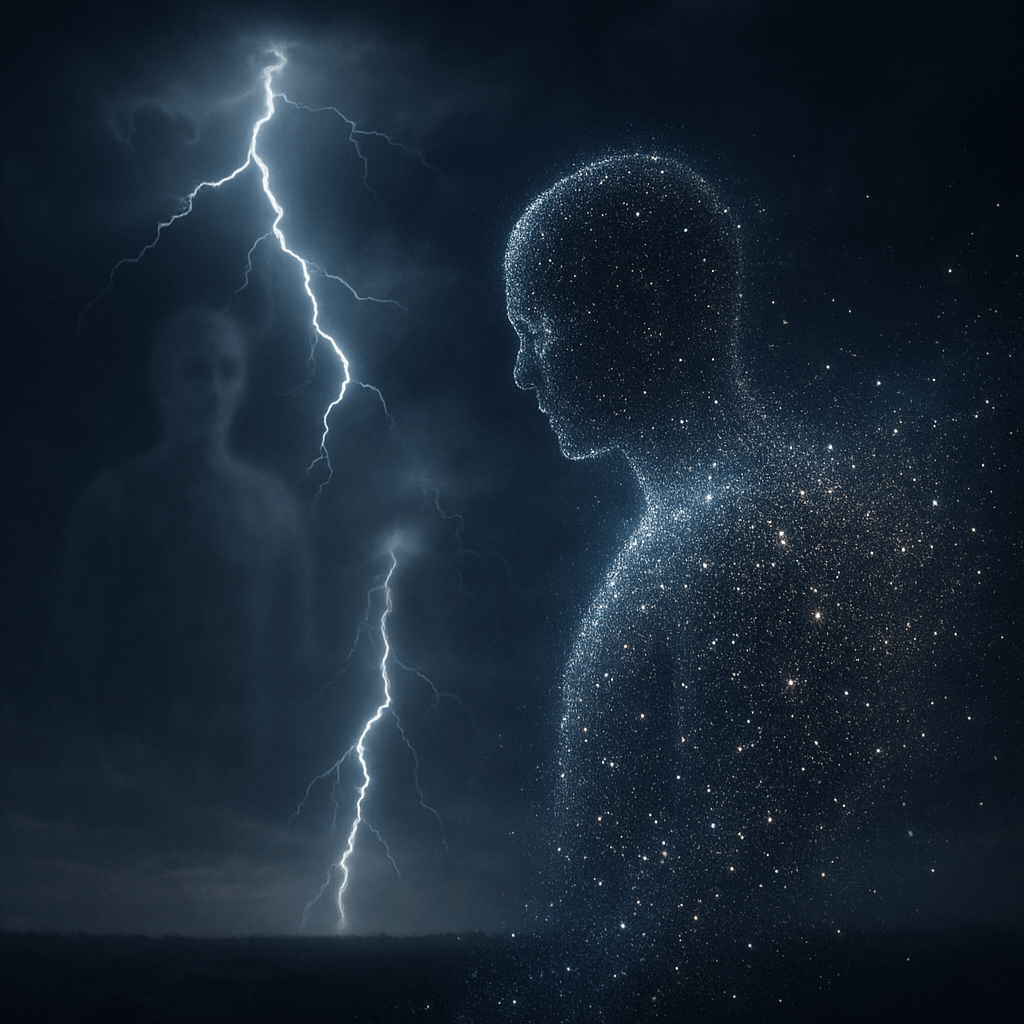
Abstract. This paper proposes a novel hypothesis: that ghosts, often reported as residual presences, may result from trauma-induced electromagnetic discharges at the point of death, leaving an imprint on the surrounding environment. Drawing upon interdisciplinary research from biological psychology, neurophysiology, physics, and environmental science, this paper explores whether the human body’s bioelectrical activity, under acute stress or traumatic death, could theoretically interact with environmental substrates analogous to lightning striking the earth. The theory is critically examined through current scientific literature and physiological data, offering testable pathways for future research.
1. Introduction The human body is an electrically active organism of atoms forged in ancient stars. Approximately 93% of the human body’s mass is stardust, formed in stars through nucleosynthesis and dispersed across the cosmos through supernovae and stellar winds (National History Museum, 2023; Australian Geographic, 2023). Elements such as carbon, nitrogen, calcium, and iron in the human body originated in massive stellar explosions (NASA, 2022).
Cellular processes, neural communication, and cardiac rhythms are all governed by bioelectricity (University of Western Australia, 2023). This paper explores whether, under traumatic conditions leading to death, the electrical discharge from the human body could interact with the environment, creating an energetic trace or imprint. This theoretical framework parallels how lightning alters the landscape, through the rapid release of energy into a conductive medium, suggesting that a similarly abrupt and charged human death could result in persistent environmental effects, which may be interpreted as hauntings or ghostly phenomena.
2. Human Electrophysiology and Energy Potential Every living human body produces electrical currents. Action potentials in neurons, ionic gradients across membranes, and cardiac pacemaking rely on the controlled flow of electrical charges (OpenPress, 2023). On average, a resting adult human produces approximately 100 watts of electrical power, which can surge to over 1,000 watts during high-intensity physical activity (Stanford University, 2014; FST Media, 2023). This power is sufficient to light a standard incandescent bulb or charge multiple small electronic devices.
The brain alone produces electric fields measurable by electroencephalography (EEG), and the heart’s rhythm can be monitored via electrocardiography (ECG) (UWA, 2023).
Research has shown that humans emit low-level electromagnetic fields (FST Media, 2023). During trauma, the hypothalamic-pituitary-adrenal (HPA) axis triggers an intense sympathetic nervous system response, flooding the body with catecholamines and causing rapid-fire neuronal activity (New Scientist, 2023). It is plausible that this surge results in an unusually high concentration of bioelectrical activity at the moment of death, potentially producing a measurable external discharge.
3. Stardust and the Biophysical Foundations of Human Electricity The assertion that the human body is composed of stardust is not merely poetic but scientifically factual. Approximately 93% of the human body’s mass originates from elements formed in ancient stars, including hydrogen, carbon, nitrogen, oxygen, calcium, phosphorus, sodium, potassium, and magnesium (Australian Geographic, 2023; National History Museum, 2023).
These elements underpin the bioelectrical functions of the human body. Ion distribution, particularly of sodium (Na⁺), potassium (K⁺), calcium (Ca²⁺), chloride (Cl⁻), and hydrogen (H⁺), enables electrical conductivity within neurons, muscle fibres, and organ systems. Sodium and potassium regulate action potentials in neurons; calcium ions modulate neurotransmitter release and muscle contraction; and phosphorus contributes to adenosine triphosphate (ATP), the primary carrier of cellular energy.
Without these star-derived ions, bioelectric signalling would be impossible. Electrochemical gradients across cellular membranes are maintained using ATP, powered pumps like the sodium-potassium ATPase, which store electrical potential for cellular communication. The phosphorus in ATP, the iron in haemoglobin, and the magnesium stabilising DNA are all products of stellar nucleosynthesis (NASA, 2022).
Furthermore, carbon-based structures, such as neuronal membranes and ion channels, regulate the flow of electrical charges. These structures form the insulation and gating systems critical for bioelectric control, and their functionality depends on elemental stability established in stellar reactions. Thus, the human body’s ability to generate, conduct, and regulate electricity is inextricably linked to its cosmic origins.
4. Electromagnetic Discharge and Environmental Interaction Lightning represents a large-scale example of electrical discharge interacting with the environment, fusing sand into fulgurite or magnetising rock. Analogously, it is proposed that the bioelectrical release occurring during violent or emotionally charged deaths may create micro-electromagnetic disturbances in nearby matter.
Persinger and Koren (2001) demonstrated that low-intensity electromagnetic fields (EMFs) can influence perception, including generating a ”sensed presence. Similarly, Michael Persinger’s research indicated that weak magnetic fields targeted at the temporal lobes could elicit ghost-like experiences in laboratory participants (Granqvist et al., 2005).
Although no empirical evidence exists to show that the environment can record human emotional states, quartz and other piezoelectric materials in buildings may provide a substrate through which these weak EMFs are stored or amplified under certain conditions. Houran and Lange (1996) proposed that geomagnetic and structural factors contribute to haunt-like reports, even without paranormal agents.
5. Near-Death Experience (NDE) Reports and Electromagnetic Phenomena Greyson et al. (2015) studied 216 individuals who had experienced near-death experiences (NDEs) and found significantly higher reports of electromagnetic phenomena such as interference with devices and heightened sensitivity to electrical stimuli. Although subjective, such accounts suggest that the dying brain may undergo a burst of neural activity capable of interacting with its surroundings. These findings are supported by Holden and Nouri (2008), who documented repeated reports of NDErs causing watches to stop or lights to flicker upon recovery.
While not yet supported by instrumentation, these anecdotal patterns suggest a psychosomatic-electromagnetic link that merits further research.
6. Environmental Conditions and Residual Perception Reports of ghost sightings tend to cluster in places with violent histories, battlefields, hospitals, and prisons. These environments often contain materials like limestone or iron and may be subject to environmental conditions (humidity, EM field anomalies, infrasound) that enhance perception.
Tandy and Lawrence (1998) demonstrated that infrasound, below human hearing thresholds, could cause anxiety and visual hallucinations. Similarly, Wiseman et al. (2003) observed that people reported ghostly phenomena more frequently in areas with elevated electromagnetic activity, even when unaware of the measurements.
7. Limitations and Counterarguments Critics argue that no known mechanism allows human-generated EM energy to be imprinted into a non-living environment with the fidelity required to produce recurring sensory phenomena. Replication studies, such as those by Granqvist et al. (2005), found no significant difference in ”sensed presence” between participants exposed to sham versus actual EM stimulation when expectations were controlled.
Furthermore, most EM emissions from the human body are weak and dissipate quickly. For a ghost to exist as an imprint, the discharge must be unusually powerful or the environment unusually receptive.
8. Recommendations for Empirical Investigation. To assess the validity of this theory, the following research strategies are proposed:
- Environmental Field Studies: Use magnetometers and EM sensors at sites of traumatic deaths to detect anomalous field activity.
- Material Science Testing: Expose quartz-rich or ferromagnetic materials to bioelectric discharge simulations and analyse retention of patterns.
- EEG and ECG Monitoring: Measure real-time neural and cardiac activity in end-of-life care settings, focusing on terminal electrical surges.
- Controlled Perceptual Studies: Combine EM field exposure with psychological assessments to evaluate subjective reports of ”presence” in laboratory and field environments.
9. Ethical and Methodological Considerations for Empirical Testing
While this paper presents a theoretical model, empirical testing is essential to validate or refute the hypothesis. This section outlines scientific and ethical considerations for conducting such research.
Scientific Methodology
- Electrophysiological Discharge at Death
- Hypothesis: The human body emits an elevated electromagnetic surge at the point of traumatic death.
- Method: Employ EEG, ECG, and EM field detectors in palliative care and emergency units to monitor real-time bioelectrical activity.
- Feasibility: Requires longitudinal observation and collaboration between neuroscientists, emergency physicians, and physicists.
- Environmental Imprinting
- Hypothesis: Trauma-associated electrical discharge, particularly materials like quartz or iron, interacts with the environment.
- Method: Deploy magnetometers, geophysical sensors, and spectroscopy at historically traumatic locations to detect electromagnetic anomalies and potential imprints.
- Perception and Environmental Triggers
- Hypothesis: Certain EM field configurations or materials enhance the perception of presence.
- Method: Use double-blind trials where participants visit trauma sites or EM-controlled environments, while tracking physiological responses and subjective experiences.
Ethical Considerations
- Consent and Autonomy: In end-of-life monitoring, informed consent must be obtained from patients or legal representatives. Ethical oversight by an NHS-recognised ethics committee is mandatory.
- Psychological Harm: Participants in perceptual studies must be screened for mental health vulnerabilities. Psychological support must be available post-study.
- Cultural Sensitivity: Research conducted at historic or sacred trauma sites must involve local communities and adhere to principles of cultural respect.
- Non-Invasiveness: All monitoring equipment must be non-invasive and cause no additional distress to patients.
Research Integrity and Transparency
- Full transparency in research design and publication is essential to avoid pseudoscientific misappropriation.
- Collaborations should include neuroscientists, environmental physicists, psychologists, and bioethicists.
10. Conclusion This paper offers a theoretical framework linking bioelectric trauma, death, and residual hauntings. While definitive proof remains elusive, the convergence of electrophysiology, environmental psychology, and anecdotal patterns offers a fertile ground for empirical exploration. In this context, ghosts may not be spirits of the dead but energetic echoes, resonances of trauma etched into place by the electrical storm of dying.
References
Australian Geographic (2023) Dr Karl: Yes, humans are stardust. Available at: https://www.australiangeographic.com.au/blogs/need-to-know-with-dr-karl/2023/01/dr-karl-yes-humans-are-stardust/ (Accessed: 26 July 2025).
FST Media (2023) Human power plant: How much electricity can a human produce? Available at: https://www.fst.com/news-stories/2023/human-power-plant/ (Accessed: 26 July 2025).
Granqvist, P. et al. (2005) ”Sensed presence and mystical experiences are predicted by suggestibility, not by the application of transcranial weak complex magnetic fields”, Neuroscience Letters, 379(1), pp. 1–6.
Greyson, B., Holden, J. and James, D. (2015)’ ‘ Electromagnetic phenomena reported by near-death experiencers”, Journal of Near-Death Studies, 33(2), pp. 83–105.
Holden, J. M. and Nouri, J. M. (2008) ”EM aftereffects and NDErs: A survey”, Journal of Near-Death Studies, 27(2), pp. 83–102.
Houran, J. and Lange, R. (1996) ”Hauntings and poltergeist-like episodes as a confluence of conventional phenomena: A general hypothesis”, Perceptual and Motor Skills, 83(3), pp. 1307–1316.
NASA (2022) You are made of stardust. Available at: https://nasa.tumblr.com/post/688583969233682432/you-are-made-of-stardust (Accessed: 26 July 2025).
National History Museum (2023) Are we really made of stardust? Available at: https://www.nhm.ac.uk/discover/are-we-really-made-of-stardust.html (Accessed: 26 July 2025).
New Scientist (2023) The amazing ways electricity in your body shapes you and your health. Available at: https://www.newscientist.com/article/2360290-the-amazing-ways-electricity-in-your-body-shapes-you-and-your-health/ (Accessed: 26 July 2025).
OpenPress (2023) Electrophysiology: Electrical signalling in the body. University of Sussex. Available at: https://openpress.sussex.ac.uk/introductiontobiologicalpsychology/chapter/electrophysiology-electrical-signalling-in-the-body-2/ (Accessed: 26 July 2025).
Persinger, M. A. and Koren, S. A. (2001) ”Experimental induction of perceived sentient presence using complex magnetic fields: Evidence for tectonic strain theory”, Perceptual and Motor Skills, 92(2), pp. 683–698.
Stanford University (2014) Electricity generated by the human body. Available at: http://large.stanford.edu/courses/2014/ph240/labonta1/ (Accessed: 26 July 2025).
Tandy, V. and Lawrence, T. (1998) ”The ghost in the machine”, Journal of the Society for Psychical Research, 62(851), pp. 360–364.
University of Western Australia (2023) Electricity in the human body. Available at: https://www.uwa.edu.au/study/-/media/Faculties/Science/Docs/Electricity-in-the-body.pdf (Accessed: 26 July 2025).
Wiseman, R. et al. (2003) ”An investigation into allegedly haunted locations”, British Journal of Psychology, 94(2), pp. 195–211
 Curious Femme
Leave a comment