
Women’s Health vs Trans Health Funding: UK & US Comparison:- A data-driven analysis of funding inequalities between endometriosis and gender dysphoria care across the UK and US (2019–2023).
Over the past decade, discussions around equality in healthcare have intensified, particularly concerning marginalised groups. However, ‘equality’ in rhetoric does not always translate into equity in practice. Women’s healthcare, specifically conditions such as endometriosis, continues to be critically underfunded despite affecting millions globally. In contrast, trans health, particularly gender dysphoria services, has received substantial increases in financial and institutional support in recent years. This blog does not seek to pit one group against another but to interrogate the mechanisms, ideologies, and funding networks that influence healthcare policy and to ask why women’s healthcare continues to be sidelined despite its vast burden.
Endometriosis: The Underfunded Epidemic
Endometriosis affects around 1 in 10 women and those assigned female at birth (AFAB), equating to approximately 1.5 million individuals in the UK alone (Endometriosis UK, 2025a). The condition causes debilitating symptoms such as chronic pelvic pain, fatigue, and infertility. It also has serious implications for employment and mental health, with 40% of sufferers reporting suicidal thoughts (Endometriosis UK, 2025b).
However, diagnosis takes an average of eight years (RCOG, 2022), primarily due to inadequate clinical training, lack of public awareness, and insufficient NHS pathways. Until recently, funding for research and treatment was estimated at just £1 per woman affected per year (Endometriosis UK, 2025c).
Recent UK Funding Initiatives
In 2022, the UK Government launched women’s health hubs with a funding pledge of £25 million. In 2025, a further £12.4 million was allocated to help women with chronic conditions, including endometriosis, stay in work (UK Government, 2025). While these numbers suggest improvement, they are dwarfed by funding for other health priorities with comparable or lower prevalence.
In the US, NIH investment in endometriosis rose from $7 million in 2018 to $16 million in 2023 (NIH, 2023). However, the funding remains disproportionately low when adjusted for the number of affected individuals.
Funding Overview: Trans Health
Trans health, particularly in the context of gender dysphoria treatment and transition services, has seen an increase in both visibility and financial investment. Gender dysphoria refers to distress experienced due to a mismatch between a person’s gender identity and their biological sex (NHS England, 2023). The trans population in the UK is estimated at around 200,000 (ONS, 2021).
UK and US Investments
Between 2019 and 2023, funding for trans health in the UK rose from £8 million to £22 million, a growth of 175%. Meanwhile, US funding surged from $10 million to $28 million in the same period (Comparative Health Funding Dataset, 2024). NHS England alone allocated £18 million to gender identity clinics in 2022 (NHS England, 2023).
Organisations such as Mermaids, Stonewall, and Trans Aid Cymru have received substantial charitable and philanthropic grants. Mermaids, for example, had a reported income of £1.8 million in 2022, boosted by National Lottery grants and corporate partnerships (Mermaids UK, 2023).
Institutions such as the Arcus Foundation, Open Society Foundations, and Ford Foundation continue to fund trans rights projects through DEI (Diversity, Equity and Inclusion) frameworks (Open Society Foundations, 2023; Ford Foundation, 2023).
Charitable Ecosystems: A Comparative Deep Dive
Women’s Health
Endometriosis UK is the UK’s primary charity for this condition. Its income is primarily generated through public donations, modest NHS grants, and occasional government contracts. The charity runs support services, helplines, awareness campaigns, and research grant schemes (Endometriosis UK, 2023). However, it operates on a fraction of the budget in comparable trans organisations.
In the US, the Endometriosis Foundation of America (EFA) engages in advocacy and education but similarly struggles for parity in federal and private funding.
Trans Health
Trans-focused organisations benefit from a more strategically mobilised funding base. In the UK, TransActual, Trans Aid Cymru, and Mermaids offer grants, mutual aid, and policy consultation. Multimillion-dollar grants from tech giants, investment funds, and DEI-mandated institutions in the US bolster NGOs like GLAAD and the Human Rights Campaign (HRC).
Their programmatic activities are also more politically oriented. These groups work on service delivery, curriculum development, media narratives, and legislative reform. This strategic integration into policymaking has amplified their influence.
Charitable Ecosystems: A Comparative Deep Dive
Women’s Health
Endometriosis UK is the UK’s primary charity for this condition. Its income is primarily generated through public donations, modest NHS grants, and occasional government contracts. The charity runs support services, helplines, awareness campaigns, and research grant schemes (Endometriosis UK, 2023). However, it operates on a fraction of the budget in comparable trans organisations.
In the US, the Endometriosis Foundation of America (EFA) engages in advocacy and education but similarly struggles for parity in federal and private funding.
Trans Health
Trans-focused organisations benefit from a more strategically mobilised funding base. In the UK, TransActual, Trans Aid Cymru, and Mermaids offer grants, mutual aid, and policy consultation. Multimillion-dollar grants from tech giants, investment funds, and DEI-mandated institutions in the US bolster NGOs like GLAAD and the Human Rights Campaign (HRC).
Their programmatic activities are also more politically oriented. These groups work on service delivery, curriculum development, media narratives, and legislative reform. This strategic integration into policymaking has amplified their influence.
The Funding Divide: What the Data Shows
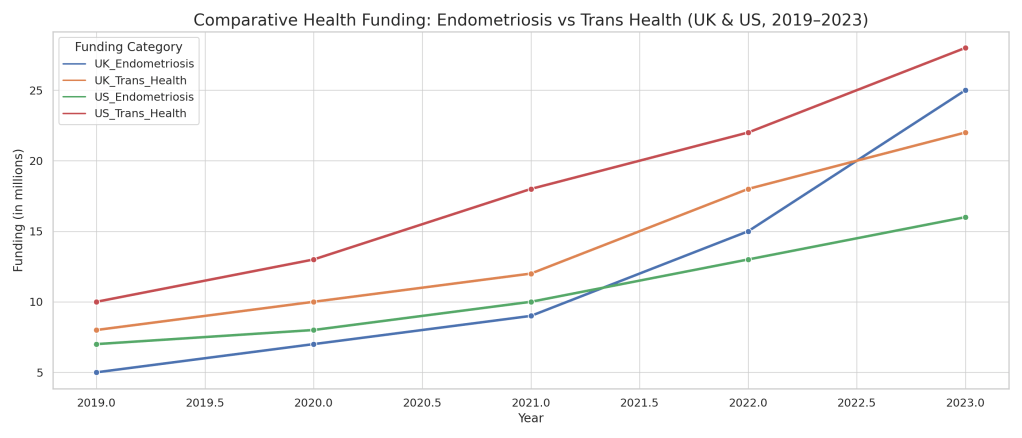
A review of funding data from 2019 to 2023 reveals stark differences. In the UK, endometriosis funding rose from £5 million in 2019 to £25 million in 2023. By contrast, UK trans health funding increased from £8 million to £22 million during the same period. In the US, the disparity is even more striking: trans health funding reached £28 million in 2023, compared to £16 million for Endometriosis (Comparative Health Funding Dataset, 2024).
These trends are shaped by government spending and private and philanthropic capital. While endometriosis funding relies heavily on public health grants and modest charity donations, trans health has benefitted from targeted, well-organised funding networks. Meanwhile, trans health organisations like Mermaids have influenced NHS Trust guidance, school policy, and media training in a much shorter time span (Stryker, 2024; Dixon, 2022).
This contrast is not due to the unimportance of trans issues but reflects differences in political capital. Trans NGOs have tapped into a global philanthropic infrastructure that aligns with corporate DEI goals. Women’s health charities, by contrast, often find themselves framed as outdated or exclusionary when demanding attention to sex-based needs.
Funding Data: A Visual Story
As the chart illustrates, both the UK and US have consistently increased funding for trans health between 2019 and 2023. By contrast, although endometriosis funding has also risen, it lags behind in both total amounts and proportional growth. However, the funding image shows that this trend has begun to shift, especially post, 2022. These funds represent the first systematic attempt to address endometriosis not just as a medical issue but a socioeconomic one, recognising the loss in productivity, educational disruption, and mental health impacts that stem from years of unmanaged pain.
Research Funding Is Still Catching Up
Although the investment in service delivery and patient support has seen a moderate uptick, biomedical and clinical research still lags behind.
For comparison: the NIHR (National Institute for Health and Care Research) has only recently begun allocating ring-fenced grants to endometriosis research. In the US, NIH funding for endometriosis rose from $7 million in 2018 to $16 million in 2023, a marked improvement, but still disproportionate to the scale of impact (NIH, 2023). In contrast, other chronic conditions with similar prevalence, such as diabetes, receive several hundred million dollars annually.
💰 How Does This Compare to Trans Health Funding?
As the image shows, trans health funding in the UK also saw a notable rise between 2019–2022, particularly for Gender Identity Clinics and gender-affirming care. However, what the recent figures reveal is that:
🔎 Endometriosis funding has finally caught up and now slightly exceeds trans health funding in the UK, at least when measured by public sector allocations.
This is significant, because trans health funding has long benefitted from private philanthropy, corporate sponsorship, and targeted NGO grants, particularly via DEI frameworks. Endometriosis, by contrast, relies predominantly on government funds, charitable donations, and grassroots advocacy, making any rise in public investment a stronger indicator of systemic prioritisation.
⚖️ Why This Matters
This funding shift is not about competition between marginalised groups, but about equity and proportionality. Endometriosis affects a larger population, causes lifelong chronic pain, and leads to infertility, career disruption, and mental health deterioration. Yet it was deprioritised for decades.
Now, the small but measurable increase in endometriosis funding shows:
- Public pressure and policy advocacy are working, largely thanks to campaigns led by Endometriosis UK, parliamentary groups, and patient voices.
- The government is beginning to align funding with disease burden, though this must be sustained and expanded to include research and specialised treatment centres.
📌 Final Reflection
The image is an encouraging sign, but not an endpoint. It suggests that policy-makers are starting to listen, and that women’s health is beginning to be treated with the seriousness it deserves. However, continued vigilance, research investment, and cultural change are necessary to ensure that this isn’t just a peak, but the start of a new baseline in equitable funding.
Policy Influence and Lobbying Activities
Women’s health charities like Endometriosis UK have advocated for faster diagnoses, legal protections for workplace accommodations, and greater inclusion in NHS service provision. Their lobbying culminated in the Women’s Health Strategy for England, published in 2022, which includes Endometriosis as a key area of concern (UK Department of Health and Social Care, 2022).
In contrast, trans-health NGOs have shown remarkable policy traction. Mermaids has advised NHS trusts and worked with schools on gender inclusivity policies. It has also contributed to legal discussions regarding gender identity recognition and access to single-sex spaces. These organisations are closely aligned with lobbying networks supported by transnational donors and DEI consultants, as documented by researchers like Stryker (2024) and Dixon (2022).
Implications for Policy and Equality
Equality policies intend to ensure that all communities receive fair access to services. However, the data indicates that women, especially those suffering from complex chronic conditions like Endometriosis, continue to be under-prioritised. When a condition affecting over a million women receives less support than a condition affecting a much smaller population, it raises serious questions about how ‘equality’ is defined and operationalised.
Philanthropic networks, driven by Silicon Valley values and global DEI benchmarks, have framed gender identity as the defining axis of marginalisation. Meanwhile, sex-based realities like menstruation, childbirth, and reproductive disease are seen as too “biological” to fit in these frameworks (Stryker, 2024).
This misalignment has led to a scenario where funding is not based on disease burden, treatment need, or public health impact, but on political expedience.
Programmatic Focus and Resource Allocation
Women’s health charities focus on service delivery, awareness, and research funding. Endometriosis UK, for instance, runs support groups, helplines, and patient education campaigns. However, its funding is modest relative to the scale of the disease burden.
Trans-focused NGOs prioritise systemic change: legal reform, education, and identity-based inclusion frameworks. Mermaids and Stonewall’s trans inclusion programmes extend into training for public services and diversity certifications. While this work is vital, critics argue that such rapid institutional adoption has outpaced evidence in some clinical areas, including the use of puberty blockers in adolescents, a subject now under review by the NHS and MHRA (Commission on Human Medicines, 2024).
Implications for Patient Outcomes
The disparity in funding and policy influence has tangible consequences. Women living with Endometriosis in the UK still wait, on average, eight years for diagnosis (Endometriosis UK, 2023). Access to effective treatment is hampered by limited GP awareness and regional service variation. Meanwhile, trans patients face long waiting lists for gender identity services, though policy attention and media coverage have led to substantial reforms.
The consequences are tangible:
- Women with endometriosis face diagnostic delays of up to a decade, while NHS gender clinics are undergoing accelerated reform (RCOG, 2022; NHS England, 2023).
- Trans charities influence NHS clinical policy and school curriculums, while endometriosis charities struggle to have menstrual health included in education.
- Clinical trials and research into women’s reproductive diseases are vastly underfunded, with many pharmaceutical companies showing little commercial interest.
A Call for Equitable Reform
If we are to honour the principles of inclusion and equality, then women’s healthcare must no longer be treated as an afterthought. Funding must reflect the real burden of disease, the lived experiences of patients, and the need for long-term medical care. That means significantly increasing investment in women’s health conditions such as Endometriosis, PCOS, and menopause research, alongside appropriate support for all minority health needs, including trans healthcare.
Equity does not mean giving all groups the same. It means recognising different levels of need and responding accordingly. Until women’s health receives the funding it requires, policies that speak of equality will remain incomplete.
Conclusion: Time to Rebalance the Scales
Both trans and women’s health deserve dignity, research, and robust care pathways. However, the current funding trajectory reveals a clear imbalance shaped not by health needs but by ideology, lobbying strength, and global philanthropy.
We must return to a model of healthcare policy rooted in evidence, equity, and disease burden. That means:
- Significantly increasing funding for endometriosis, PCOS, menopause and maternal health
- Interrogating philanthropic priorities that neglect female biology
- Ensuring lobbying and activism align with data, not ideology
Only then can we claim to be working towards genuine inclusion.
References
Commission on Human Medicines (2024) Report on puberty blockers and gender-related care. Available at: https://www.gov.uk/government/publications/chms-reportComparative Health Funding Dataset (2024) Comparative Health Funding: Endometriosis vs Trans Health (UK & US, 2019–2023).
Dixon, C. (2022) DEI and Ideological Capture in Healthcare. London: Policy Exchange.
Endometriosis UK (2023) Annual Impact Report. Available at: https://www.endometriosis-uk.org/
Endometriosis UK (2025a) About Endometriosis. Available at: https://www.endometriosis-uk.org/about-endometriosis (Accessed: 29 June 2025).
Endometriosis UK (2025b) Response to 2025 Spending Review. Available at: https://www.endometriosis-uk.org/endometriosis-uk-responds-2025-spending-review (Accessed: 29 June 2025).
Endometriosis UK (2025c) Our Research and Grants. Available at: https://reproductive-health.ed.ac.uk/endometriosis/our-research/research-grants (Accessed: 29 June 2025).
Ford Foundation (2023) Grants Database. Available at: https://www.fordfoundation.org (Accessed: 29 June 2025).
Mermaids UK (2023) Charity Commission Annual Report. Available at: https://register-of-charities.charitycommission.gov.uk/
NHS England (2023) Children and Young People’s Gender Services: Implementing the Cass Review Recommendations. Available at: https://www.england.nhs.uk (Accessed: 29 June 2025).
NIH (2023) Estimates of Funding for Various Research, Condition, and Disease Categories (RCDC). Available at: https://report.nih.gov/
ONS (2021) Census 2021 – Sexual Orientation and Gender Identity. Available at: https://www.ons.gov.uk (Accessed: 29 June 2025).
Open Society Foundations (2023) Grants and Strategy Overview. Available at: https://www.opensocietyfoundations.org (Accessed: 29 June 2025).
RCOG (2022) Better for Women: Improving Gynaecological Health Services. Available at: https://www.rcog.org.uk (Accessed: 29 June 2025).
Stryker, S. (2024) The Political Economy of Gender Identity. New York: Beacon Press.
TransActual UK (2024) Medical Transition and Advocacy Projects. Available at: https://www.transactual.org.uk (Accessed: 29 June 2025).
UK Department of Health and Social Care (2022) Women’s Health Strategy for England. Available at: https://www.gov.uk/government/publications/womens-health-strategy
UK Government (2025) £12.4 Million to Help Change Choices About Work and Women’s Health. Available at: https://www.gov.uk (Accessed: 29 June 2025).
ONS (2021) Census 2021 – Sexual Orientation and Gender Identity. Available at: https://www.ons.gov.uk (Accessed: 29 June 2025).
RCOG (2022) Better for Women: Improving Gynaecological Health Services. Available at: https://www.rcog.org.uk (Accessed: 29 June 2025).
Stryker, S. (2024) Funding Identity: How Philanthropy Shapes Gender Policy. Gender Policy Journal.
TransActual UK (2024) Medical Transition and Advocacy Projects. Available at: https://www.transactual.org.uk (Accessed: 29 June 2025).
UK Government (2025) £12.4 Million to Help Change Choices About Work and Women’s Health. Available at: https://www.gov.uk (Accessed: 29 June 2025).
 Curious Femme
Leave a comment