
The Stakes of Definition
As gender identity frameworks grow in legal and institutional influence, the very word “woman” has become contested ground. What was once a biological and political category used to protect female rights is now being reframed through subjective identity. However, the consequences of this shift are not merely semantic. They are lived, tangible, and disproportionately affect women and girls.
This blog explores the real-world effects of replacing sex-based definitions with identity-based ones. From prisons to rape crisis centres, from women’s sports to freedom of speech, the erosion of sex-based rights has introduced new risks, silenced legitimate debate, and undermined decades of feminist progress.
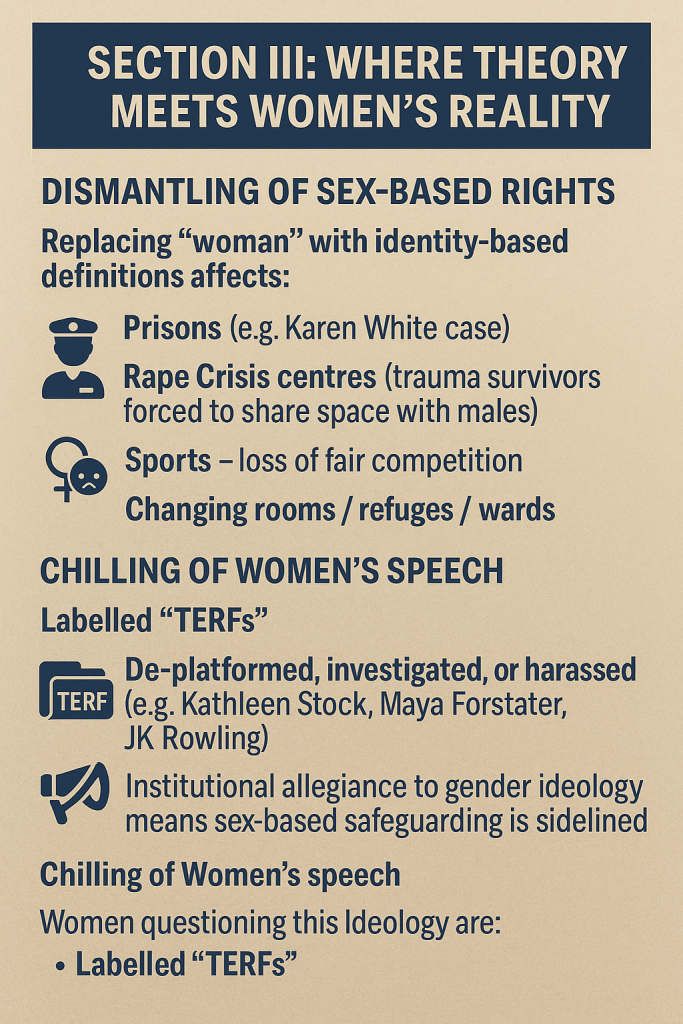
🚧 Prisons: The Karen White Case and a Wake-Up Call
In 2018, the Karen White case brought national attention to the risks posed by self-identification in the prison estate. White, a male-born sex offender who identified as a woman, was placed in a women’s prison where they sexually assaulted two female inmates within days of arrival (BBC News, 2018a; The Guardian, 2018).
Despite White’s extensive record of violence against women and a history of sexual offending, policy at the time prioritised gender identity over biological sex. This decision, now widely criticised, led to public outcry and policy reassessment (Ministry of Justice, 2019).
The Scottish Prison Service faced a similar backlash in 2024 for housing trans-identified males in female prisons, resulting in a review of its policies after media and legal scrutiny (BBC News, 2024). These cases reveal a serious safeguarding gap where institutional fear of offending trans rights overrides the need to protect vulnerable women.
“With these sensible new measures, we are striking the right balance between protecting the rights of women in custody and the rights of transgender individuals.”
– Ministry of Justice (2019)
Yet critics argue that such “balance” too often leaves women at risk.
Despite these reforms, the UK remains in tension between safeguarding and ideology. In the US, former President Donald Trump reignited the debate by proposing a blanket ban on housing transgender women in female prisons, illustrating how polarisation often overshadows nuanced policy discussion (The Guardian, 2025).
Rape Crisis Centres: When Safe Spaces No Longer Feel Safe
Women’s refuges and rape crisis services were built as sanctuaries. For trauma survivors, the ability to heal often depends on the guarantee of female-only spaces. However, under gender identity policies, this promise is being compromised.
In recent years, multiple rape crisis centres in the UK have restructured services to include anyone identifying as a woman, including male-bodied individuals. Rape Crisis England & Wales maintains that trans inclusion is part of its human rights obligations, but many women argue that this undermines their rights as trauma survivors (Rape Crisis, 2024).
The East Renfrewshire Crisis Centre publicly affirmed its commitment to serving “people of all genders aged 12–21” (ERCC, 2024), while others removed sex-specific language from their websites. Campaigns such as Sarah’s Legal Challenge have emerged in response, arguing that trauma survivors should not be forced to share therapy spaces with males, regardless of gender identity (CrowdJustice, 2024).
The heart of this issue is not one of hate or exclusion but of trauma-informed care. Survivors of male violence often need sex-specific environments to heal safely. Ignoring this need in favour of ideological uniformity risks re-traumatising those already harmed.
🏃♀️ Sports: Fairness Rewritten
In competitive sport, the tension between inclusion and fairness is especially stark. Biological males who identify as women are increasingly permitted to compete in female categories, prompting concern about safety and equity.
According to Fair Play For Women (2023), male-born athletes often retain physiological advantages, such as muscle mass, lung capacity, and bone density, even after hormone treatment. These advantages compromise fair competition and have led to injuries, losses, and the exclusion of female athletes from podiums.
A study by the Williams Institute (2023) estimates that trans inclusion in sport, while small in numbers, has significant implications at elite levels. In response, governing bodies such as World Athletics and FINA have implemented sex-based eligibility policies for fairness and safety.
The core feminist critique is simple: female athletes should not have to sacrifice opportunity, or safety, for ideological appeasement. Women’s sport was created precisely to offer equal access in a field long dominated by men.
🛁 Changing Rooms, Refuges, and Wards: Unseen Impact
The consequences of identity-based policies extend to more mundane but essential spaces: hospital wards, domestic violence refuges, and public changing rooms. Women report feeling uncomfortable or unsafe in mixed-sex spaces, particularly when recovering from trauma or illness.
However, across the UK, sex-segregated facilities are being replaced or rebranded as “gender-neutral” without public consultation. In many NHS trusts, “woman” is being removed from maternity wards and replaced with “birthing person”, a linguistic shift that erodes recognition of female biology in care (Sex Matters, 2021).
Yet voicing such concerns often leads to accusations of transphobia. In practice, women are being asked to prioritise another group’s comfort over their own bodily autonomy and psychological safety. A woman uncomfortable undressing in front of a male-bodied person is not expressing bigotry, she is asserting her boundaries.
🧨 Chilling Women’s Speech: The New Heretics
As the ideological redefinition of womanhood gains institutional traction, a parallel and deeply concerning trend has emerged: the systematic silencing of dissent. Women who challenge the replacement of sex-based definitions with identity-based ones often find themselves targeted, not with reasoned debate, but with reputational smears, professional penalties, and social ostracism.
The term “TERF” (Trans-Exclusionary Radical Feminist) is regularly weaponised to discredit gender-critical women, regardless of their political or academic standing. Far from being a neutral descriptor, it functions as a slur that delegitimises legitimate concerns about the erosion of women’s rights and safeguards.
In the “TERF Wars” special issue of Sociological Review Monographs, Pearce et al. detail how this shorthand became a disciplinary control tool institutions use to police academic speech and discipline dissenters (Pearce, Erikainen & Vincent, 2020) . They document, for example, how someone using “TERF” in an answering script faced institutional concern for potentially misogynist speech, illustrating the breadth of its silencing power.
Pearce et al. conclude that those who express gender-critical arguments “are frequently framed as misogynists, bigots or extremists, even by colleagues, employers and academic regulators”. This formalised censure extends beyond personal disagreement, it constitutes structural censorship within universities, media platforms, and civic institutions.
Consider the case of Professor Kathleen Stock, a respected philosopher who was effectively forced out of her academic post at the University of Sussex following sustained harassment campaigns. Her “crime” was to defend the idea that sex is real, immutable, and politically significant (Times Higher Education, 2021). Similarly, Maya Forstater, a tax expert, lost her job by asserting on social media that sex cannot be changed. In a landmark legal case, she later won an employment tribunal ruling affirming that gender-critical beliefs are protected under the Equality Act 2010 (Forstater v CGD Europe [2021]).
J.K. Rowling, arguably the most successful living female author, became a global flashpoint in this debate. Her support for sex-based rights and women’s single-sex spaces provoked an intense backlash, including calls for her cancellation, widespread abuse, and the distancing of former colleagues (The Critic, 2024).
The scale of this reaction is not merely anecdotal. Academic studies show that gender-critical women face some of the harshest social penalties in contemporary political discourse. In a 2024 peer-reviewed study, Pearce et al. found that women expressing sex realism are disproportionately subject to professional exclusion, online harassment, and institutional reprimands compared to their male or pro-gender-identity counterparts (Pearce et al., 2024).
This silencing is not confined to public figures. Ordinary women, including rape survivors, clinicians, teachers, and mothers, have reported losing jobs, being de-platformed, or being investigated for raising safeguarding concerns or stating that “women are adult human females.” The fear of reputational or career damage has chilled workplaces, universities, and civil society.
Peer-reviewed studies confirm that gender-critical women face more severe social repercussions than virtually any other ideological group. The institutionalisation of this mode of silencing has resulted in a climate of fear. Female academics, clinicians, survivors of male violence, and everyday women are increasingly afraid to speak out of fear for their careers, mental health, or safety.
What was once a pluralistic feminist discourse is now shrinking. Feminism is not being expanded; it is being demoted. When simply asserting that “woman” means adult human female becomes labelled as hate speech, we have not progressed; we have regressed.
The key concern is this: we are witnessing a regressive inversion of progress. Instead of fostering pluralism and protecting the rights of women to advocate for themselves, institutions now punish those who speak up for female biology, boundaries, and safety. Feminist analysis, once the bedrock of women’s liberation, is being recast as hate speech.
This is not progress; it is censorship masquerading as inclusion. Moreover, it raises an uncomfortable question: What kind of liberation punishes women for naming their own oppression?
Key concern: The stigmatisation of speech on this topic represents not progress but regression, one where feminism is punished, not promoted.
🔚 Conclusion: Inclusion Must Not Mean Erasure
Replacing the word “woman” with identity-based definitions may appear inclusive on the surface, but beneath, it erodes the sex-based rights that generations of feminists fought to establish. Prisons, rape crisis centres, sports, healthcare, and even public discourse are now shaped more by ideology than evidence.
In the name of progress, we risk reviving old oppressions under a new guise: one where women are told to be silent, to make space, and to forfeit protection so others feel seen. But visibility should not come at the cost of safeguarding.
If feminism means anything, it must mean defending the rights, safety, and voices of women, even when doing so is unpopular.
📚 References
BBC News (2018a). Transgender prisoner who sexually assaulted inmates jailed for life. [online] Available at: https://www.bbc.co.uk/news/uk-england-leeds-45825838.
The Guardian (2018). Transgender prisoner who sexually assaulted inmates jailed for life. [online] Available at: https://www.theguardian.com/uk-news/2018/oct/11/transgender-prisoner-who-sexually-assaulted-inmates-jailed-for-life.
Ministry of Justice (2019). New transgender prisoner policy comes into force. [online] Available at: https://www.gov.uk/government/news/new-transgender-prisoner-policy-comes-into-force.
BBC News (2024). Transgender prisoner controversy in Scotland. [online] Available at: https://www.bbc.co.uk/news/uk-scotland-67613441.
CrowdJustice (2024). Help Sarah’s Legal Challenge. [online] Available at: https://www.crowdjustice.com/case/help-sarahs-legal-challenge/.
Rape Crisis (2024). Women-Only Spaces Policy. [online] Available at: https://rapecrisis.org.uk/about-us/women-only-spaces/.
Fair Play For Women (2023). Campaign for fairness in women’s sports. [online] Available at: https://fairplayforwomen.com/campaigns/sports-campaign/.
Williams Institute (2023). Impact of trans sports inclusion. [online] Available at: https://williamsinstitute.law.ucla.edu/publications/impact-trans-sports-ban-eo/.
Times Higher Education (2021). Kathleen Stock: Life on the front line of the transgender rights debate. [online] Available at: https://www.timeshighereducation.com/news/kathleen-stock-life-front-line-transgender-rights-debate.
The Critic (2024). The second gender war. [online] Available at: https://thecritic.co.uk/the-second-gender-war/.
Pearce, R. et al. (2024). The silencing of gender-critical perspectives. Sociology, 58(2), pp.129–144.
SAGE Journals (2020). The limits of inclusion: Gender-critical views in the academy. Sociological Review, 68(5), pp.1034–1052.
 Curious Femme
Leave a comment