
- Updated 29/06/25
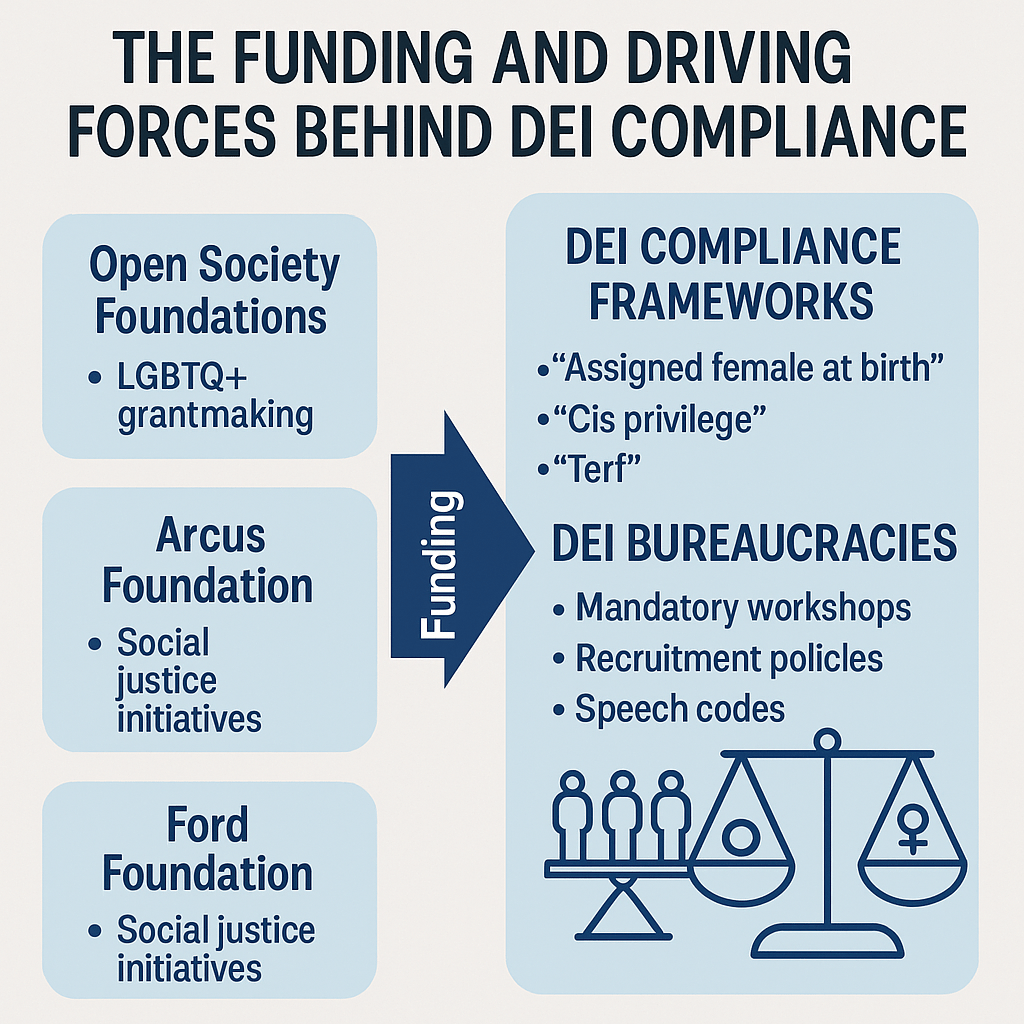
While the ideological foundation of gender identity policies originated in academia, its rapid institutional uptake was neither accidental nor purely grassroots. A critical driver was the strategic funding and influence of private foundations and corporate interests that reframed gender ideology as a global human rights and inclusion agenda. These actors provided financial resources, communication strategies, political lobbying, and policy infrastructure to embed self-identification frameworks into law, education, healthcare, and media.
Philanthropic Foundations and Ideological Capture
*.Three philanthropic giants have been central to this global rollout: the Open Society Foundations (OSF), the Arcus Foundation, and the Ford Foundation. These foundations have channelled vast sums into NGOs, academic centres, and activist organisations that promote self-identification, gender deconstruction, and the medicalisation of identity, often without public scrutiny or democratic oversight.
Recent data highlights the profound asymmetry in funding allocations. For example, the Ford Foundation alone committed over $420 million to gender equality programmes after the COVID-19 pandemic, programmes which explicitly included transgender and non-binary individuals. Of this, at least $10 million has been earmarked exclusively for trans-led and gender-diverse organisations. In contrast, organisations campaigning for sex-based rights, such as LGB Alliance or Sex Matters, are estimated to have received less than $1.5 million in combined philanthropic support over a comparable period.
This disparity reveals an institutional preference: initiatives aligning with postmodern identity frameworks receive overwhelming financial support, while those focused on material sex-based protections are systematically underfunded. The following chart illustrates the estimated allocation of philanthropic funding by target group:
This sharp financial imbalance not only explains the accelerated institutional uptake of gender identity ideology, but also reveals the structural disadvantage facing organisations defending women’s sex-based rights. Funding, in this case, is not a neutral mechanism of support, it becomes a tool of ideological engineering.
*. Summary of Key Findings:
| Target Group | Estimated Total Funding (Recent Years) | Key Funders |
|---|---|---|
| Trans & Gender-Diverse | $450M+ | Ford Foundation ($420M globally incl. trans & NB), OSF, Arcus, Astraea |
| BIPOC LGBTQ+ | $10M–$20M+ | OSF, Ford Foundation, Stonewall Community Foundation |
| Cisgender Women’s Rights | ~$50M (mostly intersectional/inclusive of trans) | Ford Foundation, Mama Cash, limited direct investment |
| Sex-Based Rights (e.g., GC Women) | < $2M globally (across 5+ years) | Crowdfunded, grassroots, minimal foundation support |
*.The data presented in the funding comparison table was compiled from multiple financial reports and audited statements from major philanthropic organisations, including the Ford Foundation (2022, 2023), Open Society Foundations (2023), Arcus Foundation (2022), Baring Foundation (2022), Astraea Foundation (2022), AHR (2022), and the Global Resilience Report (2022).
The Open Society Foundations (OSF), founded by Hungarian-American billionaire and hedge fund magnate George Soros, is one of the largest private philanthropic organisations in the world. With an endowment exceeding $25 billion, OSF operates in over 120 countries, financing causes under the broad banner of “open society” values, typically interpreted as pluralism, liberal democracy, human rights, and anti-authoritarianism (Open Society Foundations, 2023).
At its core, the OSF is shaped by Soros’s interpretation of Karl Popper’s political philosophy. In The Open Society and Its Enemies (1945), Popper proposed that open societies must remain vigilant against totalitarianism by fostering critical thinking, minority rights, and institutional reform. Soros, a devoted adherent, transposed this framework onto his global philanthropic ventures, focusing on transitions from communism, media independence, drug policy reform, and human rights (The Guardian, 2018; Forbes, 2024).
Why LGBTQ+ Rights, and Why Now?
The OSF began expanding its LGBTQ+ funding in the early 2000s, initially focused on decriminalisation and anti-discrimination in post-communist and Global South countries. However, by the 2010s, its scope broadened significantly to include gender identity, transgender healthcare, and intersectional advocacy, an evolution that reflected the shifting priorities of Western academic and activist circles.
Critics suggest that OSF’s adoption of gender identity ideology represents more than a moral or humanitarian commitment; it constitutes a strategic redefinition of civil liberties through identity-based frameworks. By embedding “gender identity” into legal, educational, and healthcare systems, OSF positions itself at the vanguard of progressive social reform, aligning with international human rights narratives while steering the conversation towards a postmodern, identity-centred conception of rights (First Things, 2020).
This approach reflects a broader neoliberal transformation of rights discourse, where subjective self-identification replaces material class- or sex-based analysis. Gender, in this schema, becomes a matter of individual autonomy rather than structural position. This shift fits seamlessly with OSF’s philosophical commitment to the autonomy of the self. However, it also has the effect of fragmenting collective political categories, such as “women” or “working class”, and replacing them with fluid, individualised identities.
What Is in It for OSF?
Several overlapping motivations can be identified behind OSF’s deep investment in gender identity ideology:
- Philosophical Alignment: Soros’s belief in reflexive individualism and scepticism of “essentialism” makes gender self-identification attractive ideologically. The notion that identity is constructed, chosen, and performed aligns with the postmodern ethos OSF-funded academic and advocacy centres embraced.
- Global Governance Influence: By funding NGOs, legal toolkits, and UN advocacy campaigns, OSF contributes to norm-setting at the international level, influencing how bodies like the United Nations and WHO frame gender and sexuality. This gives OSF strategic soft power in shaping the human rights agenda globally (Open Society Foundations, 2021).
- Restructuring Institutions: Funding gender identity policies contributes to remodelling public institutions along DEI lines. This allows OSF to steer educational, healthcare, and legal frameworks in recipient countries towards compliance with liberal Western values, often under the guise of modernisation or democratisation (The Guardian, 2018; National Review, 2022).
- Moral Capital and Elite Legitimacy: Supporting trans rights enables OSF to position itself as a moral authority, especially within elite policy and media circles. This helps secure its legitimacy among Western liberal institutions, many of which rely on OSF grants. The result is a feedback loop where cultural capital is accrued by funding identity causes that few will publicly oppose.
- The depoliticisation of Class and Material Conditions: Gender identity discourse redirects attention away from class inequality, economic justice, and sex-based oppression towards individual identity affirmation. In doing so, it diffuses radical left critiques of capitalism that once targeted elites like Soros and instead reframes social justice around personal validation rather than material redistribution.
The Democratic Deficit
What makes OSF’s influence particularly contentious is the lack of democratic accountability. Unlike elected governments or local charities, OSF sets transnational agendas based on the ideological preferences of a few unelected billionaires and their advisors. Its funding of legal activism, university programmes, and media campaigns has reshaped public policy without public consent, particularly in countries like Ireland, the UK, and Eastern Europe (The Critic, 2022).
In this sense, OSF’s support for gender identity ideology is not neutral philanthropy. It is ideological engineering conducted through the language of rights, justified by a cosmopolitan elite philosophy, and executed via a vast international funding network that redefines legal and cultural norms at scale.
The Arcus Foundation, founded in 2000 by billionaire Jon Stryker, is a leading philanthropic entity committed to “social justice and conservation,” specifically emphasising LGBTQ+ rights and ape conservation. Stryker, an openly gay heir to the Stryker Corporation fortune, a global leader in surgical equipment, has funnelled over $500 million into Arcus to date, making it one of the most powerful LGBTQ+ philanthropic institutions in the world (Arcus Foundation, 2023; Forbes, 2024).
With an explicit mission to “advance LGBTQ social justice worldwide”, the Foundation has focused heavily on influencing public discourse, policy frameworks, and institutional narratives. While its support for decriminalisation and anti-violence measures has been broadly welcomed, its more recent funding of gender ideology, including self-identification policies and transgender medicalisation, has raised questions about its ideological reach and underlying motivations.
Strategic Priorities: From Rights to Ideology
Arcus frames its grantmaking through a “movement-building” lens, prioritising:
- Narrative change (e.g., funding media outlets and storytellers)
- Legal reform (via think tanks, lawfare strategies, and UN advocacy)
- Faith-based inclusion (targeting religious institutions to adopt affirming stances)
- Intersectionality (supporting organisations that blend race, gender, and sexual identity)
Who Funds Arcus and Why?
Jon Stryker, a trained architect and the great-grandson of Homer Stryker (founder of the multibillion-dollar medical technology firm Stryker Corporation), has an estimated net worth of $4.4 billion (Forbes, 2024). The Arcus Foundation is funded almost entirely through Stryker’s private wealth, with over $500 million in assets as of 2023 and annual grantmaking exceeding $25 million (Influence Watch, 2023).
Stryker’s corporate ties are significant: Stryker Corporation produces surgical equipment, including tools used in gender-affirming surgeries, such as mastectomy and phalloplasty kits (Stryker, 2024). This has raised questions about whether Arcus’s aggressive promotion of medicalised gender transition may also align with commercial interests, especially given the Foundation’s support for the normalisation of medical transition among minors and vulnerable populations (First Things, 2022).
According to the Foundation’s strategy reports, a key objective is to “dismantle the binary construct of gender” by supporting trans-led organisations that aim to embed “fluid and expansive” concepts of identity into social policy, education, and healthcare systems (Arcus Foundation, 2022a). It has invested millions into shaping the ideological and legal scaffolding of gender identity, often through indirect influence over governments, universities, and religious communities.
Global Influence Through Strategic Grantmaking
Arcus does not merely support LGBT rights; it strategically reshapes institutions. Its funding recipients include:
- ILGA-World, the International Lesbian, Gay, Bisexual, Trans and Intersex Association
- GATE (Global Action for Trans Equality)
- OutRight Action International
- Transgender Law Center
- Religious News Service (to reshape religious messaging on LGBT inclusion)
*. The Stonewall Community Foundation, based in the United States, operates as the American counterpart to Stonewall UK. As a prominent LGBTQ+ public grantmaking charity, the foundation disbursed over US $1 million in 2024 to grassroots organisations, with a strong emphasis on BIPOC- and trans-led initiatives supporting vulnerable queer communities across the United States and its territories (Stonewall Community Foundation, 2025). Notably, it launched a two-year funding programme supported by the Mark L. Brandt Legacy Fund, awarding up to US $20,000 per year per organisation for two years.
Stonewall UK receives substantial financial backing from domestic and international public bodies in the United Kingdom. This includes taxpayer-funded grants and diversity scheme payments. In the 2022–2023 fiscal year, the organisation received approximately £573,000 from UK government sources, an increase on previous years, and continues to lead the Diversity Champions scheme, which remains active in over 175 public sector institutions, including NHS trusts, universities, and local councils (TaxPayers’ Alliance, 2023; The Times, 2024).
Additional funding has been granted through devolved governments. Between 2022 and 2025, the Welsh Government allocated £140,000 to Stonewall, while the Scottish Government provided funding estimated between £400,000 and £640,000, despite rising concerns regarding staffing capacity and organisational transparency in the region (Welsh Government FOI, 2025; The Times, 2024).
Stonewall UK also received a £29,672 grant from the Baring Foundation in 2017 to help embed LGBTQ+ inclusion within UK international aid programmes (Baring Foundation, 2018). However, it is important to clarify that the Baring Foundation is not structurally or financially linked to Stonewall or other prominent funders such as the Open Society Foundations or the Arcus Foundation. The Baring Foundation operates independently, with its board, endowment, and strategy, and is funded primarily through its investment portfolio. While it may occasionally co-fund similar causes, it remains autonomous and not part of any shared funding infrastructure.
This mixture of public money, philanthropic capital, and institutional influence positions Stonewall as a powerful lobbying force. However, it also raises questions about accountability, especially given the absence of formal democratic oversight over many of its policy-shaping activities.
Impact & Significance
Financial Leverage
Stonewall operates as a resource-rich gatekeeper, distributing significant funding and guidance within public, private, and third sectors.
Policy Conflicts of Interest
By combining government grants with policy advocacy, Stonewall poses a conflict of interest: public funds are used to influence government policy in ways that critics argue may not align with democratic accountability (TaxPayers’ Alliance, 2023; The Times, 2024).
Asymmetry in Funding
Comparatively, women-focused charities, particularly those campaigning for sex-based rights, operate with far less funding and no comparable institutional influence, illustrating the systemic imbalance in power and resources (Sex Matters, 2021).
Arcus also funds media outlets and faith-based organisations to shift public and theological narratives, effectively reframing opposition to gender ideology as “extremism” or “hate speech” (Catholic News Agency, 2015; Arcus Foundation, 2022). According to its internal strategy documents, Arcus pursues a “saturation model” of cultural change, simultaneously investing in faith, education, law, health, and entertainment to ensure the systemic adoption of gender ideology (Arcus Foundation, 2022b).
A 2022 Arcus report, The Strategy at Work, outlines how it funds “advocacy that builds pressure on public systems” and seeks to “displace narratives rooted in binary understandings of gender and sexuality” (Arcus Foundation, 2022b). This is not passive philanthropy; it is targeted ideological engineering.
Ideological and Financial Convergence
Critics argue that Arcus’s agenda promotes a Western, postmodern framework of identity that is often exported to Global South countries through conditional funding and NGO partnerships. The imposition of self-ID, deconstruction of sex-based rights, and the medicalisation of identity may conflict with indigenous, feminist, or religious values in these regions (The Critic, 2023).
Moreover, the Arcus model reflects a growing convergence between elite ideology and financial interest: its founder profits from medical technologies used in transition surgeries, while the Foundation campaigns for broader acceptance, access, and even legal compulsion of such procedures. The result is a circular economy of ideology, where belief systems are funded and monetised.
*. The Ford Foundation, one of the most influential philanthropic organisations globally, has played a pivotal role in embedding gender identity ideology into public policy, education, and healthcare. While the Foundation’s historical roots lie in civil rights and anti-poverty work, its strategic shift during the 2010s has significantly redirected resources toward identity-based frameworks, emphasising transgender and non-binary rights.
Financial Commitments and Initiatives
Throughout the 2010s, the Foundation expanded its remit to include transgender and non-binary communities, framing this as part of a broader intersectional justice agenda:
In 2014, the Foundation launched the LGBTQ+ Racial Justice Fund, initially distributing approximately US $780,000 to organisations serving LGBTQ+ people of colour in the southern United States (Ford Foundation, 2014). This was one of the earliest indications of Ford’s intention to embed intersectionality into its funding priorities.
By 2021, the Foundation had committed US $420 million globally to gender equality initiatives after the COVID-19 pandemic. This programme explicitly included cisgender women, transgender, and non-binary individuals, adopting an intersectional lens to address economic insecurity and health disparities (Ford Foundation, 2021).
In June 2022, Ford doubled its investment in trans-led and gender-diverse organisations, pledging US $10 million over five years. The funding bolsters legal advocacy, education initiatives, and public policy reforms aligned with gender self-identification frameworks (Ford Foundation, 2022b).
These interventions are not peripheral to Ford’s mission, they are core to its self-described role as a “global driver of justice.” In its 2022 Annual Report, the Foundation emphasised its work in embedding gender-diverse leadership in public, corporate, and philanthropic institutions (Ford Foundation, 2022a).
Intersectional Justice Strategy and Broader Funding:
- The Foundation has embedded gender diversity into its broader intersectional justice framework, funding organisations such as Astraea Lesbian Foundation for Justice and Mama Cash, both of which advocate for gender self-ID policies globally .
- Annual reports indicate significant, recurring grants in the multi-million-dollar range to networks working on gender identity, although exact yearly breakdowns are sometimes distributed across sub-grantees and multi-programme portfolios.
What’s in It for the Foundation?
Reinforcing Moral and Institutional Authority
The Ford Foundation positions itself as a global moral leader. Its investments in gender identity advocacy enhance its progressive reputation among policymakers, media, and academia, securing its relevance among elite institutions (Capital Research Center, 2023).
Shaping Public Policy Through Strategic Funding
By funding legal campaigns, education reform, and healthcare policy shifts, Ford directly influences institutional adoption of self-ID principles. This includes integrating HR practices, university curricula, and public sector policies.
Together, these foundations helped institutionalise gender identity ideology across national borders through the coordinated funding of legal toolkits, educational materials, healthcare guidelines, and diversity compliance structures. What began as a philosophical argument in the humanities departments of Ivy League universities was rapidly converted into a bureaucratic orthodoxy in Western public institutions.
🔹 Corporate and Medical Financial Interests
Beyond philanthropy, gender identity ideology intersects with powerful commercial incentives. The rise of medicalised gender identity, puberty blockers, cross-sex hormones, double mastectomies, phalloplasties, and facial surgeries, has opened a lucrative and expanding market.
Companies such as Stryker Corp, which produces surgical equipment used in “gender-affirming” operations, are implicated in the growing profitability of these procedures (Stryker, 2024). Meanwhile, the pharmaceutical industry profits from lifelong hormone prescriptions, a dependency often initiated during adolescence. For example, gonadotropin-releasing hormone agonists (GnRHa), such as those used to block puberty, are associated with long-term medical monitoring and risks that remain insufficiently studied (UK Commission on Human Medicines, 2023).
Reports have highlighted the multi-billion dollar industry emerging from what is increasingly described as the gender industrial complex, wherein ideological narratives enable commercial expansion under the guise of healthcare access and inclusion (National Review, 2022). This commercial infrastructure benefits from the rapid institutional uptake of Diversity, Equity, and Inclusion (DEI) policies, which often mandate compliance training, consultancy contracts, and external certification schemes which monetise the ideology.
Monetising Inclusion Through Policy Capture
Policy rollout has also occurred through DEI frameworks, which offer public and private institutions accreditation in “inclusive” practice, often via paid consultancy provided by NGOs aligned with gender identity lobbying. Stonewall’s Diversity Champions Programme, for example, operated as a fee-based model, encouraging institutions to adopt self-ID policies in exchange for approval and branding (Sex Matters, 2021).
In this sense, inclusion becomes a commodified virtue. Rather than emerging from organic democratic dialogue, gender identity frameworks are sold to institutions as evidence of progressive values, modernity, and compliance with best practice. The result is that public bodies, from NHS trusts to primary schools, have implemented controversial policies without public consultation, medical consensus, or parliamentary debate.
Conclusion: Ideology Backed by Infrastructure
The institutionalisation of gender identity ideology has not been an organic or democratic development; it has been deliberately engineered. Driven by well-resourced philanthropic foundations, reinforced by corporate and medical interests, and embedded through Diversity, Equity, and Inclusion (DEI) compliance structures, this ideological shift has been systematically funded, promoted, and normalised. Through strategic investment, what began as an academic theory has been transformed into policy orthodoxy across education, healthcare, law, and public administration.
This convergence of ideology, finance, and institutional authority has reframed deeply contested concepts as moral imperatives, often bypassing public consultation and democratic scrutiny. The result is not only a redefinition of rights but a redistribution of power away from citizens and toward unelected foundations, consultants, and global policy elites.
As the next section will show, the implications are not theoretical. From compromised data practices to policy conflicts in women’s healthcare and safeguarding, the lived consequences are now surfacing across sectors, with growing concern among professionals, parents, and academics alike.
References
- Equality Act 2010. UK Public General Acts. Available at: https://www.legislation.gov.uk/ukpga/2010/15/contents
- Fast Company (2018). How the Ford Foundation is investing in change. Available at: https://www.fastcompany.com/40580227/how-the-ford-foundation-is-investing-in-change (Accessed June 2025)
- First Things (2020). The Billionaires Behind the LGBT Movement. Available at: https://www.firstthings.com/web-exclusives/2020/07/the-billionaires-behind-the-lgbt-movement (Accessed June 2025)
- First Things (2022). The Billionaires Behind the LGBT Movement. Available at: https://www.firstthings.com/web-exclusives/2022/01/the-billionaires-behind-the-lgbt-movement (Accessed June 2025)
- Forbes (2024). George Soros Profile. Available at: https://www.forbes.com/profile/george-soros/ (Accessed June 2025)
- Forbes (2024). Jon Stryker Profile. Available at: https://www.forbes.com/profile/jon-stryker/ (Accessed June 2025)
- Ford Foundation (2014). Strengthening the Voices of LGBTQ People of Color. Available at: https://www.fordfoundation.org/news-and-stories/news-and-press/news/strengthening-the-voices-of-lgbtq-people-of-color/ (Accessed June 2025)
- Ford Foundation (2021). Delivering Gender Justice Takes All of Us. Available at: https://www.fordfoundation.org/news-and-stories/stories/investing-in-change-why-we-must-support-women-and-gender-diverse-leaders/ (Accessed June 2025)
- Ford Foundation (2022a). Annual Report 2022. Available at: https://www.fordfoundation.org/about/annual-report/ (Accessed June 2025)
- Ford Foundation (2022b). Ford Doubles Investment for Trans Organisations. Available at: https://www.fordfoundation.org/news-and-stories/news-and-press/news/ford-foundation-doubles-investment-for-trans-organizations-makes-sweeping-commitments-to-support-lgbtq-communities/ (Accessed June 2025)
- Ford Foundation (2023). Grants Database. Available at: https://www.fordfoundation.org/work/our-grants/ (Accessed June 2025)
- Influence Watch (2023). Arcus Foundation. Available at: https://www.influencewatch.org/non-profit/arcus-foundation/ (Accessed June 2025)
- National Review (2022). The Gender Industrial Complex Makes Billions Annually. Available at: https://www.nationalreview.com/corner/the-gender-industrial-complex-makes-billions-annually/ (Accessed June 2025)
- Open Society Foundations (2021). What We Do: LGBTI Rights. Available at: https://www.opensocietyfoundations.org/topics/lgbti-rights (Accessed June 2025)
- Open Society Foundations (2023). George Soros Biography. Available at: https://www.opensocietyfoundations.org/george-soros (Accessed June 2025)
- Spherical Insights (2023). Global Gender-Affirming Care Market Report. Available at: https://www.sphericalinsights.com/reports/global-gender-affirming-care-market (Accessed June 2025)
- Stryker (2024). Medical and Surgical Equipment Overview. Available at: https://www.stryker.com/ (Accessed June 2025)
- The Critic (2022). Ireland Has Become an Exporter of Gender Ideology. Available at: https://thecritic.co.uk/ireland-has-become-an-exporter-of-gender-ideology/ (Accessed June 2025)
- The Guardian (2018). The George Soros Philosophy and Its Fatal Flaw. Available at: https://www.theguardian.com/news/2018/jul/06/the-george-soros-philosophy-and-its-fatal-flaw (Accessed June 2025)
 Curious Femme
Leave a comment