
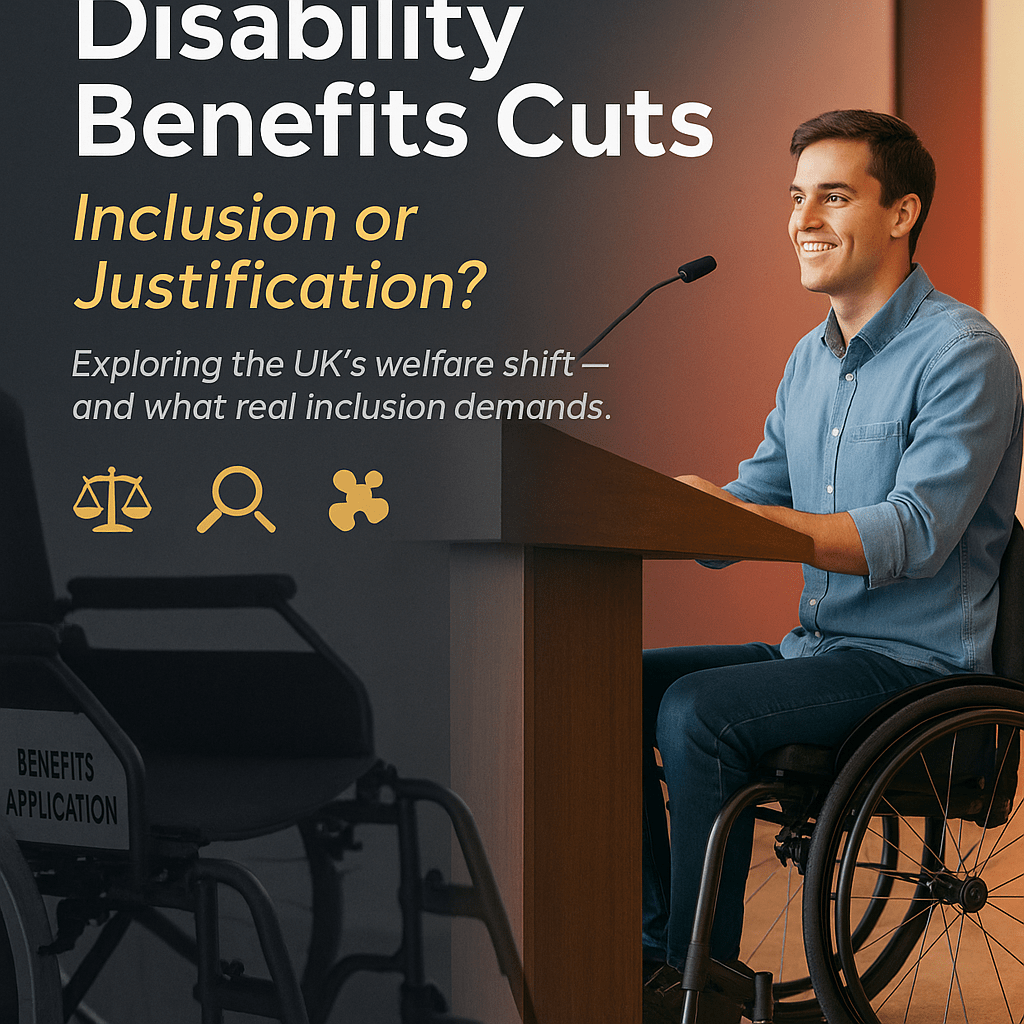
Recent government proposals in the UK suggest substantial reductions in health and disability-related benefits, including changes to Personal Independence Payment (PIP) and Universal Credit. Analysis from the Joseph Rowntree Foundation, Disability Rights UK, and Scope indicates these cuts could push approximately 400,000 people into poverty (Disability Rights UK, 2025; JRF, 2025).
Ministers have justified these changes as part of a drive to “get Britain working”, implying that benefit reform is necessary to reduce welfare spending and encourage economic participation (BBC News, 2025a). However, such framing invites deeper scrutiny. Why are disabled people, particularly those with mental health conditions, long-term illness, or caring responsibilities, bearing the brunt of fiscal tightening?
Critics argue that these reforms reflect more than financial necessity; they represent a societal value shift from collective care towards conditional support. The underlying message equates human value with economic productivity, sidelining those unable to work within traditional frameworks (The Guardian, 2025; ITV News, 2025). This shift appears to align with a broader austerity doctrine—where welfare retrenchment is driven by ideology, not necessity. Historically, austerity has disproportionately affected marginalised groups (Citizens Advice, 2025).
Work Support for Disabled People: Promises vs Reality
Government policy often emphasises schemes like Access to Work as support mechanisms, offering grants for practical assistance in employment settings (Gov.uk, 2025). While comprehensive in theory, its practical delivery has fallen short. Reports show significant delays, with applicants waiting months for essential adjustments, often resulting in lost job opportunities (Disability News Service, 2025; Disability Rights UK, 2025).
At the same time, the Department for Work and Pensions (DWP) claims that over 200,000 disabled benefit recipients are “work ready” (Benefits and Work, 2025a). Yet many report inadequate support and systemic barriers to sustainable employment (Big Issue, 2025). A survey by Citizens Advice highlights that employment alone rarely provides financial stability, particularly for those losing benefits upon entering the workforce (Citizens Advice, 2025).
Organisations such as the TUC and Scope argue that current policy focuses more on removing people from benefits than genuinely facilitating inclusive employment (TUC, 2025; Scope, 2025). Many former PIP claimants report being financially worse off after taking up work (Benefits and Work, 2025b).
Is the UK Falling Behind? International Comparisons
Internationally, countries like Norway, Germany, and New Zealand have adopted inclusive models integrating care, employment, and rights. Norway’s Inclusive Workplace Agreement promotes collaborative adjustments between employers and government (OECD, 2023). Germany enforces quotas for disabled employment and reinvests employer levies into support schemes (European Commission, 2022). New Zealand’s Enabling Good Lives model, co-designed with disabled communities, offers holistic, cross-sectoral support (New Zealand Ministry of Social Development, 2024).
In contrast, the UK system continues to rely on conditionality. Access to Work, while valuable, remains difficult to access and inconsistently delivered (Scope, 2025).
Can a System Rooted in Conditionality Deliver Inclusion?
Conditionality presumes a transactional relationship, support in exchange for compliance. This model rarely fosters belonging. True inclusion acknowledges systemic barriers and centres support on rights, not earned status.
Building With, Not For, Disabled People
Real change requires:
- Co-production: Decision-making shared with disabled people (New Zealand Ministry of Social Development, 2024).
- Rights-based frameworks: Legal entitlements rather than conditional grants.
- Integrated support: Cross-sector systems recognising disability as multifaceted.
- Narrative shift: From burden to infrastructure.
- Accountability: Transparent data and independent oversight.
What Structures Must Change?
- Welfare: From suspicion to trust, with automatic access and income guarantees.
- Employment: Redefining productivity and embedding access.
- Education: Inclusive design from the outset.
- Care: Integrated services and personalised support.
- Politics: Structural representation and disabled-led policy.
Letting go of control means embracing collaboration and valuing lived experience as expertise.
Care Over Compliance
Valuing care would mean:
- New metrics centred on wellbeing.
- Trauma-informed, person-centred systems.
- Public investment in care infrastructure.
- Positive narratives around interdependence.
Rights Over Privilege
Support must be a guaranteed right, not a discretionary favour. This requires:
- Legislative entitlement.
- Ending punitive assessments.
- Historical recognition and reparation.
The Central Question: Inclusion or Justification?
Government rhetoric emphasises empowerment, but many experience withdrawal, delay, and suspicion. The shift is from need-based support to work-contingent entitlement.
Timeline: Key UK Disability Policy Shifts
| Year | Event | Impact |
|---|---|---|
| 2012 | PIP replaces DLA | Increased reassessments, reduced eligibility |
| 2016 | ESA and UC reforms | Penalised claimants, reduced financial stability |
| 2019 | UN criticism | International condemnation of systemic exclusion |
| 2021 | Disability Strategy | Criticised as tokenistic and underfunded |
| 2023 | Kendall’s budget remarks | Cost-saving prioritised over inclusion |
| 2025 | PIP/UC cuts | 400,000 risk falling into poverty |
Narratives vs Realities
| Narrative | Framing | Reality |
| “Back to work” | Empowerment | Ignores barriers and reduces support |
| “Broken system” | Fraud prevention | Fraud is minimal; cuts hit the vulnerable |
| “Sustainability” | Future-focused | Short-term cuts with long-term harm |
| “Targeted support” | Efficiency | Creates hierarchies of deservingness |
What Must the UK Government Do?
To move from rhetoric to reality, the government must:
1. Legislate Support as a Right
- Enshrine access to disability support in law.
- End benefit conditionality.
- Introduce a guaranteed income model for disabled people.
2. Invest in Care as Infrastructure
- Fully fund and streamline Access to Work.
- Expand funding for personal assistance and peer support.
- Recognise unpaid care as socially valuable.
3. Co-Produce All Policy
- Prioritise disabled-led organisations in welfare reform.
- Replace token consultation with shared governance.
4. Rebuild Employment Systems
- Mandate accessible, flexible jobs.
- Incentivise inclusion across all sectors.
- Protect against benefit losses for those working part-time or irregularly.
5. Shift the Narrative
- Promote inclusion as standard, not exceptional.
- Reject deficit-based portrayals in media and politics.
- Treat support as essential social infrastructure.
Final Reflection: Inclusion or Erasure?
If support is conditional on work, but systems do not enable work, then exclusion becomes policy. When value is tied to productivity, those who do not conform are erased.
The question is no longer whether reform is needed but whether it will serve justice, not just the balance sheet.
References
BBC News (2025a) Health and disability benefit changes to affect hundreds of thousands. [Online] Available at: https://www.bbc.co.uk/news/articles/cdjxygjrk9ro [Accessed 26 Jun. 2025].
Benefits and Work (2025a) DWP survey says 200,000 disabled claimants are “work ready”. [Online] Available at: https://www.benefitsandwork.co.uk/news/dwp-survey-says-200,000-disabled-claimants-are-work-ready [Accessed 26 Jun. 2025].
Benefits and Work (2025b) Ex-PIP claimants are unlikely to get work and will probably be worse off even if they do. [Online] Available at: https://www.benefitsandwork.co.uk/news/ex-pip-claimants-unlikely-to-get-work-and-will-probably-be-worse-off-even-if-they-do [Accessed 26 Jun. 2025].
Big Issue (2025) The truth about disabled people and work under the DWP. [Online] Available at: https://www.bigissue.com/news/employment/dwp-disability-benefit-claimants-work-truth/ [Accessed 26 Jun. 2025].
Citizens Advice (2025) Pathways to Poverty: How Planned Cuts to Disability Benefits Will Impact the Vulnerable. [Online] Available at: https://www.citizensadvice.org.uk/policy/publications/pathways-to-poverty [Accessed 26 Jun. 2025].
Disability News Service (2025) Access to Work delays shoot up just as the government is trying to address disability employment. [Online] Available at: https://www.disabilitynewsservice.com/access-to-work-delays-shoot-up-just-as-government-is-trying-to-address-disability-employment/ [Accessed 26 Jun. 2025].
Disability Rights UK (2025) 400,000 People to be Pushed into Poverty by Benefit Cuts. [Online] Available at: https://www.disabilityrightsuk.org/news [Accessed 26 Jun. 2025].
European Commission (2022) Labour Market Integration of Persons with Disabilities – Germany Country Profile. [Online] Available at: https://ec.europa.eu/social [Accessed 26 Jun. 2025].
Gov.uk (2025) Access to Work: Eligibility. [Online] Available at: https://www.gov.uk/access-to-work/eligibility [Accessed 26 Jun. 2025].
ITV News (2025) PIP and Universal Credit Cuts: Who Will Be Hit and How Much Will They Lose? [Online] Available at: https://www.itv.com/news/2025-06-25/pip-and-universal-credit-cuts-who-will-be-hit-and-how-much-will-they-lose [Accessed 26 Jun. 2025].
JRF – Joseph Rowntree Foundation (2025) Where Will Cuts to Sickness and Disability Benefits Fall Hardest? [Online] Available at: https://www.jrf.org.uk/social-security [Accessed 26 Jun. 2025].
New Zealand Ministry of Social Development (2024) Enabling Good Lives. [Online] Available at: https://www.msd.govt.nz/about-msd-and-our-work/work-programmes/disability/enabling-good-lives.html [Accessed 26 Jun. 2025].
OECD – Organisation for Economic Co-operation and Development (2023) Disability and Work in Norway: Policy Insights. [Online] Available at: https://www.oecd.org/social/disability [Accessed 26 Jun. 2025].
Scope (2025) Access to Work Grant Scheme – Advice and Support. [Online] Available at: https://www.scope.org.uk/advice-and-support/access-to-work-grant-scheme [Accessed 26 Jun. 2025].
The Guardian (2025) UK Benefits System Could Collapse if Payments Are Not Cut, Says Liz Kendall. [Online] Available at: https://www.theguardian.com/politics/2025/jun/18/uk-benefits-system-could-collapse-if-payments-are-not-cut-liz-kendall-says [Accessed 26 Jun. 2025].
TUC (2025) The government should be supporting people into work – not making disabled people’s lives harder. [Online] Available at: https://www.tuc.org.uk/blogs/government-should-be-supporting-people-work-not-making-disabled-peoples-lives-harder [Accessed 26 Jun. 2025].
#DisabilityJustice #SocialPolicy #WelfareReform #InclusionNotConditionality #RethinkWelfare
 Curious Femme
Leave a comment