
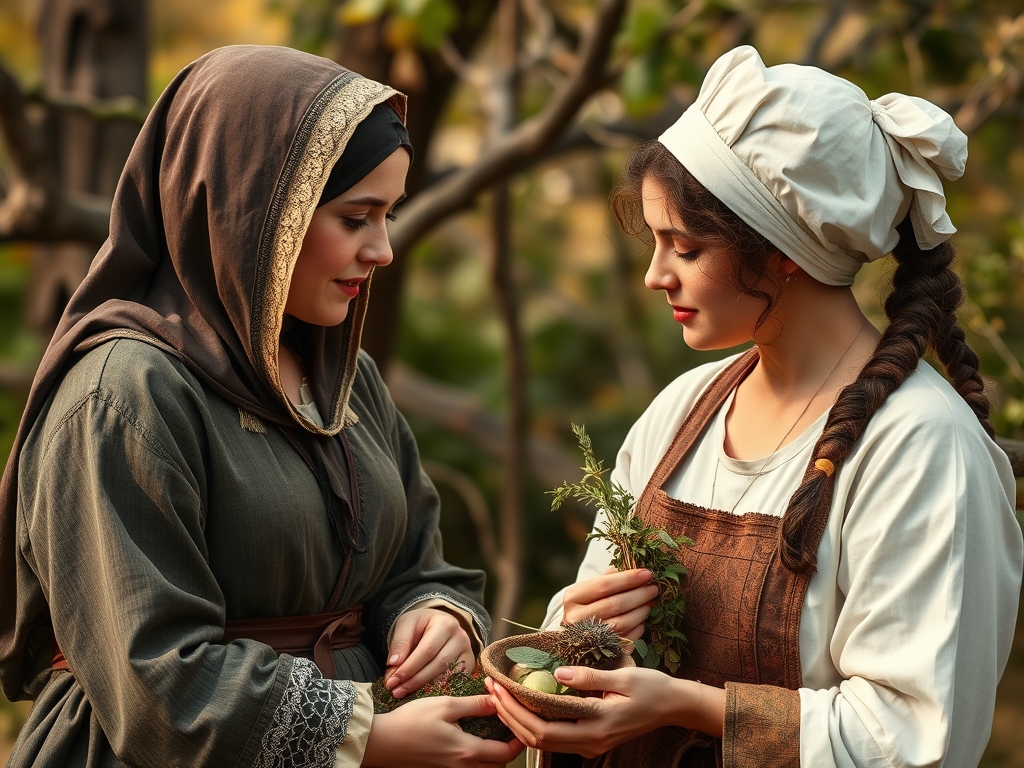
Throughout history, women have been at the very heart of healing. They were midwives, herbalists, caregivers, and community healers, offering practical, empirical, and often effective remedies long before the rise of modern medicine. However, their knowledge and practice were systematically dismantled, demonised, and criminalised under the weight of church authority, patriarchal structures, and, later, capitalist interests. This persecution did not just harm individual women; it severed entire societies from centuries of accumulated wisdom in women’s health.
Today, much of what they practised is repackaged as “cutting-edge science” by pharmaceutical companies making billions. Meanwhile, women’s health remains chronically underfunded, pathologised, and controlled.
Let us pull back the curtain.
Women as Healers: A History of Empowerment and Persecution
From the Middle Ages to the early modern period, women dominated the realm of healing. They grew medicinal herbs, prepared salves and tinctures, managed births, and cared for the sick and dying. Barbara Ehrenreich and Deirdre English’s seminal work Witches, Midwives, and Nurses outlines how women operated as “the unlicensed doctors and anatomists of Western history”, trained through apprenticeship and oral tradition, passing knowledge from mother to daughter, neighbour to neighbour. Their tools were plants, intuition, and empirical knowledge. Much of their medicine was highly effective, from chamomile teas for anxiety to garlic poultices for infection to willow bark for pain (the precursor to aspirin).
However, the growing power of the Church in medieval Europe saw these women as a threat, not only to theological orthodoxy but to emerging male-dominated medical professions that were gaining social and economic privilege through university education and church patronage.
The infamous Malleus Maleficarum (1486) was not simply a legal text; it was a theological and misogynistic manifesto that explicitly targeted women for their healing roles. The authors, Dominican inquisitors Heinrich Kramer and Jacob Sprenger, laid out in graphic detail why women were especially susceptible to witchcraft:
“All wickedness is but little to the wickedness of a woman… Women are by nature more impressionable; and more ready to receive the influence of a disembodied spirit… They are more credulous; and since the chief aim of the devil is to corrupt faith, therefore he attacks them in particular.” (Part I, Question VI, Malleus Maleficarum)
Specifically on midwives, Kramer wrote:
“No one does more harm to the Catholic faith than midwives. For when they do not kill children, they offer them to devils. And through their spells, they hinder conception and cause abortions.” (Part II, Question I, Chapter 13)
In the eyes of the Church, midwives’ intimate knowledge of women’s reproductive health, pregnancy, abortion, fertility, and contraception represented a dangerous power that threatened both patriarchal and ecclesiastical control.
Further, herbalists were seen as competitors to the rising male-dominated profession of university-trained physicians, deeply threatened by women’s community-based, empirical healing work.
The Malleus effectively criminalised entire fields of women’s knowledge: gynaecology, obstetrics, contraception, abortion, and herbal medicine.
It functioned not just as a manual for witch-hunting but as an ideological attack on women’s authority over their bodies, their communities, and healing knowledge.
Healing was one of the few areas where women could hold expertise, social standing, and community influence. Midwives, in particular, wielded specialised knowledge of birth, herbs, and the female body, and that made them dangerous to patriarchal, religious, and emerging medical institutions.
As the Church aligned itself with burgeoning state powers, women’s healing roles were increasingly criminalised. By the late medieval and early modern period (roughly 1400–1700), women dominated local healing professions across Europe:
- In some rural communities, up to 80% of all healers were women (Ehrenreich & English, 1973; Gélis, 1988).
- In many German-speaking territories, records suggest that over 60% of village healers and midwives were women (Levack, 1987).
- In Scotland alone, from 1563 to 1736, nearly 4000 people were accused of witchcraft, 85% of them were women, most charged for practising folk healing, midwifery, or herbalism.
- Across Europe, an estimated 40,000–60,000 people were executed for witchcraft, the vast majority being women, many of whom were explicitly accused because of their healing work (Thurston, 2001; Roper, 1994).
Accusations often stemmed not from genuine acts of maleficence but from community tensions, religious reformations, and the professionalisation of medicine, which saw women’s knowledge as primitive and dangerous.
Treatments Rooted in Women’s Healing Traditions
Despite their vilification, many of the treatments these women employed have since been vindicated by modern science. The accused often used:
- 🌿Herbal remedies: Plants like chamomile for calming, foxglove (digitalis), willow bark for pain relief (the precursor to aspirin), and garlic for antimicrobial properties.
- 🫖Topical applications: Poultices of comfrey (wound healing), honey, and cabbage to treat wounds, infections, and swelling.
- 🫖Nutritional advice: To restore strength and immunity, broths, teas, and nutritional tonics.
- 👩⚕️Midwifery skills: Techniques to manage childbirth safely, often using gentle positioning, massage, and herbs to facilitate delivery and recovery.
- 🔥 Rituals and holistic care: many incorporating community support, prayer, and spiritual comfort
Modern integrative nursing still draws from these traditions. Herbal applications, compresses, and teas remain part of holistic nursing practices globally, from using cabbage leaves for breast engorgement to lemon compresses for fevers.
The Industrialisation of Medicine and the Rise of Profit-Driven Healthcare
Healing became institutionalised with the decline of folk medicine and the consolidation of university-trained, male-dominated medical professions in the 18th and 19th centuries. Scientific medicine did advance our understanding of pathology, but it simultaneously marginalised women’s health knowledge as “old wives’ tales”.
The 20th century saw the rise of pharmaceutical giants, often built on the very plant compounds women had used for centuries. Aspirin and digitalis, and countless others, were synthesised into profitable drugs. Today, the global pharmaceutical industry is worth over £1 trillion, reaping enormous profits from both novel and traditional compounds.
While Big Pharma has undoubtedly developed life-saving medications, it has also turned healthcare into a commercial enterprise. Common, low-cost treatments like herbal remedies, dietary changes, and preventive care are often under-researched, underfunded, and inaccessible within mainstream healthcare because they do not generate comparable profits.
The Medicalisation of Birth and the Marginalisation of Women’s Health
Nowhere is the legacy of this shift more visible than in childbirth. What was once the domain of midwives has become a highly medicalised industry dominated by obstetricians, surgical interventions, and pharmaceutical pain management. In many countries, caesarean rates far exceed WHO recommendations and natural birth options are increasingly limited by hospital protocols.
Women’s reproductive health, more broadly, remains underfunded and neglected. Conditions like endometriosis, polycystic ovary syndrome (PCOS), and menopause have historically received minimal research funding compared to male-centric health issues, reflecting enduring systemic biases in both clinical trials and medical education.
As Philippa Carter notes, these disparities stem from historical, gendered power structures that long associated women’s healing roles with irrationality and superstition while positioning men as the arbiters of legitimate medical knowledge.
A Feminist Call to Reclaim Women’s Healing Heritage
The suppression of women healers was not a natural evolution of science but a calculated disempowerment of women’s knowledge systems. Today’s feminist health advocates argue for a reclamation of these traditions, not as an alternative to evidence-based medicine, but as a complementary, integrative model that centres on women’s autonomy and bodily wisdom.
Grassroots herbalists, nurse herbalists, and holistic practitioners continue to draw from centuries of tradition while advocating for scientifically informed, patient-centred care. These practices offer a path toward decommodifying health, restoring community agency, and challenging the profit-driven priorities of Big Pharma.
As modern medicine grapples with the consequences of over-medicalisation, antibiotic resistance, and chronic disease epidemics, perhaps it is time to re-examine and honour the wisdom of the women who healed before us.
After Final Thoughts: Knowledge Is Power — And So Is Memory
**✨ If you want to explore this history even deeper, read my book:
🕯️ The Witches of Blackthorn Hollow — a historical feminist novel inspired by real women persecuted as healers, midwives, and “witches.”
🔗 Order your copy here: https://amzn.to/4kUNDml.
References:
- Ehrenreich, B., & English, D. (1973). Witches, Midwives, and Nurses: A History of Women Healers. Feminist Press.
- Mackay, C. S. (2009). The Hammer of Witches (Malleus Maleficarum). Cambridge University Press.
- Ring, N. A., et al. (2024). Healers and Midwives Accused of Witchcraft (1563–1736): What the Scottish Survey Can Teach Nursing Today. Nurse Education Today.
- Carter, P. (2025). Work, Gender and Witchcraft in Early Modern England. Gender & History.
- Journal of Integrative Nursing (2024). Complementarity in Nurse-Herbalism.
- Singer, L., & Bourauel, C. (2023). Herbalism and Glass-Based Materials in Dentistry: Review of the Current State of the Art. Journal of Materials Science: Materials in Medicine.
- Bitcon, C., Evans, S., & Avila, C. (2016). The Re-emergence of Grassroots Herbalism: An Analysis Through the Blogosphere. Health Sociology Review.
 Curious Femme
Leave a comment