
⚠️ Content warning: This article discusses misogyny, incel ideology, and gender-based violence.
Introduction
The new Netflix drama Adolescence has triggered a cultural earthquake. Written by acclaimed actor Stephen Graham, it explores the radicalisation of teenage boys, toxic masculinity, and the deadly consequences of a misogynistic ecosystem fuelled by social media, peer pressure, and cultural silence. But rather than applaud its relevance, much of the online backlash has come from men — who dismiss it as “tosh,” “feminist propaganda,” and, in one disturbing case, a reason to “bring back mental asylums.”
The most revealing part of this backlash isn’t about the show itself—it’s what the outrage exposes.
A Drama Based on Real Horrors
Though Adolescence is a fictionalised drama, it is inspired by multiple real-life events. In a Radio Times interview, Graham cited several true cases:
-
The murder of Brianna Ghey in Warrington by two teenagers who lured her into a park (BBC News, 2023).
-
The fatal stabbing of Elianne Andam, a 15-year-old girl at a bus stop in Croydon (BBC News, 2023).
-
The killing of 12-year-old Ava White in Liverpool by a teenage boy, a story that directly influenced the emotional core of the script (Radio Times, 2024).
Graham’s haunting question in the interview—”What’s going on? What is this that’s happening?”—is one many women have been asking for decades. The escalation of misogynistic violence is no longer subtle; it’s in the news, on the streets, and now, on screen. Yet the male response to this very portrayal is not concern but rage.
The Outrage: A Mirror, Not a Monster
Take Gary Conway’s viral tweet:
“In response to the brutal murder of three girls, the Prime Minister turned up for 11 seconds to lay some flowers. Yet in response to a highly misleading fictional drama on Netflix he has launched a campaign in every school in the country.”
On the surface, it’s a call for proportionality. But look closer. When faced with real-world examples of femicide, these same critics often stay silent. It’s only when misogyny is named, framed, and addressed directly—especially in a way that challenges male behaviour—that the backlash begins.
This isn’t about fiction. It’s about defensiveness. It’s about refusing to see how gendered violence is both pervasive and preventable.
What Misogynist Backlash Looks Like Online
When I responded to Conway to clarify that the show was based on multiple real stories, I was immediately met with hostility:
-
“Shut your cakehole, you dumb neurotic cow.”
-
“You’re a liar.”
-
“Spouting any old bullshit.”
-
“Please don’t be a mother. You’re brainless… give your children up for adoption.”
These are not reasoned arguments. They are tactics to silence. This is the real-world echo of the online radicalisation Adolescence tries to depict: a digital mob culture where women are discredited for speaking up and called hysterical for pointing out misogyny.
When women say misogyny is escalating, this is the response. Disbelief. Ridicule. Abuse. And then we’re told to prove it.
Misogyny Is Escalating. And We Have the Data.
-
-
- In the UK, one woman is killed by a man every three days (ONS, 2023).
-
Reports of domestic abuse and coercive control have risen steadily over the past five years (Home Office, 2023).
-
Online abuse disproportionately targets women, especially those in public life or activism (Ofcom, 2022).
-
The murder of Sarah Everard, the attacks by Kyle Clifford, and the rising tide of incel-linked violence are not isolated events (BBC News, 2021).
-
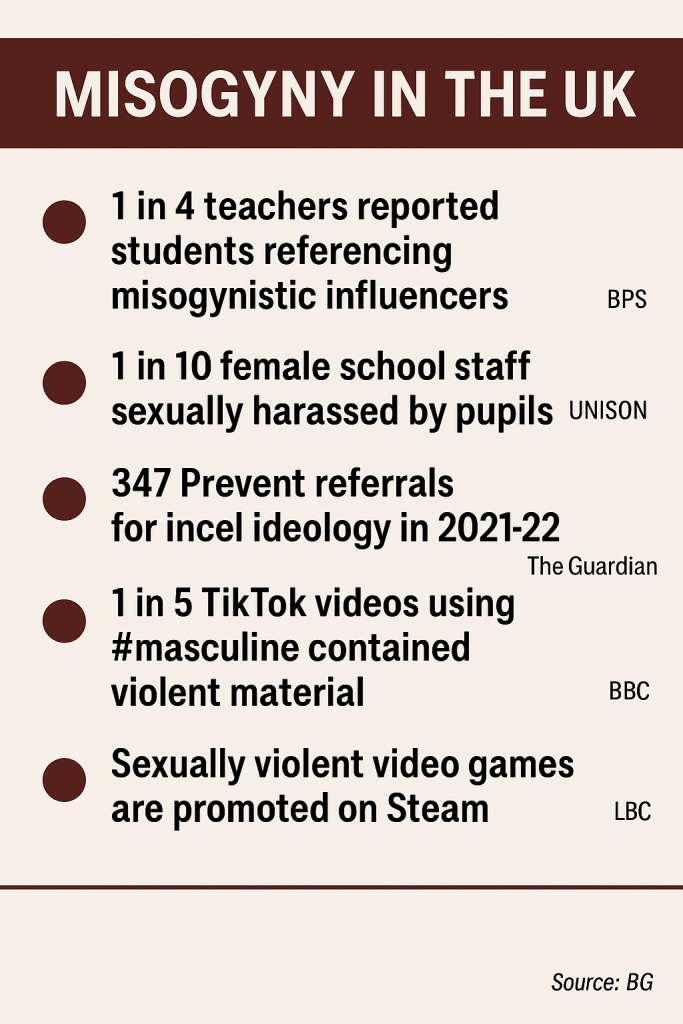
A 2024 UNISON survey found that 25% of secondary school support staff witnessed sexual harassment in school (UNISON, 2024).
-
One in ten female staff in secondary schools has been sexually harassed by pupils (UNISON, 2024).
-
24% of school staff witnessed pupils discussing sexist online content. Half saw behaviour change as a result—boys calling girls “bitches” and dismissing female teachers (UNISON, 2024).
-
In a 2025 University of York study, 1 in 4 teachers reported students referencing misogynistic influencers. One pupil reportedly said: “You can hit women – Andrew Tate does.” (BPS, 2025).
-
Why Adolescence Matters
Adolescence is not perfect. But it is urgent. It dares to ask uncomfortable questions about male entitlement, identity, and violence. It dares to depict a system where boys are groomed not by strangers in vans but by YouTube algorithms and peer normalisation.
Critics say it paints boys unfairly. But the real question is this:
If the shoe fits, why does it hurt so much to wear it?
Why do you see yourself in the critique if you are not part of the problem?
Final Thoughts
This show does what the justice system, the education system, and many governments refuse to do: it takes misogyny seriously.
You can rage-tweet about it. You can call it fiction. But for too many women and girls, the reality is already more horrific than anything a screenwriter could dream up.
We don’t need a culture war. We need a cultural reckoning.
And it’s long overdue.
References
-
BBC News (2021) ‘Plymouth shooting: Jake Davison’s gun rampage was ‘premeditated”, https://www.bbc.co.uk/news/uk-58207064
-
BBC News (2023) ‘TikTok promotes misogynistic and harmful content’, https://www.bbc.co.uk/news/technology-62908601
-
GamesIndustry.biz (2024) ‘UK minister slams Valve for explicit game’, https://www.gamesindustry.biz
-
Guardian (2023) ‘Large rise in men referred to Prevent over women-hating incel ideology’, https://www.theguardian.com/uk-news/2023/jan/26/large-rise-in-men-referred-to-prevent-over-women-hating-incel-ideology
-
LBC (2024) ‘Video game banned from Steam for promoting sexual violence’, https://www.lbc.co.uk/tech/video-game-banned-steam-women-uk-no-mercy
-
SAGE Journals (2023) ‘The mainstreaming of misogyny through digital subcultures’, https://journals.sagepub.com/doi/10.1177/13691481231224275
-
Safeguarding Network (2024) ‘Responding to the Incel Ideology’, https://safeguarding.network/content/responding-to-the-incel-ideology
-
University of Portsmouth (2024) ‘New research highlights the role of TikTok’, https://www.port.ac.uk/news-events-and-blogs/news/new-research-highlights-the-role-of-tiktok-in-spreading-videos-that-encourage-violence-against-women
-
Yahoo News (2024) ‘Developers defend controversial sexual assault game’, https://www.yahoo.com/news/devs-behind-controversial-sexual-assault-210500480.html
 Curious Femme
Leave a comment