
Lately, I’ve been thinking a lot about burnout. Not the dramatic collapse we imagine, but the quiet, creeping exhaustion—the grey fog that makes everything feel heavy. If you work in education, health, or any role where emotional labour is a daily currency, you’ll know the feeling: long hours, blurry boundaries, and that ever-growing inbox.

So, how do we protect ourselves without dropping the ball? How do we rest without guilt? Let’s talk recovery, not just survival.
💡 The Reality of Burnout in Caring Professions
Burnout isn’t just being “a bit tired.” It’s chronic stress that hasn’t been properly managed. According to Sonnentag & Fritz (2014), burnout thrives when we don’t psychologically detach from work. That’s why a weekend off sometimes changes nothing—we haven’t mentally left the job.
But science also offers hope. Recovery is possible. Not just through holidays, but through daily practices that honour your limits.
🧠 Science-Backed Strategies for Stress Management
🕒 1. The 50:10 Rule
Work for 50 minutes, break for 10. No screens. Walk, stretch, breathe. This protects your brain’s prefrontal cortex from overload (Kaplan & Berman, 2010). It also stops you staring blankly at your screen for hours, thinking you’re being productive.
🔒 2. Create a “Shutdown” Ritual
End your day by jotting down three bullet points:
- What you achieved
- What needs attention tomorrow
- One thing you’re proud of
Then physically shut the laptop and leave the workspace. Rituals create boundaries.
🔁 3. Control the Controllable
If you’re drowning in what-ifs, try this: draw two circles—one for things you can control (your schedule, your attitude) and one for what you can’t (staffing shortages, other people’s behaviour). Focus your energy where it matters.
⏳ Structuring Your Day for Energy
Here’s a rough blueprint I use, adapted for anyone balancing teaching, emotional labour, and the chaos of modern work:
| Time | Focus | Why it Works |
|---|---|---|
| 08:00–09:00 | Gentle admin | Start with easy wins |
| 09:00–10:30 | Deep work | Peak focus time |
| 10:30–10:40 | Micro-break | Brain reset |
| 10:40–12:00 | Communication | Batch replies to avoid scatter |
| 12:00–13:00 | Unplugged lunch | Protect your break! |
| 13:00–15:00 | Meetings or lighter work | Energy naturally dips |
| 15:00–15:10 | Reset | Stand up, breathe |
| 15:10–16:00 | Wind down | Tidy up and log off |
🌸 Recovery Rituals That Don’t Feel Like Work
You don’t have to meditate on a mountaintop to heal. Sometimes recovery looks like a cup of tea and a cuddle with your dog.
Daily (10–30 mins)
- Mindful walk (with or without a Labradoodle)
- A proper cuppa, sipped in silence
- Journalling: “What lifted me today?”
- Breathing: in for 4, hold for 4, out for 4, hold for 4
Weekly
- One guilt-free hobby hour (painting, playlist-making, creative writing)
- A solo date (yes, the pub counts)
- ‘Creative not productive’ time—write, doodle, daydream
✨ Small Joys That Build Resilience
- Light a candle to mark the end of work. Let scent and flame transition your brain.
- Keep a “wins jar.” Drop in post-its with good feedback or moments of joy.
- Start a “five-word diary.” You’ll be surprised what five words can capture.
Final Thought: Your Worth Isn’t Measured by Output
You are more than your productivity. You are not a machine. You’re allowed to pause. You’re allowed to rest.
Burnout prevention isn’t indulgence—it’s resistance. It’s feminist. It’s survival.
So light that candle. Walk that dog. Leave that email unread. You’ve done enough for today.
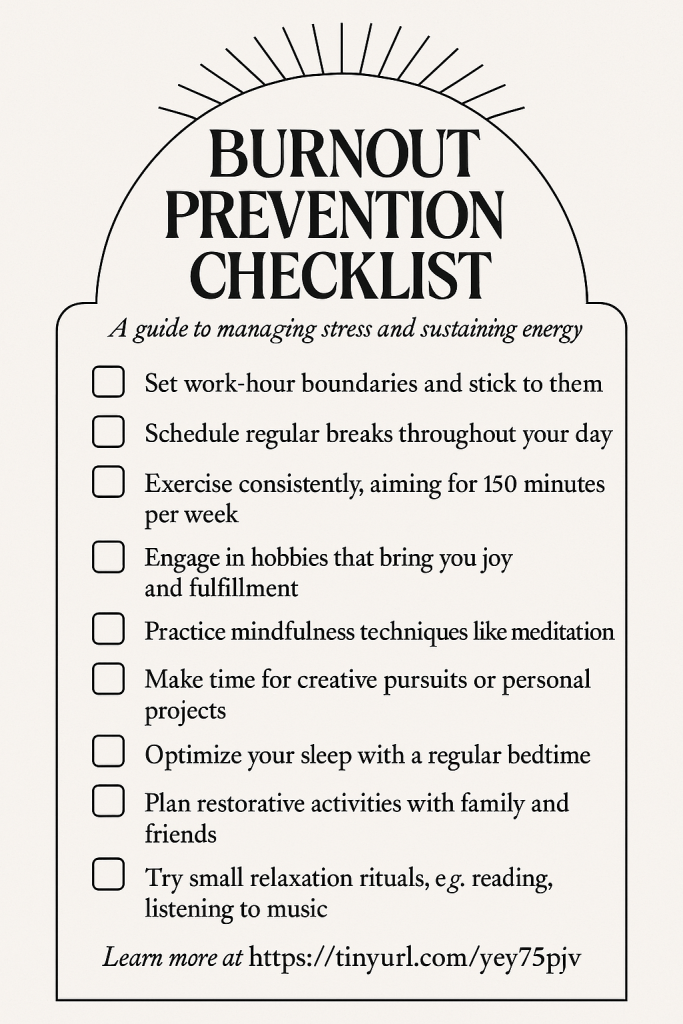
References
Kaplan, S., & Berman, M. (2010). Directed Attention as a Common Resource for Executive Functioning and Self-Regulation. Perspectives on Psychological Science.
Sonnentag, S., & Fritz, C. (2014). Recovery from job stress: The stressor–detachment model as an integrative framework. Journal of Organizational Behavior.
Covey, S. (1989). The 7 Habits of Highly Effective People.
 Curious Femme
Leave a comment