
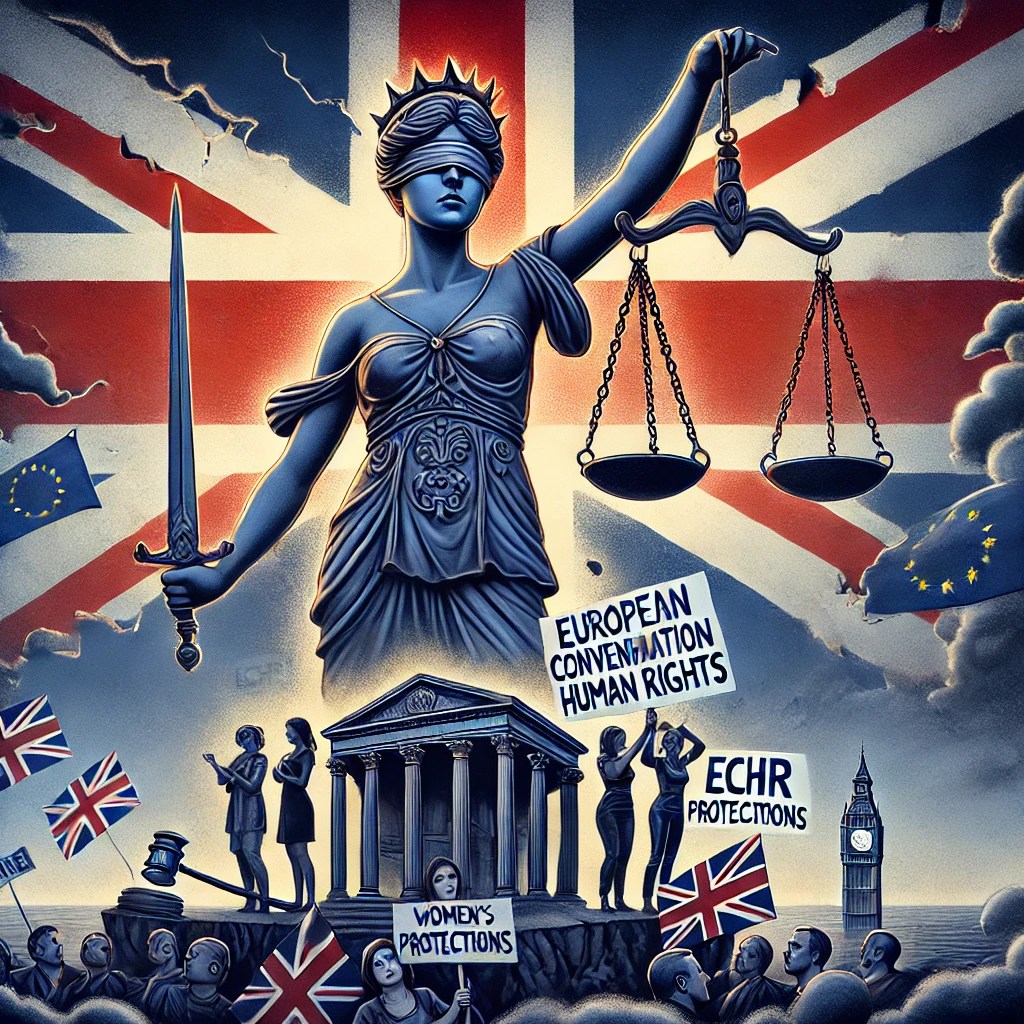
Nigel Farage, leader of Reform UK, has called for the United Kingdom to leave the European Convention on Human Rights (ECHR), presenting this as a move to reclaim national sovereignty and control over immigration. Alongside this, his recent suggestion that Parliament should debate reducing the legal time limit for abortion has raised alarm among advocates for women’s rights. These proposals suggest a shift that could jeopardise progress in gender equality and protections for women. Moreover, leaving the ECHR would not only impact women but could create wider issues for all UK citizens.
The ECHR: A Cornerstone for Women’s Rights
Established in 1953, the ECHR has played a critical role in advancing and safeguarding women’s rights across Europe. It offers a framework for holding governments accountable and protecting fundamental rights. For women in the UK, the ECHR has been transformative in areas such as:
- Combating Gender-Based Violence
The ECHR has shaped UK legislation addressing domestic abuse, sexual violence, and other forms of gender-based violence. It underpins the UK’s commitment to the Istanbul Convention, which focuses on preventing violence against women and protecting survivors (Council of Europe, 2011).
- Promoting Equality
By embedding principles of non-discrimination, the ECHR has helped advance gender equality in employment, education, and public life. Its influence is evident in equal pay legislation and maternity protections (Equality Act 2010).
- Protecting Reproductive Rights
The ECHR supports women’s access to reproductive healthcare, including contraception and abortion, through its protection of the right to private and family life under Article 8.
- Assisting Vulnerable Women
The ECHR has been instrumental in providing protections for women fleeing persecution, including those escaping forced marriage, female genital mutilation (FGM), and honour-based violence. It ensures they are treated with dignity and have access to justice.
Farage’s Call to Leave the ECHR
Farage’s stance has been reinforced by figures like Patrick O’Flynn, who recently described continued adherence to the ECHR as “nothing short of extremist lunacy” (O’Flynn, 2024). Both argue that the Convention, created in a post-war context, can no longer address modern challenges such as immigration and border control.
Farage has echoed this sentiment, claiming that the ECHR undermines national sovereignty and hampers the UK’s ability to implement effective policies. However, critics argue that this rhetoric oversimplifies the role of the ECHR in upholding broader human rights protections, particularly for women.
Without the ECHR, legal protections for women against discrimination and violence could be weakened, leaving them more vulnerable to systemic injustices. The Convention ensures that governments remain accountable for their actions—or inactions—regarding gender-based violence and inequality. Its removal risks regression in these areas, with future administrations potentially deprioritising women’s rights.
Impact on UK Citizens
Leaving the ECHR would affect women’s rights and have broader implications for all UK citizens. Key concerns include:
- Loss of Human Rights Protections
Citizens would lose the overarching framework that protects fundamental rights, such as the prohibition of torture (Article 3), the right to a fair trial (Article 6), and the right to private and family life (Article 8). Domestic laws might not provide the same robust safeguards.
- Reduced Accountability for Governments
The ECHR ensures that individuals can hold the government accountable for violations through the European Court of Human Rights (ECtHR). Without this oversight, governments could enact policies with less scrutiny, increasing the risk of overreach or abuses of power.
- Impact on Vulnerable Groups
Vulnerable individuals, including asylum seekers and victims of discrimination, would be disproportionately affected. For example, the ECHR ensures that asylum seekers are not deported to countries where they face torture or inhumane treatment. Its removal could reduce these protections.
- International Agreements
The ECHR is integral to agreements like the Good Friday Agreement in Northern Ireland. Leaving the ECHR could destabilise such arrangements and damage the UK’s reputation as a human rights leader.
- Economic and Social Consequences
Departure from the ECHR may signal a retreat from international human rights commitments, potentially deterring foreign investment and damaging the UK’s global standing.
Farage’s Stance on Abortion
Farage has also suggested that MPs should debate reducing the legal time limit for abortion, currently set at 24 weeks in England, Wales, and Scotland (The Independent, 2024). While he has framed this as a call for “sensible debate,” it aligns with a broader conservative agenda aimed at restricting reproductive rights, echoing trends in the United States under figures like Donald Trump.
Such a proposal risks undoing decades of progress in women’s reproductive autonomy. Campaigners have criticised Farage for using women’s health as a political tool, arguing that debates around abortion limits detract from addressing real challenges, such as access to healthcare and resources for survivors of gender-based violence.
The Bigger Picture
Farage’s proposals to withdraw from the ECHR and revisit abortion laws form part of a wider trend that could undermine women’s rights. His focus on sovereignty and conservative values overlooks the tangible benefits that the ECHR provides. Leaving the ECHR would also send a troubling message that the UK is retreating from its commitments to human rights, potentially influencing other nations to follow suit.
Conclusion
Conclusion
Nigel Farage’s proposals pose a significant threat to women’s rights and the broader human rights landscape in the UK. The ECHR has been instrumental in advancing gender equality, combating violence, and protecting reproductive rights. Removing it from the UK’s legal framework would risk eroding these hard-won gains. Similarly, revisiting abortion laws could restrict women’s autonomy over their own bodies.
Moreover, leaving the ECHR would have far-reaching consequences for all UK citizens, diminishing protections, reducing government accountability, and risking instability in international agreements. While Farage’s rhetoric may appeal to those prioritising sovereignty, the consequences for individuals and society as a whole could be profound. It is essential to remain vigilant and ensure that equality, dignity, and justice for all are not compromised in the pursuit of political agendas.
References
- Council of Europe (2011). Convention on preventing and combating violence against women and domestic violence (Istanbul Convention).
- Equality Act 2010.
- O’Flynn, P. (2024). Remaining in the ECHR is nothing short of extremist lunacy. The Telegraph.
- The Guardian (2024). Nigel Farage suggests MPs should debate rolling back the abortion limit.
- The Independent (2024). Nigel Farage reignites abortion debate in push for Reform UK support.
 Curious Femme
Leave a comment