
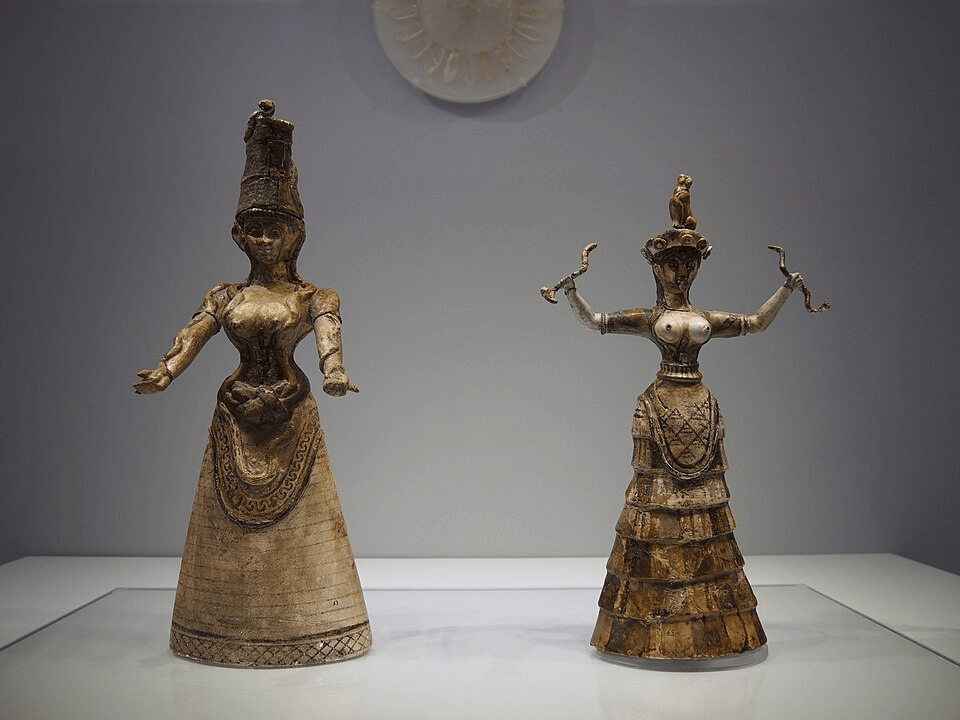
Minoan Snake Goddess figurines, c. 1600 BCE, Heraklion Archaeological Museum, Crete.
“There was a time when divinity had a woman’s face.” – Marija Gimbutas.
For millennia, before the rise of kings, priests, and empires, cultures existed where power did not flow from domination but from balance. Across early Europe and the Aegean, from Anatolia to Crete, evidence suggests that women once stood at the spiritual and social centre of human life. The archaeologist Joan Marie Cichon (2022) describes Bronze Age Crete as a Goddess-centred civilisation whose art, architecture, and ritual life revolved around the feminine divine. This opening chapter re-examines that forgotten world, one that reveals how patriarchy was not humanity’s beginning, but its interruption.
1. Hunter-Gatherers and the Lost Balance
Recent research in evolutionary anthropology has overturned the long-held assumption that prehistoric men hunted while women gathered in a subservient role. A 2024 study from the Central European University found that hunter-gatherer societies exhibited near parity in decision-making, food distribution, and mobility (CEU, 2024). Likewise, a 2023 PLOS One analysis of burial sites demonstrated that both sexes shared economic and ritual prestige (PLOS One 2023).
These early communities operated through what Riane Eisler (1987) later called a partnership model, societies where gender was complementary rather than hierarchical. Authority arose from cooperation, not coercion. It was only with the emergence of agriculture and the inheritance of land that men’s control over women’s fertility became a political and economic necessity.
2 The Cycladic Figures: Stone Witnesses of Feminine Power
Across the Cycladic islands of the Aegean (5300–2000 BCE), artisans carved hundreds of marble figures, mostly nude women with their arms folded across their abdomens. Their serene faces and luminous marble bodies stand among the earliest representations of the human form in Europe.
According to the Metropolitan Museum of Art, these figures were made in various forms, including female, male, and abstract, and were placed in both domestic and funerary contexts. They were not mere grave goods but central to ritual and daily life, suggesting societies that honoured the life-giving and protective aspects of the feminine (Met Museum 2024).
The marble’s translucency, polished to glow in candlelight, may have symbolised fertility or divinity. Deposits of deliberately broken figures at Keros suggest communal rituals, where destruction itself was part of a sacred cycle of renewal (Metropolitan Museum of Art, 2024).
“The Cycladic figures remind us that the female body was once the measure of sacredness, not shame.”
These artefacts link directly to later Minoan traditions. They testify that before patriarchal Greece, the islands of the Aegean celebrated women as creators, protectors, and mediators between worlds, a worldview radically different from the warlike pantheon that would later dominate Olympus.
3. The Minoan Mother Goddess: Evidence from Crete
Nowhere is this pre-patriarchal balance more visible than on Bronze Age Crete. Excavations from Knossos, Malia, and Ayia Triadha reveal frescoes, seal stones, and figurines depicting powerful female figures, snake-bearing priestesses, mountain goddesses, and women in ritual procession.
Dr Cichon’s comprehensive synthesis of archaeological and mythological evidence demonstrates that Crete, between 6500 and 1070 BCE, maintained a continuous, Goddess-centred tradition. Male gods, she argues, appear late and occupy subsidiary roles. Women officiated at rituals, owned property, and participated visibly in public life, extraordinary for the ancient world (Cichon 2022, p. 216).
The Mother Goddess of Crete embodied life, death, and regeneration, the cosmic cycles of nature rather than conquest. In Minoan art, power is portrayed not through weapons but through balance, fertility, and transformation. Bulls symbolised energy, but it was the female figure who mastered them; the famous “bull-leaping” scenes depict women and men participating equally in sacred sport.
This stands in sharp contrast to later Greek imagery, where female figures became passive muses or victims of male gods. Crete’s iconography suggests a society that honoured the feminine as the active principle of creation, what Eisler termed gylany, the linking rather than ranking of the sexes.
4. Archaeomythology and Modern Insight
Cichon’s approach draws on archaeomythology, a discipline pioneered by Marija Gimbutas, combining archaeology, mythology, and linguistics to decode sacred symbols. The approach recognises that material culture alone cannot explain human belief; myth and ritual are also part of the evidence.
When archaeomythology is combined with modern gender-anthropological frameworks, such as Peggy Reeves Sanday’s definition of matriarchy as a culture centred on maternal values of nurturance and reciprocity, a pattern emerges: ancient Crete, like many early agrarian societies, operated through consensus and balance rather than hierarchy (Sanday 2002).
Cichon’s findings echo this: Minoan society was likely matrilineal and matrilocal, its economy based on reciprocity rather than accumulation, and its governance oriented toward communal decision-making (Cichon 2022, pp. 219–231).
5. The Archaeological Record: Women at the Centre
From the Snake Goddess figurines at Knossos to the frescoes of Akrotiri on Thera, women appear as priestesses, dancers, and mediators between worlds. They are shown in open postures, hands raised in invocation, positions of power, not submission.
Even Minoan Law offers clues. The later Gortyn Code preserves remnants of earlier matrilineal customs, granting women inheritance and divorce rights unprecedented in Greek antiquity. These suggest continuity from a Bronze Age tradition in which lineage and property passed through the maternal line (Cichon 2022, p. 166).
Enheduanna — The Voice of Inanna (c. 2300 BCE, Sumer)
High Priestess of Ur and the world’s first known author. Her hymns to the goddess Inanna proclaimed divine feminine sovereignty: “You are magnificent; your name is known from the mouth of all lands.”
Puabi — Queen of Ur (c. 2600 BCE)
Entombed with her own royal seal and vast treasures, Puabi ruled or officiated independently of any male king, providing evidence of female sovereignty before the later patriarchal restrictions.
Kubaba — Queen and Later Goddess of Carchemish (c. 2500 BCE)
A tavern-keeper who rose to power and was later deified, her cult spread across Anatolia, blending rulership with motherhood.
The Priestesses of Knossos and Akrotiri (c. 1700 – 1450 BCE)
Depicted with serpents and lilies, these women presided over temple rituals and civic ceremonies, possibly forming councils rather than courts of kings (Cichon 2022; Marinatos 2010).
“La Parisienne” (c. 1400 BCE, Knossos)
A fragmentary fresco shows a woman with vivid red lips and elaborate curls, a priestess or dignitary immortalised mid-ceremony, radiating authority and composure.
Ariadne — The Mythic Memory of Crete
Before Greek myth turned her into Theseus’s abandoned lover, Ariadne’s name meant Most Holy. She likely personified the Cretan Goddess herself, later re-cast as a mortal to fit patriarchal narrative.
Hatshepsut — Pharaoh of Egypt (c. 1479 – 1458 BCE)
Contemporary with late Minoan Crete, Hatshepsut reigned as Pharaoh in her own right, proof that female sovereignty was possible and respected in the wider eastern Mediterranean world.
Together, these figures illustrate a continuum of sacred and civic authority before male-exclusive institutions took hold.
6. From Balance to Erasure
How did such cultures vanish? Around 1450 BCE, the eruption of Thera and the arrival of Mycenaean warriors marked a violent turning point. With them came Indo-European language, weaponry, and a patriarchal social order. Male gods supplanted the Goddess; kings replaced councils of women.
What followed was the rewriting of myth: the serpent-bearing deity became Medusa, demonised and decapitated; the earth mother Gaia was subordinated to Zeus. The matriarchal memory was not lost; it was buried beneath patriarchal reinterpretation.
7. Why This History Matters
Understanding pre-patriarchal societies is not about romantic nostalgia but historical correction. As Gerda Lerner (1986) wrote, “Patriarchy is a historical construct; it had a beginning and it will have an end.” The Minoan record reveals that social systems founded on cooperation, female reverence, and ecological balance are not utopian fantasies; they are part of humanity’s actual past.
Modern anthropology increasingly supports this. Studies of gender-egalitarian hunter-gatherers reveal how equality arises naturally in mobile, cooperative environments (CEU 2024). The persistence of maternal symbols in early European art, from the Venus figurines to Minoan frescoes, demonstrates that reverence for the feminine once structured human meaning itself.
Conclusion
Before the age of kings and priests, power wore a woman’s face.
On Crete and in the Cyclades, divinity was embodied in the cycles of nature, not the hierarchies of man.
To rediscover this history is not to idealise the past but to reclaim possibility, to remember that patriarchy is neither timeless nor inevitable.
Beneath the ruins of Knossos and the marble dust of the Cyclades, another story endures: one where creation, care, and courage were the true measures of civilisation.
References
- Cichon, J.M. (2022) Matriarchy in Bronze Age Crete. Oxford: Archaeopress.
- Central European University (2024) ‘New Research Reveals Insights into Gender Equality in Hunter-Gatherer Societies.’ https://www.ceu.edu/article/2024-11-28/
- Eisler, R. (1987) The Chalice and the Blade: Our History, Our Future. San Francisco: Harper & Row.
- Lerner, G. (1986) The Creation of Patriarchy. New York: Oxford University Press.
- Marinatos, N. (2010) Goddess and the Warrior: The Naked Goddess and Mistress of Animals in Early Greek Religion. London: Routledge.
- Metropolitan Museum of Art (2024) ‘Who Were the Early Cycladic Figures?’ Available at: https://www.metmuseum.org/perspectives/cycladic-figures
- Minoan Magissa (2022) ‘The Minoan Mother Goddess.’ https://minoanmagissa.com/2022/07/18/the-minoan-mother-goddess/
- PLOS One (2023) ‘Gender Roles and Mortuary Practices in Prehistoric Europe.’ PLOS One, 18(7). doi: 10.1371/journal.pone.0287101
- Sanday, P.R. (2002) Women at the Center: Life in a Modern Matriarchy. Ithaca: Cornell University Press.
 Curious Femme
Leave a comment